


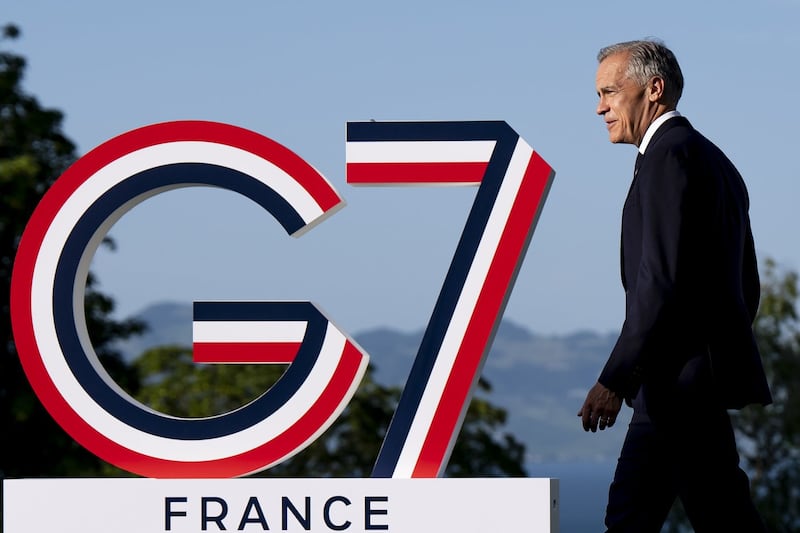
EVIAN-LES-BAINS -- Prime Minister Mark Carney is meeting with several world leaders Tuesday at the G7 summit in France.
Following a working session on building peace for Ukraine, Carney met with Ukrainian President Volodymyr Zelenskyy.
At the meeting, the prime minister announced Canada is imposing new sanctions on Russia as its war on Ukraine continues. The package will target 162 individuals, entities and vessels linked to Russia’s war machine.
The meeting with Zelenskyy was one of at least five bilateral meetings Carney has scheduled for Tuesday. He’ll also sit down with the leaders of Italy, the United Arab Emirates, India and South Korea.
After a meeting with Italian Prime Minister Giorgia Meloni, the two leaders announced Canada and Italy have entered talks on a purchase of M-346 advanced jet trainer aircraft. It’s not clear how many jets Canada is looking to purchase.
The first full day of the 2026 leaders’ summit also includes discussions of conflicts in the Middle East and a drop in foreign aid funding that is forcing the world to rethink how it handles international development.
The leaders gathered for a working lunch on overcoming crises and ensuring stability in the Middle East. Ahead of the meeting, Carney had what looked to be a short, intense discussion with U.S. President Donald Trump.
“Less than three per cent of our market,” Carney was heard saying in a hot camera moment -- a likely reference to Chinese-made EVs. “A cap... I thought you’d actually like that.”
“That’s good, I like it,” Trump responded.
Canada recently pledged to reduce its 100 per cent tariff on Chinese-made electric vehicles to 6.1 per cent, with an annual import cap of 49,000 vehicles. In turn, China is expected to lower retaliatory tariffs on Canadian agricultural products.
While it’s not known whether Carney and Trump will have a more official meeting in Evian, Canada-U.S. Trade Minister Dominic LeBlanc and United States Trade Representative Jamieson Greer are set to connect on the summit’s sidelines.
Canadian officials told reporters on background before the trip that Canada’s main priorities for the summit involve critical minerals, macroeconomic imbalances and reforming foreign aid.
The officials said a key challenge is that many of the macroeconomic imbalances stem from China’s industrial overcapacity.
French President Emmanuel Macron hosted a call last week with a senior Chinese official and other leaders, including Carney, in lieu of China attending the summit.
John Kirton, who heads the University of Toronto’s G7 Research Group, told The Canadian Press the summit could yield progress on major themes, despite tensions with the U.S. over tariffs.
He said the Trump administration found plenty of room for agreement with allies at last year’s summit, hosted by Carney in Kananaskis, Alta.
On Sunday, Trump announced an agreement had been reached to end the war in Iran and that he had authorized an end to the U.S. blockade in the Strait of Hormuz.
He later said the strait wouldn’t open until Friday, when the deal is set to be officially signed in Switzerland.
Ambassador of Canada to France Nathalie Drouin told reporters that Canada is ready to contribute in the Middle East, especially in light of the deal between the U.S. and Iran.
Asked if she sees the focus on international conflicts taking leaders’ attention away from other priorities at the summit, Drouin said crises have always formed part of discussions at the G7.
By Catherine Morrison
With files from Dylan Robertson and Jim Bronskill
This report by The Canadian Press was first published June 15, 2026.

