The Alberta government is poised to make an announcement about its plans for a new West Coast oil pipeline on Thursday, but experts say industry skepticism is well warranted.
Sam Blackett, press secretary to Premier Danielle Smith, said Tuesday that there will be a “major announcement” on July 2 to share new details about the province’s submission to the federal major projects office, established a year ago to speed along infrastructure deemed in Canada’s national interest.
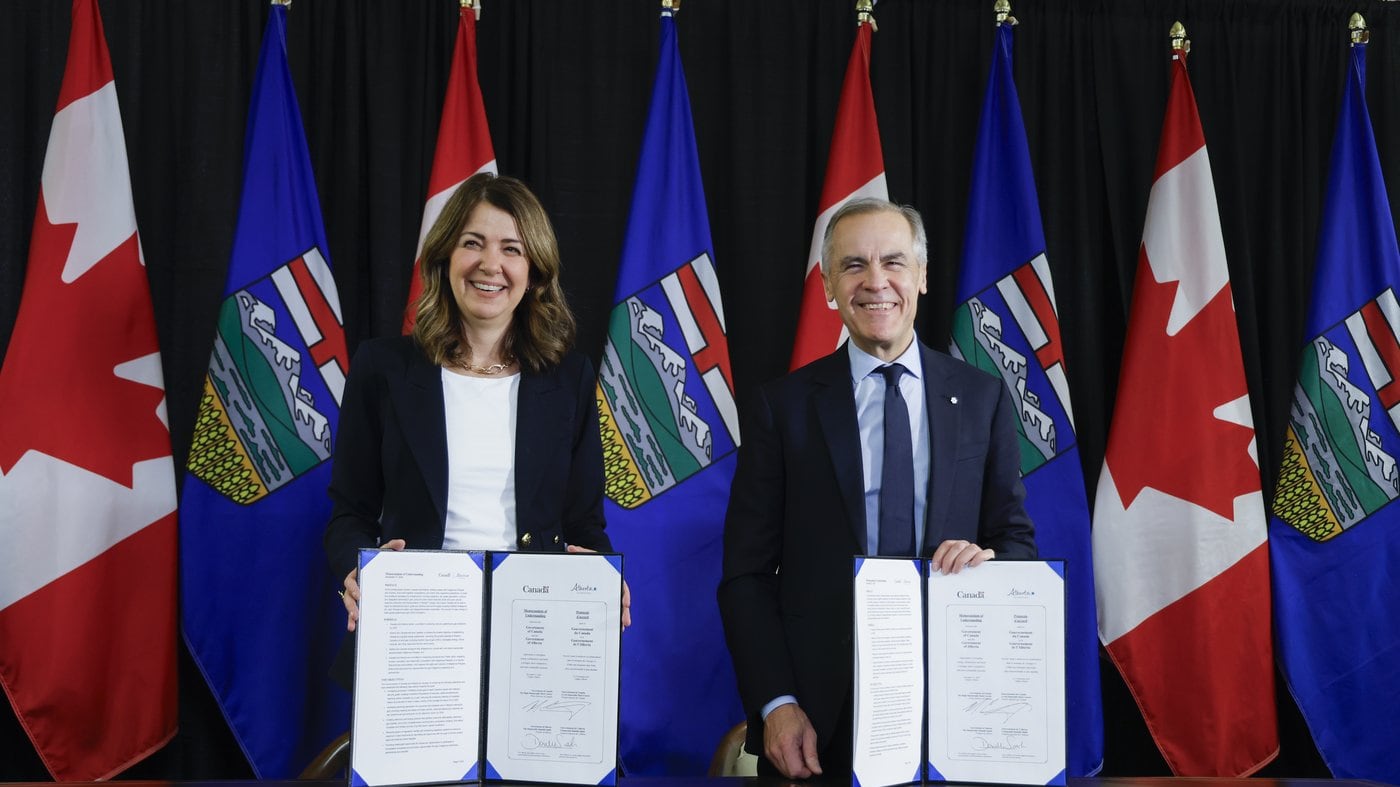
Alberta is acting as a proponent for a new pipeline that would carry up to one million barrels per day from the oilsands to a yet-to-be-determined West Coast tanker port. Under a federal-provincial energy accord signed last year, Ottawa’s support for the pipeline is contingent upon the building of the massive Pathways carbon transport and storage project that would offset some of the emissions impact from increased oilsands production.
Smith has said the province would submit plans for a West Coast pipeline to the projects office by a self-imposed July 1 deadline.
Prime Minister Mark Carney is set to arrive in Alberta on Wednesday evening. He told reporters in Kuujjuaq, Que., on Tuesday that he and Smith have been in “close contact” and that Alberta’s efforts to submit a proposal around Canada Day are “tracking well.”
At a major energy conference earlier this month, Brian Jean, Alberta’s energy minister, said “a number” of potential investors had shown interest in the pipeline, including an unidentified Fortune 500 company with which it had held talks about financing the entire project.
But the fate of the proposal rests largely with the CEOs of the five biggest oilsands companies, whose production would be needed to fill the new pipeline and who are partners in the Pathways project, said Dennis McConaghy, a retired pipeline executive and author.
Those companies would be hard pressed to sign on as shippers on a new oilsands pipeline so long as they’re subject to higher climate costs in the form of the industrial carbon tax and required to spend tens of billions of dollars on Pathways, he said.
“The private sector can finance this if it is confident that they will be allowed to go forward on these expansions with rational climate policy,” McConaghy said.
“Producers are not going to climb on without, I think at a minimum, a significant about-face by Mark Carney, which I don’t think will happen — at least not in the short run.”
The Alberta government is aiming for the pipeline being designated a project of national interest by October and getting shovels in the ground as early as September 2027. Startup would be in the mid-2030s.
The pipeline application comes as Albertans prepare to vote on 10 referendum questions in October, including one on whether to remain in Canada or hold another referendum on separation at a later date.
“My guess is those CEOs will be very reluctant to make long-term commitments until the referendum affirms the status quo,” McConaghy said. And if the pipeline talks break down with Ottawa, it will only serve to fan the separatist sentiment.
“This becomes a very clearcut example of, ‘Does Ottawa work for Alberta?’”
Prime Minister Mark Carney says he’s ‘up to speed’ on Alberta’s pending pipeline proposal and it will take months before a decision is made on whether to send it to the major projects office. (June 30, 2026)
Would-be private-sector investors are also keenly aware of the long-term demand outlook for crude at the other end of the pipe in Asia, said Werner Antweiler, an energy economist at the University of British Columbia’s Sauder School of Business.
“And here the alarm bells have been ringing for some time,” he said, noting China’s growing adoption of electric vehicles and steps to reduce reliance on oil amid the Middle East war.
“You’re not looking at a growing market for oil. You’re looking at a market that is plateauing.”
Antweiler sees merit in plans to expand capacity on the federally owned Trans Mountain pipeline currently shipping crude to the B.C. Lower Mainland for export to Asia. Work is set to begin later this year to dredge Vancouver’s Burrard Inlet to make room for larger oil tankers loading up from Trans Mountain.
Smith has expressed a preference for a pipeline that would run through northern B.C. to the deepwater port at Prince Rupert, which is a shorter shipping distance to Asia.
But as Antweiler sees it, the southern route is the “only game in town,” as opposition from coastal First Nations in the northern part of the province poses big legal risk.
“It will always end up in court. We’re talking about constitutional rights that cannot be abridged,” he said.
“It’s a very telling sign that Enbridge, probably the most experienced company in the business, is not interested in repeating the Northern Gateway idea in some form or another. They have gone through it, they know better than to try that again.”
Enbridge has said it lost hundreds of millions of dollars on its plan to connect oilsands crude to a tanker port in Kitimat, B.C., and Alberta’s plan has been described at a resurrection of Northern Gateway. That plan was ultimately killed by the federal government under former prime minister Justin Trudeau in 2016.
Antweiler said he is staunchly against any government money propping up a new pipeline.
“This is a mature industry that can stand on their own two feet,” he said.
“They need to take the risks. If they think the risks are right, please go ahead and do it. If the risks are not right, then walk away.”
---
Lauren Krugel, The Canadian Press
With files from Nick Murray in Kuujjuaq, Que.
This report by The Canadian Press was first published June 30, 2026.

