Alberta Premier Danielle Smith announced Thursday that her government has a route -- and builders -- for a new pipeline to the B.C. coast, just hours after Prime Minister Mark Carney announced a deal with B.C. to make it possible.
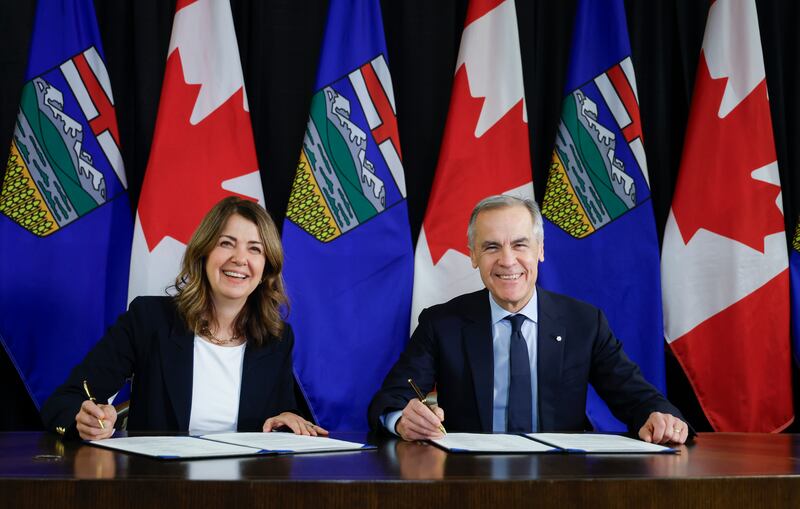
Smith and Carney stood together in Calgary to announce that Alberta has formally submitted a proposed route to Ottawa’s major projects office.
“The profits from this pipeline will generate billions in revenues over the coming decades for the provincial and federal governments, and will enrich Indigenous communities that choose to partner with us,” said Smith.
“This is transformational wealth, an opportunity neither Canada nor Alberta can afford to leave unrealized.”
A submission package shared by the province says the project will follow closely along the path of the current Trans Mountain pipeline.
It would run from Bruderheim, northeast of Edmonton, to a terminal in Delta, B.C., just south of Vancouver. It would deliver more than one million barrels per day and see tankers ship it to Asian markets.
The submission package says the estimated price tag is between $35.2 billion and $43.7 billion, including contingency fees. Alberta has spent $18.3 million planning the project so far, it says.
Carney said the route makes the most sense given the line already exists. “This is more than just an accord. It’s also an approach that gives certainty to our businesses to build,” he said.
Smith said the Alberta government is partnering with the federally owned Trans Mountain Corp. and Calgary-based Pembina Pipeline to build and operate what has officially been labelled the West Coast Pipeline.
Alberta’s submission says that the ownership structure has yet to be nailed down. Trans Mountain Corp. said in a statement that the initial partnership has Ottawa and Smith’s government as the majority interest holders.
Mark Maki, the chief executive officer of Trans Mountain, said in an interview that he couldn’t say what percentage the Crown corporation would control. “But as far as our role, we’re there really as the developer, the project manager and then eventually the operator,” he said.
Pembina said in a statement that its interest position sits at 10 per cent but could rise to 20 per cent once the pipeline is operational. It also said the goal is to sign definitive agreements by September.
The environmental group Climate Action Network criticized the project and what Smith calls its initial “public-private partnership.” The group said it “sounds a lot like Canadians will be signing a blank cheque.”
Smith said she thinks it’s possible a full or greater private sector takeover of the project could occur down the line.
Smith and Carney said the project has opportunities for Indigenous ownership and that details will come. The submission package says the proposed route will go through the traditional territories of as many as 125 Indigenous communities.
It says the province consulted some First Nations before Thursday’s announcement, though it notes many were consulted under the premise that Alberta would be pitching a route to the northern coast rather than the southern one.
Carney said consultations with First Nations on the new route would begin immediately.
Earlier in the day, Carney stood beside B.C. Premier David Eby, who has been an outspoken critic of Smith’s pipeline, to announce a wide-reaching deal that featured a number of promises to ease Eby’s opposition.
It included a commitment that Ottawa would uphold a tanker ban on B.C.’s northern coast and promises that Ottawa would take on financial risks for any potential environmental issues and spills should the pipeline be approved. It also promises that B.C. receive financial compensation for having the pipeline run through it.
Eby said the deal doesn’t force him to support the project, but he conceded that his province wouldn’t fight it in court.
“That’s why this agreement matters. It ensures that the northern tanker ban stays in place, and it ensures that if the pipeline goes ahead, British Columbians are fairly compensated for the environmental risks we would take,” he said.
Another aspect of the B.C. agreement is for Ottawa to commit $10 billion in infrastructure upgrades at the Roberts Bank Terminal in Delta, the end point for Smith’s pipeline.
Carney didn’t mention the connection when speaking with Eby, but said the upgrades could create $100 billion in trade capacity and add $3 billion to the country’s economy annually.
Alberta’s submission package says the terminal will need to accommodate large oil tankers and feature two new loading berths.
In Camrose, Alta., on Thursday, federal Conservative Leader Pierre Poilievre criticized Carney for sticking with the oil tanker ban, calling it a “ridiculous” policy. He said Canada should be trying to diversify its exporting options, but added that he wasn’t opposed to another southern B.C. Pipeline.
"You got one guy standing in the way of it all, and that’s Mark Carney," Poilievre said. “Provide the permit, let the private sector build it, get out of the way and get it done.”
Smith and Carney also announced Thursday that they are close to finalizing an agreement with the Oil Sands Alliance for its Pathways carbon capture project. Last year’s energy deal between Carney and Smith made her pipeline conditional on advancements on the carbon capture deal.
For Smith, the pipeline is not only an economic issue.
She’s held up her energy accord and the project as being necessary to prove that Canada can work, just as her province barrels towards a fall referendum on whether Alberta should stay in Confederation or take steps to hold a second, binding vote on quitting the country.
Smith has said she wants Alberta to stay, but she has also said federal policies and rules in recent years have stymied Alberta’s oil industry, leading some to say it’s time the province go it alone.
To that end, the pipeline has become a political mirror, with each side seeing it either as another form of alienation or co-operation.
Both Smith and Carney say the deal shows Canada can work. But leaders of Alberta’s separatist movement say if their province remains beholden to deals with Ottawa to get its own resources to market, then Confederation remains broken.
This report by Chuck Chiang and Jack Farrell, The Canadian Press, was first published July 2, 2026.
-- With files from Lauren Krugel in Calgary and Lisa Johnson in Edmonton.

