


The Canadian government has chosen a German company to build Canada’s new submarine fleet with the first four deliveries expected by 2034.
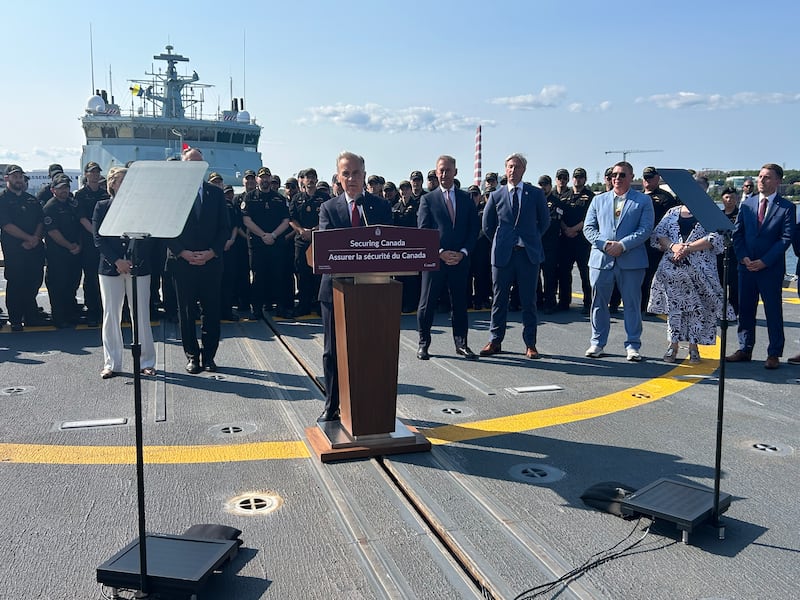
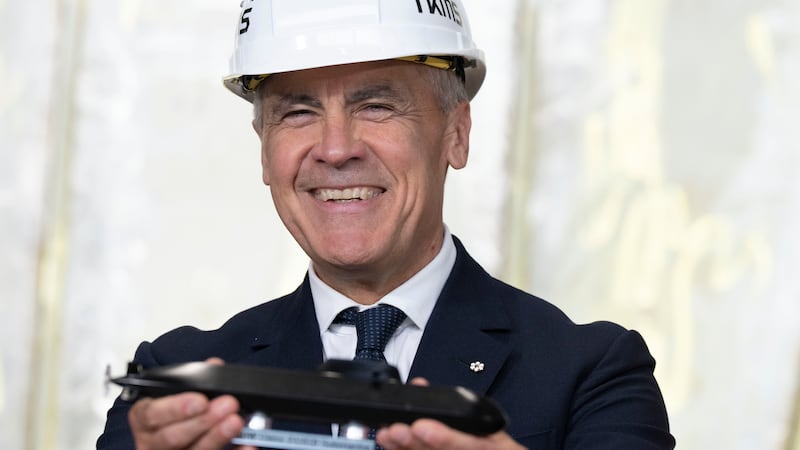
Speaking in Halifax on Monday, Prime Minister Mark Carney revealed that Germany’s TKMS has been selected as the federal government’s preferred supplier to build up to 12 new state-of-the-art submarines. Carney said TKMS will reallocate boats from German and Norwegian orders to ensure the 2034 delivery date is met.
“These subs will strengthen our defence industrial base, they will deepen our partnerships with trusted allies, and they will open new opportunities for Canadian businesses in European supply chains,” Carney said.
One of Canada’s largest military procurements, the 12 vessels are meant to replace Canada’s current fleet of four British-made Victoria-class submarines, which have been plagued with issues since they were purchased in 1998. Only one of the four submarines is considered fully operational.
“This was a difficult, close decision between two highly qualified suppliers,” Carney said. “Both the TKMS and the Hanwha platforms met the very high capabilities of the Royal Canadian Navy, and both of them put forward strong proposals to maximise benefits for Canadian workers and businesses.”
In a statement issued Monday, TKMS said the partnership will generate $167 billion in total economic activity in Canada, deliver over $86 billion in economic impact and more than 650,000 job years over the entire lifespan of the project. The German-Norwegian consortium has not provided a time frame for its calculations, but the lifespan of one submarine can range between 30 and 50 years.
Along with procuring the submarines, Canada’s project involves paying for 30 to 50 years of maintenance. The contract, over its entire lifespan, has an estimated value of more than $100 billion. According to industry sources cited by Reuters, the submarine order itself is estimated to be worth more than US$12 billion.
“TKMS is the best choice for Canadian workers,” the prime minister said. “It will directly create and sustain an ecosystem of well over a hundred thousand well-paying jobs across Canada.”
While the prime minister would not reveal details of the bid or talk about any commitments the company has made to Canada, he said the costs of purchasing these submarines has already been included in the government’s fiscal framework. He also said a condition of the contract with TKMS is that 100 per cent of the value of Canada’s investment overseas must be matched in Canada.
“We can confirm that this means Canada will receive tens of billions in investment from TKMS,” Carney said. “Investments that impact every region of the country. Investment across key defence and industrial domains, including space, munitions, autonomous technology, critical minerals, and R&D (research and development).”
In his remarks, Carney gave the example of engineers in Vancouver and Halifax who will build the sustainment capability that will help keep the fleet at sea for decades and high-tech workers in Montreal who will build the simulators needed to train the sailors who will serve aboard the new submarines.
“I can confirm that this procurement will be the largest in Canadian history and that, by design … this process will have, far and away, the greatest economic impact of any defence investment, right across Canada,” Carney said.
Connection to NATO made a difference
In the weeks leading up to the decision, there were hints about the direction the government was going with the submarine contract. In late June, Canada’s Department of National Defence posted an advanced contract award to a consulting firm that has experience in dealing with submarines and NATO countries.
TKMS, also known as ThyssenKrupp Marine System, is currently the world’s largest manufacturer of non-nuclear submarines and supplies approximately 70 per cent of NATO’s fleet. The bid for the Canadian submarines was made in partnership with Norway, another NATO member.
The other bidder, South Korea’s Hanwha, is not a NATO member, and the Germans argued that Hanwha did not have the same connectivity with NATO countries the German-Norwegian consortium does.
In his speech, Carney made multiple references to TKMS submarines being used by NATO allies, and arctic defence being integral to the security of NATO’s western flank. The fact that the submarines are “fully NATO interoperable,” Carney said, will allow NATO partners to share training, maintenance, parts, technology and even crews.
“The TKMS platform is optimised for Arctic waters and fully NATO interoperable, allowing it to communicate seamlessly, share intelligence, and carry out joint missions,” Carney said. “The submarine is proven and capable. It is used widely by our allies.”
Speaking to reporters in Ottawa late Monday, German Ambassador to Canada Tjorven Bellmann characterized the decision as a “major strategic undertaking.”
“We will produce, maintain, train, and operate together. Our joint fleet will be highly interoperable. Our crews will be interchangeable,” Bellman said. “This makes Europe safer. It makes Canada safer. It makes all allies in NATO safer.”
Carney’s government, meanwhile, has vowed to meet NATO’s new defence spending target, which is pegged at five per cent of member nations’ GDP, but has yet to outline a path to do so. Canada reached the alliance’s previous two per cent benchmark earlier this year and has pledged to meet the new target by 2035.
“In the end, this decision was about choosing the absolute best platform and partnership to meet Canada’s combined strategic, security, and economic interests,” Carney said.
In a statement issued after the announcement, TKMS called the decision a historic milestone for Canada that will strengthen national security, NATO interoperability and long-term industrial co-operation while generating lasting economic impacts across Canada.
“The announcement marks the start of a new chapter in defence co-operation between three close NATO allies, bringing together shared expertise and common security interests,” the statement read. “For Canada, the decision represents a significant long-term investment in maritime security and sovereign capability.”
Shortly after today’s announcement the prime minister departed for the NATO leaders’ summit in Turkiye.
What’s next?
Less than one year ago, TKMS and South Korea’s Hanwha were put on a shortlist of companies bidding for the major defence contract.
Now that TKMS has been announced as the preferred supplier, negotiations will continue to finalize a deal. Today’s news does not necessarily guarantee that a contract will be signed, but it does indicate Canada’s strong desire to work with the German company for decades to come.
Asked about timelines Carney said contract negotiations like this can take somewhere between 6 to 18 months.
“It will take as long as it takes but no longer,” Carney said.
If talks with TKMS are unsuccessful, Carney said Canada retains the right to designate Hanwha Ocean the preferred supplier and enter negotiations with them.
When asked by reporters about the 2034 timeline, TKMS CEO Oliver Burkhard said there is a chance the first submarines could be delivered before 2034.
“I think one of the big advantages was that we have already existing contracts that Canada can step into them,” Burkhard said in Ottawa, later suggesting Norway could potentially give “one of their boats” to Canada.
Bellmann added that there could be an adjustment to Germany’s own timelines to receive submarines to accelerate Canada’s procurement.
“The exact timelines depend on contract negotiations and other factors. We will have to see how this all turns out, but there is a willingness from our side, because we understand that Canada needs to replace the Victoria-class fleet quickly to make that possible as fast as we can,” Bellmann said.
Government officials speaking to CTV News on background call this a unique pace in Canada that they intend to highlight at this week’s NATO leaders’ summit in Turkiye. In his speech, the prime minister said today’s decision is five years ahead of the original schedule.
“This is a powerful demonstration of Canada’s new Defence Investment Agency in action: equipping our Armed Forces with the capabilities they need, when they need them, while strengthening Canada’s industrial base for the decades ahead,” he said.
Rob Huebert, the Director of the University of Calgary’s Centre for Military, Security and Strategic Studies, says today’s decision will bring Canada closer to the European Union, and NATO.
It shows Canada means business,” he said in an interview with CTV News Channel. “It means business about moving towards that target that NATO has been set and the way this procurement has been done is incredibly transparent, incredibly innovative and very deliberate,” he said.
But Conservative defence critic James Bezan criticized the prime minister for announcing more negotiations.
“We were disappointed that this was just an announcement that they’re entering into negotiations,” Bezan said in an interview with CTV News Channel. “Prime Minister Carney is great at announcements. He’s great at photo-ops, but what we really need is action, and we need submarines delivered now.”
Hanwha Canada CEO Glenn Copeland, meanwhile, called the news “disappointing” in a statement released on Monday.
“The team at Hanwha have demonstrated to the Canadian public and government that there is unlimited potential to unlock within the South Korean defence industrial base and that Hanwha and its business divisions will continue to grow aside from today’s decision. We look forward to continuing to demonstrate why Hanwha is the backbone of the world’s fourth largest defence export nation,” the statement reads in part.
With files from Reuters, The Associated Press, Daniel Otis, CTV News Ottawa Bureau Chief Graham Richardson and CTV News senior correspondent Judy Trinh.

