Eric Ham is based in Washington, D.C. and is a political analyst for CTV News. He’s a bestselling author and former congressional staffer and writes for CTVNews.ca.
WASHINGTON — U.S. President Donald Trump has controlled all levers and levels of power in Washington with an iron fist for two years, upending the global economic landscape and alienating America’s neighbours.
Now, with the midterm elections just weeks away, Ottawa is watching closely in hopes that a shift in the balance of power might rein in the president’s mordacious attitude towards Canada.
Prime Minister Mark Carney’s trade negotiators and manufacturers would no doubt like to see — should the minority Democratic Party win back control of Congress in the midterms — a follow-up to the modicum of success they achieved with the passage of a series of resolutions calling for the repeal of Trump’s tariffs.
However, it won’t be so easy. A split in power could lead to government deadlock, leaving trade in economic purgatory, with Canada isolated and locked out of the lucrative U.S. market for the next two years.
The opposition party’s ability to outmaneuver the majority for even a small victory in a Congress marked by polarization and entrenchment is a reason for optimism. Lawmakers have united against the Trump administration’s economic policies that created a deep well of anxiety throughout the nation and alienated many allies, including Canada.
Now, with the left on the brink of a massive victory, Democrats, should they take control in November, are preparing to move from symbolism to action. House Minority Leader Hakeem Jeffries is mobilizing his caucus to enact laws that will eliminate many, if not all, of the White House’s tariffs.
Fraying Democratic coalition
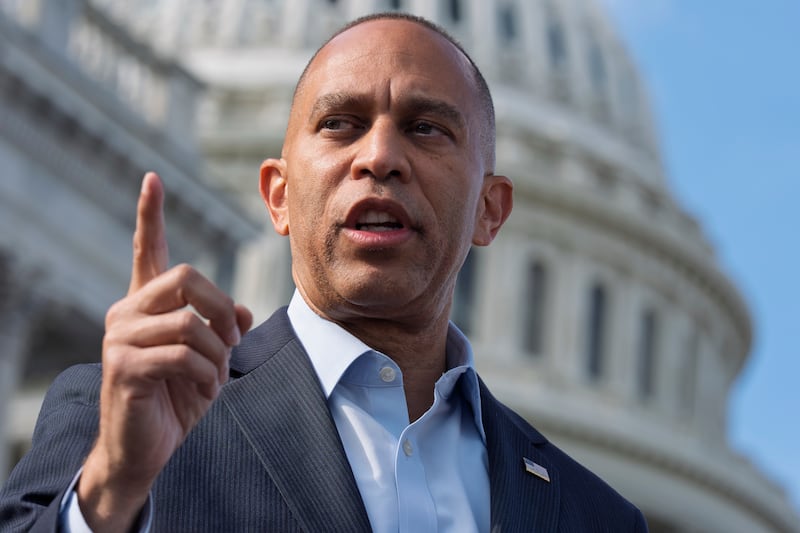
In an interview with The New Republic, Jeffries outlined an ambitious agenda that includes restoring congressional authority over trade.
However, recent defections in the House Democratic caucus show that unity — or a lack thereof — could be the biggest culprit derailing Jeffries’s bold agenda, which includes tariff relief for Canadian businesses. Even as the opposition party feverishly battles across the nation to claw back seats, in Washington, some lawmakers on the left appear to be following a different agenda.
Recently, a pair of centrist Democrats crossed the aisle to help GOP leaders advance a number of bills. This marked the second time this month that Democratic leaders had failed to unite their caucus against the Republicans’ messaging agenda that was specifically designed to help MAGA keep the House in November’s midterms.
Should Democrats succeed in wresting control of the gavel from Republicans, it is unclear if leadership — as well as rank-and-file members — has the political will, let alone the unanimity, to thwart the White House’s signature economic policy.
Beyond the political machinations, the left will have constitutional and procedural powers, in theory, to at least stifle Trump’s levies on billions’ worth of goods coming into the country.
Constitutional tug-of-war over trade
Article I, Section 8 of the U.S. Constitution “grants Congress the power to levy taxes and duties.” Moreover, earlier this year the Supreme Court ruled that key tariffs implemented by the White House were unconstitutional.
A right-leaning majority of the judiciary deemed that some of the tariffs enacted were in fact duties and therefore within the jurisdiction of the legislative branch. Additionally, beyond tariffs, the Constitution also grants Congress control over trade with foreign nations.
But lawmakers, for decades, have delegated significant the power to impose tariffs to the Executive Branch through federal statutes. The White House has invoked all of its constitutional authority to enact sweeping tariffs on a range of goods from every nation, including America’s largest trading partners, Canada and Mexico, through the following:
- the International Emergency Economic Powers Act (IEEPA);
- Section 301 (Unfair Trade Practices);
- Section 232 (National Security);
- Section 122 (Balance of Payments); and
- Section 338 (Foreign Discrimination).
All of the above have been used for maximum leverage by the White House.
To date, only the IEEPA tariffs were struck down by the courts. Section 122 went into effect in the immediate aftermath of the justices’ ruling against IEEPA. Although the Constitution is clear on the authorities granted to the legislative branch, it remains to be seen how Democratic leadership plans to use such power to negate the White House on trade.
Even with a unified House and Senate armed with veto-proof legislation, the Trump administration has shown a willingness to flout laws and ignore court rulings with brazen disregard.
Canada’s collateral damage
Such actions by the White House could set up an epic battle between both sides of Pennsylvania Avenue that ultimately leaves Canadian steel and aluminum producers, as well as potash producers, among others, caught in the crossfire.
Perhaps the only and most crucial weapon available to lawmakers is their power of the purse. Trump’s MAGA base controls both chambers of Congress but still refuses, so far, to acquiesce to White House demands on some of its more unpopular issues -- including the war in Iran.
A balance of power is still no indication that leaders Chuck Schumer and Hakeem Jeffries are prepared to take a more Machiavellian approach by starving the executive branch of appropriations in an effort to rein in the West Wing on tariffs.
Using all the powers granted to the White House, Trump has demonstrably reshaped America’s relationships with long-standing allies. Beyond military might, the president has followed through on threats to cut off nations from the United States’ nearly US$33-trillion economy, even if it means massive destabilization and upheaval for industry suppliers of goods that American consumers and the United States’ northern neighbour rely on daily.
Largely sidelined and powerless to check an emboldened and empowered executive branch, Democratic congressional leadership — believing it is on the cusp of making seismic political gains — appears eager to pit its authority against that of the president. Should Democrats prevail in November, victory alone won’t be enough to automatically block the Trump administration or end the trade war that is already driving Canada further away from the U.S.
Such an intense and high-stakes showdown might ultimately bring Washington to a grinding halt — a stoppage that could push Canada to the point of no return. It could leave firms completely cut off from their biggest export market and put Ottawa on a permanent trajectory of abandoning the U.S. entirely for more stable, hospitable governments.

