


FORT MCMURRAY — The Canadian government is designating a proposal for a new oil pipeline to the West Coast – now titled Pacific Link – the first-ever project of national interest under Prime Minister Mark Carney’s Building Canada Act.
This decision was made on the recommendation of Intergovernmental Affairs and One Canadian Economy Minister Dominic LeBlanc, a government official speaking on a not-for-attribution basis told reporters Thursday morning in a technical briefing ahead of Carney’s announcement in Fort McMurray, Alta., alongside Alberta Premier Danielle Smith.
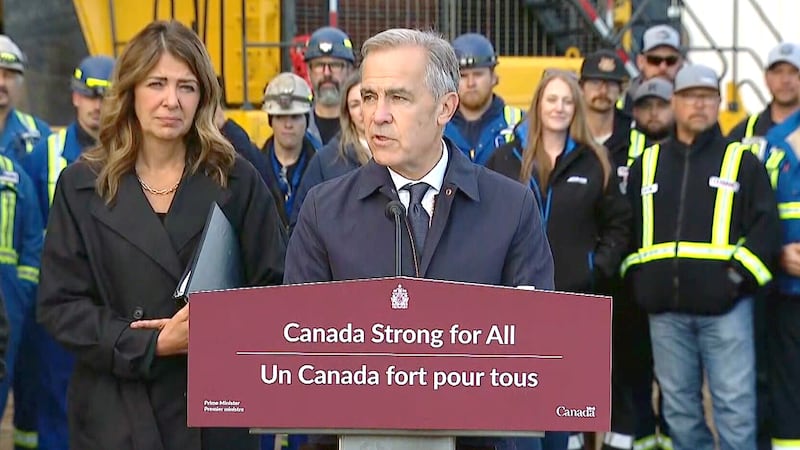
“This is true nation building, and it will take a nation to build it,” Carney said Thursday.
The pipeline – a 1,200-kilometre pipeline from Bruderheim, Alta., south to Delta, B.C. – is estimated to carry an extra million barrels a day when finished, mainly to Asian markets.
“The government has determined that this project would strengthen Canada’s autonomy, resilience, and security, while creating material economic benefits that will improve the nation’s prosperity, which will be critical within the context of increasing trade uncertainty,” the official said, referencing the potential to expand Canada’s energy export market well beyond the United States.
“Today, 90 per cent of Alberta’s oil goes to the U.S.,” Carney said. “Pacific Link will materially reduce that dependence.”
In making this call, the federal Major Projects Office – after conducting analysis of the project, the capabilities of the proponents, the environmental factors and rights of Indigenous communities – believes the pipeline could be executable within a reasonable time frame, and that “the business case is very strong.”
Why this project?
Citing an estimate from the Royal Bank of Canada, the official said the project could generate roughly C$20 billion annually in incremental export revenues at a Western Canadian Select price of $60 per barrel.
The pipeline could also lead to $70-$80 billion in construction investment, generate upwards of 144,000 jobs at the height of building, and “will have significant positive impacts on GDP,” with expectations it would create $100 billion in government revenue by 2060.
Despite these figures, so far, no private sector proponent has indicated any interest in paying for the project in full. The Pembina Pipeline Corp. has expressed interest in a 10 per cent private sector stake and has optioned up to another 10 per cent once the pipeline is in operation.
Pressed on these figures, the official noted that in the case of the Trans Mountain pipeline, it took several years for private players to meaningfully materialize.
Based on conversations had at Carney’s recent investment summit, the official said, “If it goes as expected, I would expect to see a number of private investors lining up to try to get into this project.”
The designation also indicates a 10 per cent equity ownership stake for Indigenous communities, in addition to mutual benefit agreements that could see contracting, procurement, and employment opportunities offered to First Nations along the route.
Environmentally speaking, the project “does not directly contribute to Canada’s greenhouse gas emission reduction targets” but it will advance climate efforts by investing in carbon reduction efforts by the Oil Sands Alliance, the official said.
The official also said that conditions will be developed to mitigate potential impacts on marine and terrestrial life – including on the southern resident killer whale population – though ultimately “the government determined that these potential impacts do not displace the national interest character of the project.”
Smith – who amid separation tensions in her province, has championed this pipeline as a way to allow Alberta oil to flow more freely and help address the federal government’s diversification efforts – celebrated the historic designation.
“This is a monumental day for our province and for our country,” Smith said. “For too long, we’ve watched projects with enormous transformative potential get mired down in uncertainty and delay. And today, we’re turning the page. The work ahead will still require cooperation and perseverance, but with continued collaboration, I am confident we can keep moving forward.”
What happens now?
As the first project to receive this designation since Parliament passed Bill C-5 more than a year ago, the pipeline will now set off on an accelerated and streamlined approval process aimed at ensuring investor confidence.
This designation means a series of authorizations and permits have been deemed approved, and the project will now move into a regulatory review phase once the proponent provides a “comprehensive project information document,” which is expected “sometime early in 2027.”
As one senior official put it: “The focus will move from whether the project [should] proceed to how it should proceed responsibly and under what conditions.”
More than 20 other nation-building initiatives have been referred to the Major Projects Office and are awaiting a similar designation decision.
For Pacific Link, the plan is to finalize the conditions for the project by September 2027 “clearing the way to get shovels in the ground,” according to a press release from the Prime Minister’s Office. The current timeline for the pipeline to be “online and through construction” is 2032 or 2033.
Among the milestones that will contribute to the final concept being developed are public hearings on the social, cultural, health, safety, and security concerns, as well specific forums for Indigenous communities and public stakeholders, both expected to be held over the winter and spring of 2027.
Between now and next September, the work being undertaken – including route mapping, ecological surveys, cost estimates, procurement, and workforce planning – is estimated to cost approximately $4 billion.
The Alberta and federal governments will foot this bill initially, reporters were told. Though those costs, as well as the actual construction of the pipeline, will eventually be charged back to the shippers and recovered.

“The Canadian taxpayer is going to make a lot of money off this pipeline,” Carney said when pressed on how many billions of dollars he was expecting Canadian taxpayers to contribute to the project.
The lead official briefing reporters noted that after being involved in building projects for many years, the amount of progress made as of Oct. 1 would have taken five years to complete under the previous national process. Though, they also conceded that given this new approach, the government is anticipating there “probably” will be legal challenges ahead.
While the B.C. government has stated its opposition clearly to a new pipeline, Premier David Eby – who is in the midst of a provincial election campaign – has said the government would not challenge the project. His province has recently been the recipient of a $1.2-billion funding commitment to improve marine incident prevention and strengthen ocean and ecosystem monitoring and protections.

Federal NDP pan, business groups embrace
Early reaction to the Pacific Link designation was mixed.
In a statement, Federal NDP Leader Avi Lewis criticized the Liberals for “rushing through” an oil pipeline that in his estimation “is absolutely not in the national interest.”
“It is an offence to Canadian science, public health, collective safety, and common sense. And it is a gift to an oil industry,” Lewis said. “This project leaves Canadians bearing all the risks of a bad investment without any of the rewards.”
The NDP leader went on to note that projects that truly serve the national interest would be those that lower costs and protect the people and places Canadians love, citing renewable energy projects and public transit systems as examples.
Though business groups begged to differ, rapidly embracing the announcement.
“This designation demonstrates that the federal government recognizes what this project will mean for Canada’s economic prosperity and sovereignty,” said the Business Council of Alberta, calling on those involved in the process to move as swiftly as possible.
“The designation is an important step toward expanding Canada’s access to global markets and creating jobs and prosperity for Canadians.”
The Business Council of Canada echoed this, adding that “the project would also support the country’s goals to diversify trade, preserve economic security, bolster competitiveness and ensure that Canada receives fair value for its energy products.”
“Canada is rich in resources and long faced limited routes to get them to the world. In a moment full of historic actions to deliver economic and energy security, this Pacific Link pipeline remains a standout project to change that,” said Canadian Chamber of Commerce senior director of natural resources, environment and sustainability Bryan Detchou.
“By definition, we know nation-building projects are in the national interest – and this is a prime example of one. Getting our resources to Asia-Pacific markets is a path to more production, prosperity and a brighter future for workers, their families and communities.”

