TORONTO – On the final day of competition at the World Humanoid Robot Games in Beijing, a Chinese-built robot ran 100 metres in 8.64 seconds — almost a full second faster than Usain Bolt’s world record.
Then it literally hit a wall.
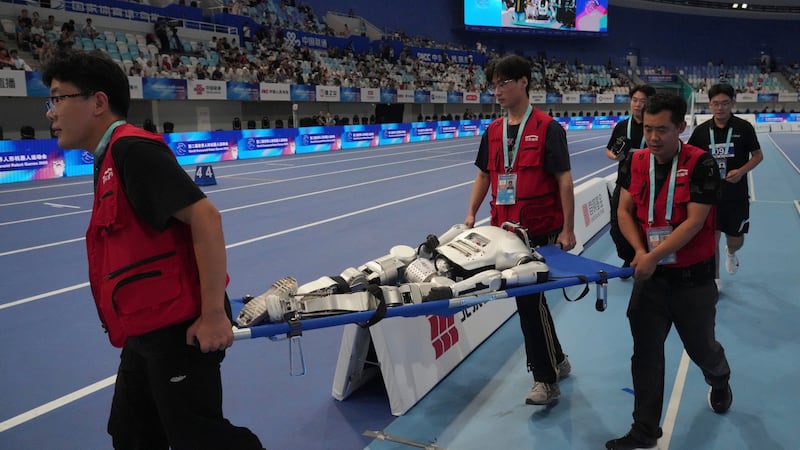
There is a padded blue barrier past the finish line at the games, and it is there because, for humanoid robots, the sprinting is easier than the stopping. So, the machines cross the line at full speed, smack into the padding and often crumple to the ground.
Sparks can fly. At times, staff run in with fire extinguishers, and the robots are often carried off on a stretcher.
If that sounds like a technology in trouble, tech analyst Carmi Levy says it is the opposite.
“Failure is part of the equation when developing advanced technologies like robotics and AI. You iterate, it fails, you learn why it fails, you improve the technology, and you go from there,” Levy said. “SpaceX blows up its rockets all the time, and they get better with each successive launch. These robots are following exactly the same game plan.”
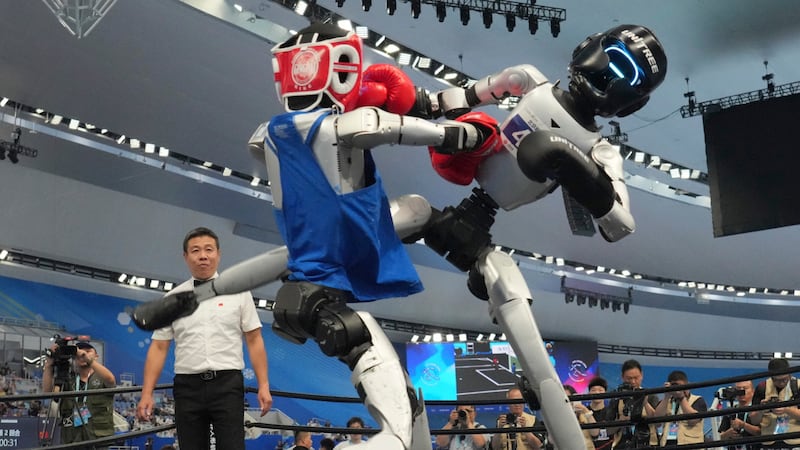
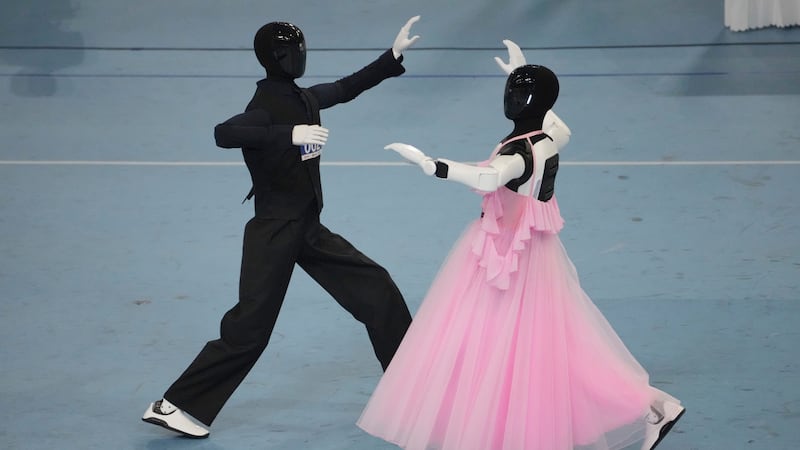
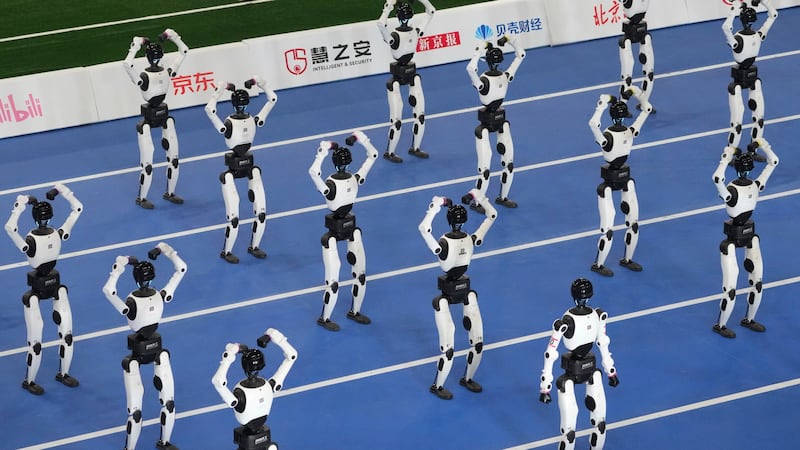
The second World Humanoid Robot Games ran from Aug. 22 to 26 at Beijing’s National Speed Skating Oval, a venue built for the 2022 Winter Olympics. Organizers said more than 2,000 robots from more than 600 teams and 16 countries competed in events, including boxing, soccer, tug-of-war, break dancing and real-life tests like industrial assembly and laundry folding. There were even robot cheerleaders, with pom-poms.
To give you a sense of how fast the robots are improving, consider the standing high jump, in which machines leap from a stationary position. The winner this year reached 3.4 metres, which is higher than most ceilings. At last year’s games, the best a humanoid managed was 0.95 metres.
The sprint record fell three times in five days, each time to the same machine: Tiangong Ultra, built by the Beijing Innovation Centre of Humanoid Robotics. It ran the 100 metres in 9.39 seconds on opening day, 8.86 in the semifinal and 8.64 in the final. A year ago, at the inaugural edition of the same event, the fastest robot finished the race in 21.50 seconds.
Usain Bolt’s record of 9.58 seconds was set in Berlin in 2009, though he didn’t slam into a crash mat at the end of the race.
“This shows just how far robotics has come, and just as importantly, how quickly the technology is advancing,” Levy said. “A year ago at this same event, the videos were far less impressive. The robots could not run on their own. They needed human minders to pick them up when they stumbled and point them in the right direction.”
China showcases prowess in robotics
There were stumbles in other events this year. A weightlifting attempt ended in a face plant, becoming one of the week’s most-shared video clips. But many of the robots also impressed, and the entire spectacle was promoted heavily by China’s government.
“China isn’t doing this for fun. They are telegraphing to the world exactly how powerful they have become in robotics and artificial intelligence, and how quickly their technology is advancing,” Levy said. “This isn’t about some technological Olympiad. This is about showing the world that you’re a technological superpower.”
“They call these the World Humanoid Robot Games, but in reality, it’s China’s show, and everyone else is just a side player,” he added.
According to China Daily, 641 of the 666 teams at the games were Chinese. The country builds an estimated 85 per cent of the world’s humanoid robots, and Morgan Stanley has projected the country’s humanoid market alone could reach US$15 billion by 2030.
Washington has noticed. In July, the U.S. Federal Communications Commission banned imports of new foreign-made humanoid and four-legged robots, citing cybersecurity and supply-chain risks. Beijing dismissed it as protectionism. Ottawa has not imposed any similar restrictions.
As for the games, not everyone reads the spectacle the same way.
In a statement to CTV News, Tarek Rahim, CEO and co-founder of Mirsee Robotics in Cambridge, Ont., says he doesn’t believe the point of them was to portray China as the dominant leader in advanced robotics — an interpretation he says most people have gotten wrong.
He credits Chinese manufacturers with significant progress when it comes to mass production, and says the games were worthwhile if the goal was to showcase what’s possible and spark curiosity about robotics.
But he believes the machines aren’t as advanced as they might seem. He says Chinese humanoid companies are chasing high volumes of low-cost, fast robots built mainly for academic research and entertainment, rather than practical work.
In his view, the vast majority of what was on display in Beijing was neither sophisticated nor well engineered, calling them machines with “a few dozen low-cost actuators pushed far beyond their rated power limits.”
“A stunning visual display does not indicate brilliant design,” Rahim said.
Western firms, he says, are optimizing for something else: safety, utility and reliability. They could build robots that do backflips or run at breakneck speeds, he says, but it would be dangerous and pointless.
“There were countless examples of robots crashing, batteries exploding, and a reckless disregard for safety,” Rahim said in the statement.
“For us, breaking a world record is not worth compromising safety.”
Robot Games ‘wake-up call’ for Canada: expert
But Levy says the games should sharpen concern about a widening gap in innovation.
“This should be a wake-up call to Canada’s robotics sector that other countries are doing it better than we are,” Levy said. “We need to double down on investments in terms of dollar amounts, as well as resourcing and support from all levels of government.”
As for viral videos of crashes, Levy thinks they’re leaving the wrong impression.
“The videos seem funny at first glance,” Levy said. “But there’s nothing funny about China establishing its dominance in robotics and AI for all the world to see.”

