TORONTO — If you’re convinced you know what Bank of Canada governor Tiff Macklem’s going to do at the next interest rate announcement or have a sixth sense about the weather, Wealthsimple will soon you let you put your money where your mouth is.
The financial services company said Thursday it will introduce a beta version soon and a new app — Wealthsimple Predict — this summer giving retail investors access to bets through Kalshi, a U.S. based prediction market platform.
Prediction markets let investors bet on the outcome of real-world events by purchasing corresponding contracts for less than $1. The more people who bet on an outcome by purchasing a contract, the higher the purchase price will be. If you guess right, you make money on every contract you’ve bought. An unlikely bet would offer a better return on investment than a consensus choice, but you have to be right for it to pay off.
Wealthsimple will offer prediction market trading to 4,000 events tied to economic, financial or climate matters.
The company, which has emerged as a significant challenger to Canada’s biggest banks, sees offering prediction trading as a way to respond to consumer demand but also potentially corner what it considers to be “one of the fastest growing financial markets in the world.”
“We don’t know the demand specifically from our customers, but we do believe that there is a global demand for a product like this,” said Swapnil Parikh, Wealthsimple’s vice-president of investing products.
Prediction markets have grown quickly and the regulatory environment is nebulous. Up until now, Interactive Brokers was the lone company legally offering Canadian customers access to prediction markets through contracts traded on ForecastEx, a U.S.-based exchange.
Elsewhere, Polymarket and Crypto.com have got in on the action. (In Canada, the Ontario Securities Commission has banned Polymarket in Ontario for regulatory infractions but other provinces have allowed it.)

The addition of Wealthsimple, which has four million Canadian customers and $125 billion in assets under administration, will significantly increase the number of Canadians who have access to prediction markets.
It will also test how much interest there is in the product and what safeguards are necessary to protect investors who could get carried away with trades that cost less than $1.
Wealthsimple will limit prediction market trading to economic, financial or climate matters because that’s the model Interactive Brokers used to get a greenlight from Canadian securities regulators, chief legal officer Blair Wiley said.
That means customers won’t be able to trade on World Cup matches or the Oscars race any time soon.
Charles Martineau, an associate professor of finance at the University of Toronto, considered Wealthsimple wise to limit prediction trading to “far less sexy” topics because it reduces the attractiveness of the product and thus, the risk of people adopting gambling-like behaviours.
However, he said consumers are generally better off investing in other products because prediction markets aren’t big money makers for most investors.
He contributed to a research paper released last week which studied trading gains and losses on Polymarket and suggests the median investor lost $2 on prediction trading in the period between Nov. 11, 2022 and March 29, 2026.
Despite the data, he suspects Wealthsimple is offering the product because it can be lucrative, if you bring in high trading volumes and charge a transaction fee or take a cut of earnings.
To decide who can access prediction trading, Wealthsimple will measure how sophisticated interested investors are.
Usually, it asks investors questions about how comfortable and experienced they are with certain financial products before letting individuals use them.
Because prediction markets are new, the company won’t be able to use that approach, Wiley said.
Instead, it will require customers to be employed and meet an income threshold.
“If the customer is a student and unemployed, they would not have access,” Parikh said.
For Martineau, the product’s safety comes down to how good Wealthsimple is at testing its clients’ acumen before giving them access, because “they’re really opening the door to almost anyone to participate in prediction markets”
If it asks customers questions that are too simple then the guardrails won’t do much, he reasoned.
Wealthsimple did not say what questions it will ask customers beyond their employment status and income.
New clients will have to participate in a Know Your Client process — a set of standards the finance industry uses to ensure brokers have sufficient information about their clients, their risk profiles and their financial position.
For those with access, Wealthsimple said its role is “mostly to inform rather than restrict users,” who they said are generally responsible.
“The vast majority of clients are very good risk managers on their own,” Wiley said.
He cited as an example the company’s launch of crypto products, which also carried risk and volatility. Critics worried investors would start remortgaging their houses to buy bitcoin.
“The actual evidence did not show that at all,” he said. “People were buying very small amounts of crypto assets alongside all of their other investments.”
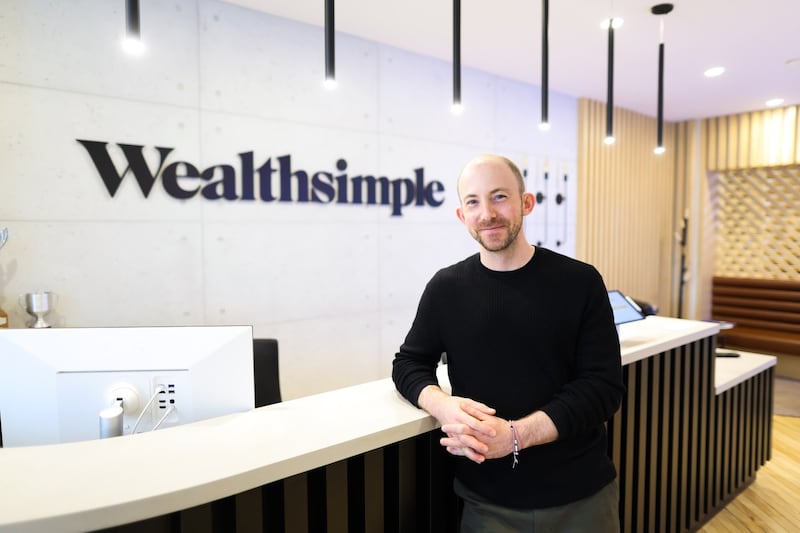
While Wealthsimple can’t know what habits users will form around prediction trading, if someone transfers a large amount of their portfolio to predictions, it will trigger a communication to the user asking if that was a mistake.
It was unclear what the threshold would be to remove someone’s access to prediction trading.
Wiley said Wealthsimple always has the power to take away a product but tries to be “very thoughtful and deliberate” when considering that step.
“It’s not something we think is generally appropriate,” said Wiley, who compared cutting off prediction trading access to “de-banking” clients.
“It’s something that we’re very, very cautious to do.”
This report by The Canadian Press was first published June 18, 2026.
Tara Deschamps, The Canadian Press

