U.S. chip stocks stumbled on Tuesday, but the broader market’s initial slump brought out bargain-hunting investors, stemming the falloff in other companies central to the AI infrastructure rally that have powered the market over the last few years.
The tech-heavy Nasdaq Composite index was still down 1.4 per cent, wiping out around US$680 billion in market value in morning trading on Tuesday. Elon Musk’s SpaceX briefly traded below $2 trillion in market cap for the first time since its debut earlier this month before rebounding into positive territory.
Tech has endured its first major selloff in weeks over the last several days, with the Nasdaq off by nearly five per cent from its peak close from early June. The world’s most valuable company Nvidia saw its market cap slip below $5 trillion with a 2.6 per cent decline. It and Tesla were among the biggest drags on the Nasdaq.
Chipmakers, which have been among the biggest winners of the AI trade this year, clocked heavy losses, with the Philadelphia SE Semiconductor Index down 6.3 per cent. Micron, one of the biggest gainers in recent months, was down nine per cent. It will report earnings after the markets close on Wednesday.
“The trade has been highly concentrated and flow-driven, which makes it vulnerable to relatively small shifts in sentiment,” said Ross Mayfield, investment strategy analyst at Baird.
“It doesn’t appear to be closely tied to the fundamentals of the AI story, but rather to the heavy concentration and strong inflows into global tech over the past few months now starting to unwind.”
Memory chipmakers — the best-performing stocks on the S&P 500 so far this year — lagged on Tuesday, with SanDisk falling 12 per cent and Western Digital losing 11 per cent. Memory chipmakers in South Korea also recorded steep declines.
SpaceX shares were up 1.7 per cent at $157 just after 10:40 a.m. ET (1440 GMT), after falling as low as $147.11, its first slip below its opening-day price of $150.
Tech giants mixed
Other tech heavyweights were mixed, with Alphabet off 0.4 per cent, Apple up 0.8 per cent, and Microsoft up more than two per cent. Software stocks like Workday and Salesforce were also higher; those shares sold off heavily earlier this year on AI-linked fears.
Commonly dubbed hyperscalers, these firms have committed billions to ramp up their AI infrastructures, though clearer evidence that AI products can generate returns justifying the spending remains elusive.
Lauren Hyslop, investment manager at Mattioli Woods, said the selloff was due to a more challenging interest‑rate backdrop and concerns about the scale of capital required to fund the next phase of AI investment.
SpaceX’s record-breaking IPO fuelled a trading frenzy in its first week as a listed company, but shares have unraveled in the past few trading sessions, erasing more than $600 billion in market capitalization since last Wednesday.
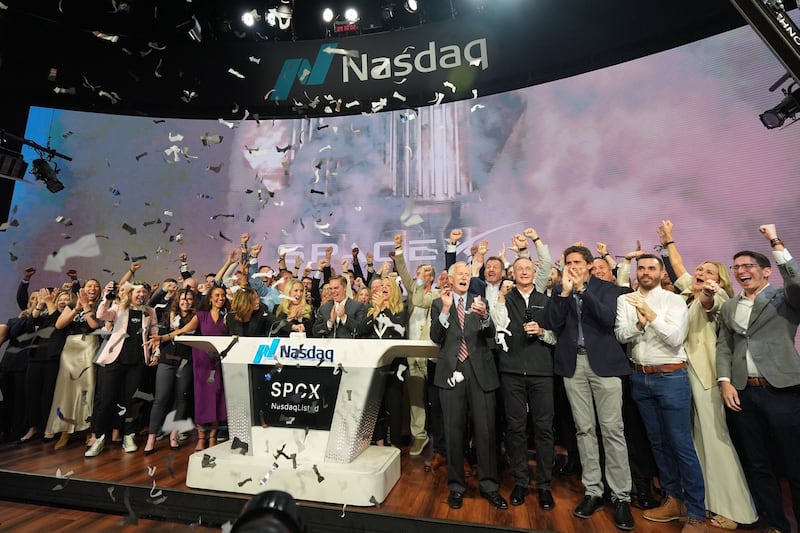
“I’d be cautious about seeing this as a second-chance buying opportunity. The drop looks dramatic in scale, but these swings aren’t unusual for a stock with such a small public float,” said Nic Puckrin, cross-asset analyst and founder of Coin Bureau.
The company’s shares are still more than 10 per cent above their IPO price of $135. SpaceX also announced a bond offering earlier this week.
Big IPOs often face turbulence in their early days on the public market. A Reuters analysis of 50 IPOs with the highest valuations in the past five years showed investors would have been better off buying an S&P 500 index fund about three-quarters of the time than buying into a big IPO.
Rate-sensitive technology stocks have also been hurt by expectations of tighter monetary policy under U.S. Federal Reserve Chair Kevin Warsh, especially as recent economic data points to a resilient economy.
(Reporting by Shashwat Chauhan and Medha Singh in Bengaluru; Editing by Pooja Desai, Colin Barr and David Gaffen)

