Mining stocks tied to copper, gold and lithium could benefit from long-term structural trends despite recent price weakness across commodities.
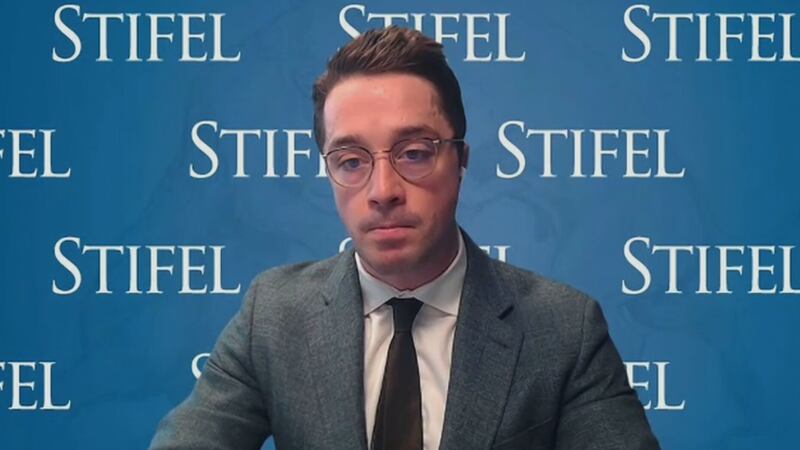
BNN Bloomberg spoke with Cole McGill, mining equity research director at Stifel Financial, who said macro themes such as de-dollarization, electrification and constrained supply are supporting a revaluation of hard assets.
Key Takeaways
- Recent declines in metals prices reflect short-term volatility, while long-term trends like de-dollarization and electrification continue to support demand.
- Copper supply constraints and declining ore grades are creating opportunities for new large-scale discoveries to fill future shortages.
- Exploration success and high-grade discoveries can significantly increase asset value and attract strategic interest from major miners.
- Gold developers nearing production often see valuation re-rating as they transition to cash flow generation.
- Lithium demand is being supported by rapid growth in energy storage tied to AI and power consumption, favouring low-cost producers with expansion potential.
Read the full transcript below:
LINDSAY: Welcome back. It’s time now for Hot Picks, and today we are zeroing in on three plays in the mining sector. Our next guest has picks in copper, gold and lithium. Let’s get more perspective from Cole McGill, director of mining equity research at Stifel Financial. It’s good to have you join us. Thanks so much.
COLE: Thanks for having me. Good to be back.
LINDSAY: Before we get into your actual Hot Picks, I just want to talk about the metals sector as a whole. Gold is down today, copper is down, lithium is down. But you say this has the potential to benefit forward-thinking investors. Why is that?
COLE: Yeah, I think the way to preface investing within the commodities equity space right now is to take stock of the fact that we’ve seen a lot of the froth come out of the market. But the central tenet of the thesis, which is the revaluation of hard assets, hasn’t changed since the war in Iran began. The Strait of Hormuz is pushing energy prices up. That’s going to have an impact on margin expansion with respect to a lot of the miners.
But the central tenet around de-dollarization, global bifurcation, electrification, especially in the East because of energy prices and diversification of energy sources, is going to be a continuing trend and represent secular upside over the mid- to long term.
LINDSAY: What about potential rate decisions further down the road? Obviously, the war in Iran is influencing how central banks are thinking about things, so it’s hard to tell what’s going to happen. But does that have any effect, or do you watch for that in terms of what’s going to happen with the price of metals?
COLE: Yeah, 100 per cent. That has a definite impact with respect to near-term gold upside. But again, I think the central tenet — de-dollarization being the broader macro theme toward revaluation of hard assets — underpins the upside toward gold exposure as well as copper exposure.
LINDSAY: Okay, so let’s get into it then. Your copper pick — we’ll start with that — is ATEX Resources. What is it that you like about this one?
COLE: Yep. So ATEX Resources is a pre-revenue, development-stage exploration company with a large asset in Chile. Chile is home to around 30 per cent of the world’s copper production. Chile and Peru account for almost 50 per cent, and they’re home to the legacy assets that have produced a lot of the secular growth and supply expansion over the past 25 years.
ATEX’s flagship asset is the Valeriano project. That’s around a 33-billion-pound porphyry. For perspective, that would be a top-10 undeveloped asset globally. What’s taking the asset to the next level is the recent discovery of near-surface, higher-grade mineralization, which has the ability to increase competitive tension for the asset and drive multiple expansion.
Since around 2020, we’ve seen a geological shift where drilling deeper within the epithermal-porphyry continuum in the Andes has led to major discoveries. That includes projects like Filo del Sol and Lunahuasi, and transactions like the multi-billion-dollar acquisition involving BHP. There’s been more than $12 billion of value creation tied to this thesis, and we think ATEX is well positioned for that next wave.
We see good downside protection based on comparable transactions, and upside driven by a strong drill program currently underway, with results expected over the next three to four months.
LINDSAY: And obviously, when we’re talking about copper, there’s high demand and limited supply. We’re also hearing about companies spending more on AI, which requires copper for data centres and infrastructure. Are there any risks with this company?
COLE: I think the interesting aspect with respect to growth is that, over the past decade, large miners have prioritized returning capital to shareholders. You’ve seen muted volume growth and increased buybacks, along with balance sheet repair and limited investment in new supply.
That creates an opportunity for smaller-cap, pre-production developers to fill the next wave of supply. For perspective, since 2000, the average grade of the top 20 copper mines has dropped around 30 to 35 per cent. That decline, combined with underinvestment, creates a strong setup for new discoveries to be developed or acquired in the next cycle.
LINDSAY: Okay, your next pick is gold — Montage Gold. Gold is always an interesting story.
COLE: Yeah, and the way I think about alpha in the next cycle is by looking at single-asset developers transitioning to producers. They typically get re-rated from a net asset value basis to a cash flow basis.
We’ve seen this play out, with those companies outperforming gold benchmarks significantly in the two years leading up to production. That same thesis is playing out with Montage. The stock has pulled back about 25 per cent over the past month, which we see as a buying opportunity.
You can think about development assets in terms of people, process and property. The property is the Koné project in Côte d’Ivoire. It has strong infrastructure access, and construction is well advanced, with first production expected by year-end.
The management team includes experienced operators with a strong track record in West Africa, and the company has structured its financing efficiently, limiting dilution. We also see upside from production growth and mine life extension, as well as a shift toward a broader growth platform through regional consolidation.
LINDSAY: We’re tight on time, so I’ll ask you to be quick on this last one. Your final pick is Lithium Argentina.
COLE: Yep. We’ve seen a rebound in lithium prices, driven in part by new demand from energy storage, which is linked to AI and rising power consumption. Energy storage demand is growing at roughly 50 to 55 per cent year over year, supporting pricing.
The way to approach lithium right now is to focus on low-cost producers with strong balance sheets and a path to free cash flow. Lithium Argentina fits that profile. They’ve ramped up their Cauchari asset efficiently, faster than many peers, and they have two growth projects that could drive further production expansion.
LINDSAY: Cole McGill, director of mining equity research at Stifel Financial. Appreciate your time. Thanks so much.
| DISCLOSURE | PERSONAL | FAMILY | PORTFOLIO/FUND |
|---|---|---|---|
| ATEX NASDAQ | N | N | Y |
| MAU TSE | N | N | Y |
| LAR NYSE | N | N | N |
---
This BNN Bloomberg summary and transcript of the March 24, 2026 interview with Cole McGill are published with the assistance of AI. Original research, interview questions and added context was created by BNN Bloomberg journalists. An editor also reviewed this material before it was published to ensure its accuracy and adherence with BNN Bloomberg editorial policies and standards.

