Shares of Wheaton Precious Metals rose after the Vancouver-based miner reported record third-quarter earnings, driven by higher production volumes, stronger metal prices and new contributions from partner projects.
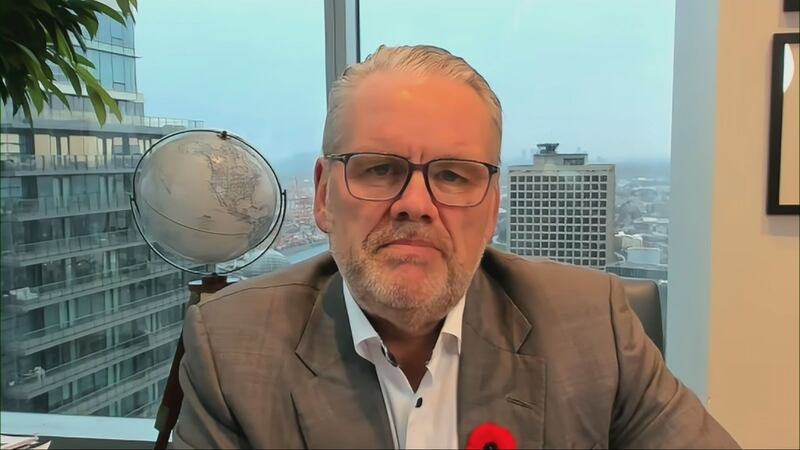
BNN Bloomberg spoke with Randy Smallwood, president and CEO of Wheaton Precious Metals, about the company’s record-breaking results and its new US$670-million gold stream on the Spring Valley project in Nevada, expanding its growth profile in a top-tier jurisdiction.
Key Takeaways
- Wheaton Precious Metals posted record Q3 revenue of US$476 million, up 55 per cent from a year earlier.
- Net earnings hit a record US$367 million, boosted by production gains at Salobo, Antamina and new output from Blackwater.
- The company expects to finish the year near the upper end of its guidance of 600,000 to 670,000 gold-equivalent ounces.
- Wheaton announced a US$670-million deal for a gold stream on the Spring Valley project in Nevada with Waterton Gold.
- The Nevada project is nearing completion of permitting, with construction expected in 2026 and production beginning in 2028.
Read the full transcript below:
ANDREW: Okay, so Wheaton Precious Metals just released its third-quarter earnings, and the question is, when will this company become the first streamer to generate the equivalent of one million ounces of gold every year? Of course, they don’t mine it themselves. They get dibs on other people’s gold mining production. We’re joined by Randy Smallwood, president and CEO of Wheaton Precious Metals. Always great to see you, Randy. Thanks very much. So just remind us, this year, what will your gold-equivalent ounces production be roughly?
RANDY: Well, our guidance is somewhere between 606, 70 for the year — 600, 670,000 gold-equivalent ounces. You know, we’re definitely trending towards the upper end, as you can see by the first three quarters. And so it wouldn’t surprise me to see us finish in the top half. You know, things have gone well. Salobo’s doing well. Peñasquito is doing well. Antamina is doing well. Constancia is doing well. So, you know, all our assets, and then we’ve got some great startups going. Blackwater is hitting it out of the park. And we’ve got Goose finally starting to deliver us some gold. So lots of growth all over the place. The portfolio is doing very well.
ANDREW: Goose — we actually talked to Clive Johnson, the CEO of B2Gold, yesterday. Goose has had some teething troubles, but I guess it’s going to happen with a complex engineering project.
RANDY: There’s no doubt it’s a tough location, but locations like this, once you get your infrastructure support in place, then they just have the ability to blossom and grow. And, you know, I’ve known the Goose–Back River area for a long time. This is a major mining camp that will be producing gold for a very long time, but they’re just going to get the infrastructure in place to support continued operations. And, you know, with a new startup in a jurisdiction like that, a location like that, there’s always going to be some challenges. But, you know, a group like B2Gold — Clive and his team — I have no doubt that they will get through this and make that project shine.
ANDREW: Now, the traditional model for streamers, of course, was you’d come in to a base metal person, like Antamina, a big mine, and you’d buy the gold because investors didn’t care about the gold from a base metal mine. But right? I mean, I’m just looking at this deal that you did with Waterton Gold and Spring Valley. You bought a stream there for $670 million. It’s a heap-leach operation in Nevada, but you’re getting gold there. So how does that work? They’re willing to give up a per cent of their gold production to you for finance.
RANDY: Well, again, it comes down to accessing capital, and the cost of that capital. Streaming is — I would argue streaming is the most competitive, the most attractive source of capital to build assets. And with these gold prices, we’re seeing a lot of gold projects moving forward. We haven’t seen sustained strength yet in copper or the other base metals — definitely the other base metals — copper a bit of strength, but not enough to sort of commit to new big construction projects. But with gold prices that are hovering around $4,000 and definitely still lots of strength and support for even higher, there are a lot of investments into the gold space. And when it comes to sourcing capital, a stream is the most competitive source of capital. It’s much more attractive than issuing shares at a discount to NAV. A stream — when we value, we’re purchasing the metal in advance at pretty well net asset value, at one times net asset value, at a fair value — whereas issuing shares at sometimes 0.5, 0.6 times the P/NAV valuation is very dilutive to the existing shareholders. And I like to remind our potential partners that you’re working for your existing shareholders, not your future ones. You’re only working for your existing ones in the hope that they stay as future shareholders. And so, you know, dilution through issuing shares is still pretty expensive in the gold space.
ANDREW: Randy, but isn’t one problem with streaming that Randy Smallwood never goes away? You’re always going to be there. Sorry, go on.
RANDY: Well, it’s no different with shareholders. When you issue new shares, those shareholders are there all the way along too, right? You’re selling off a part of your company. And so, you know, the nature of that relationship — and we put a lot of effort into trying to be good partners. I think, you know, one of the reasons that Waterton came back and approached us in a non-competitive situation on Spring Valley — non-competitive. We didn’t even have to compete against our peers. We offered them a fair-value transaction. It’s because they’ve worked with us in the past. We’re a good partner. We really strive to be a good partner — a partner of choice — and I think this is a good example of delivering on that, that ability to work with our partners to help them be successful on a continued-effort basis. I’d say it’s the difference between a streaming company and a royalty company is that we do put a lot of effort into trying to help our partners be successful.
ANDREW: How much of your business is royalties, though? Do you have actual royalties?
RANDY: None. Okay, we’re 100 per cent streaming. We get the advantage of leverage because we have the base production payment on a per-ounce basis, and so we’ll always outperform the royalty companies. Most royalties are across all metals. They’re an NSR across all the revenue, so you get all sorts of other metal impact, whereas with streams, we’re focused on the metals. And so, yeah, we’re a 100 per cent streaming company. We do have a couple of royalties that we’ve picked up here or there, but only ancillary stuff, and no cash flow coming from that. All of our cash flow comes from streams. Streams. Streams are better.
ANDREW: Can you give me a ballpark — now, you’ve got multiple, multitudes of deals across the industry — but what, roughly, are you paying for gold now? Can you, you must have a ballpark estimate of what?
RANDY: Well, no, and that’s the whole — that’s the whole point, is that in doing a stream, we pay fair value based on the spot price. So guess what? We’re paying more for gold than we ever have because gold is priced higher than it’s ever been. And so now we use a discount whenever we’re purchasing assets. Our long-term price is always a backwards curve off the spot. But, to be honest, it all depends on how bullish we are in terms of commodity prices. And we are bullish on gold right now. We’re also bullish on silver. And so our long-term price isn’t too far off the spot price. You know, we’re in the 85 to 90 per cent of spot. And so, yeah, we are paying, you know, in the high threes. But that’s because we believe that precious metals are going to continue showing strength.
ANDREW: So a typical deal, just remind us — this latest deal in Nevada — how much are you paying for the gold from that one?
RANDY: Well, it varies because we have a curve going down, but if you look at it, see, you know, the one issue with Spring Valley is that it’s a heap-leach operation, where a portion of the ore is crushed, but then the bulk of the tonnage that goes out is actually going to be run-of-mine material. And in this, it’s a unique situation, where you’ve got the waste dumps about the same distance as the heap pads from the pit, and so you have a choice. You can either dump it onto the heap pads and collect a little bit of gold, or you can put it onto the waste dumps and not get anything. There’s not a lot of cost extra to processing it and recovering gold.
Now, when you consider that the reserve was then at $1,800 and the spot price is around $4,000, we see a lot of lower-grade material that winds up in the ROM on the pad that’s not part of the current production plan. And so this is an asset that it wouldn’t surprise me to see us collecting well over 30,000 ounces to our credit per year, even though the official mine plan has us averaging around 28,000 ounces a year for the first five years. You know, it shouldn’t be any problem with us seeing over 30,000 ounces a year from this mine just because of that. So we look for opportunities within the assets themselves. This is a unique asset where, you know, the haulage costs are exactly the same for waste and the run-of-mine heap pad, and so this is a classic Nevada big-tonnage, low-grade heap-leach operation that has plenty of optionality, especially given the fact that reserves were estimated at less than half of the spot price today. So we’re excited about this, and that’s where we see the real value in this. So if you looked on the reserve basis, you know, we paid a price in the high threes for that gold because, you know, we’re comfortable with that. But the upside that we see is that we see plenty of optionality in this asset, in terms of it performing much better than expected.
ANDREW: We better leave it there. Randy, thanks very much indeed, and love to have you back — do a deeper drill into the economics here. Randy Smallwood, president and CEO of Wheaton Precious Metals.
---
This BNN Bloomberg summary and transcript of the Nov. 7, 2025 interview with Randy Smallwood are published with the assistance of AI. Original research, interview questions and added context was created by BNN Bloomberg journalists. An editor also reviewed this material before it was published to ensure its accuracy and adherence with BNN Bloomberg editorial policies and standards.

