Linamar reported a rise in third-quarter net earnings, supported by stronger mobility-sector performance, operational improvements and recent acquisition activity. The company is balancing opportunities in both mobility and industrial markets amid evolving trade, tariff and technology pressures.
BNN Bloomberg spoke with Jim Jarrell, president and CEO of Linamar, about the results, the company’s M&A pipeline and how shifting auto market dynamics are influencing capital allocation and strategy.
Key Takeaways
- Mobility-sector launches and platform content drove stronger year-over-year profit.
- Agriculture demand remains softer as geopolitical factors weigh on dealer inventories.
- Linamar sees significant global M&A opportunities, including two deals announced this quarter.
- Multi-energy strategies and EV market shifts are creating distress — and openings — for suppliers.
- Tariff changes, particularly around steel and aluminum, are manageable but increasingly complex.
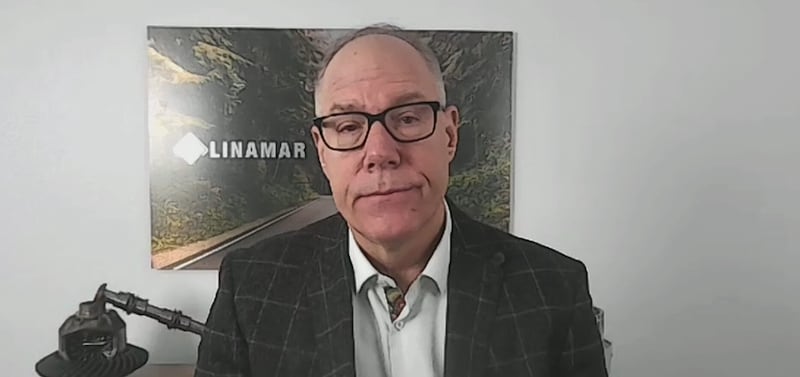
Read the full transcript below:
ROGER: The Canadian auto parts manufacturer Linamar Corp. reported $169.2 million in net earnings in its latest quarter, up from $138 million during the same period a year earlier. We are joined today by Jim Jarrell. He is the CEO and president of Linamar. Jim, thanks very much for joining us today.
JIM: Good morning, great to be here.
ROGER: What led to those numbers?
JIM: I think overall, I mean, the higher sales and earnings in our mobility sector, which really was based on launches that we’ve been, you know, going through over the last few years. Certainly a few key platforms that we have, you know, higher content on were really a driving force. I would say certainly operational improvement, elimination of waste through all of our teammates globally, definitely looked at fixed and overhead costs. And, you know, I think again, with that mobility side being very positive, you know, we had some declines, certainly on the agricultural side, based off a lot of the geopolitical things going on. But really, I think those would be the three big areas that really gave us that boost.
BRYDEN: Hi, Jim, thanks for being with us. On that mobility side, as you said, the numbers look really good this quarter. With results like this, are you gaining confidence in some of the investments that you’ve made on the mobility side in the last couple of years really coming through? And does that give you more of an impetus to continue making those capital allocation decisions on the mobility side?
JIM: Yeah, absolutely, I agree 100 per cent on that. We’ve never really shied away from that capital investment. You know, in Canada, in Ontario, we think these are our most productive plants. And a lot of that equipment has been very flexible equipment. I would say 85 per cent of our capital that we invest is flexible and really can drive to any sort of multi-energy strategy in the mobility sector. So I think again, our, you know, capital confidence is extremely, extremely high right now.
ROGER: And on the agriculture you mentioned concerns about geopolitical, I believe. Are those starting to flatten out a little bit, or does it look like that might continue?
JIM: It’s a tough call to say right now. I mean, dealers are concerned. I would say farmer sentiment, though, is pretty good, you know. And I think the farm net income, cash income, is probably up from last year. I’m talking mainly in the U.S. right now, but there’s a US$40-billion sort of subsidy that is waiting to get deployed. And so, in our view, we’ve got to sort of see how that translates into, you know, dealer inventories opening up and the purchases going forward. And I think 2026, what else is going to come through, you know, the subsidy side through the U.S.
BRYDEN: I’m wondering, Jim, also, one of the highlights is, obviously, with the free cash flow that you’ve been generating, a focus on this quarterly release is the buyback and renewing the NCIB. And in light of the environment right now, maybe the acquisition environment might be a little bit more uncertain. Do you feel that there’s a heavy lean that you can have on the buyback in subsequent quarters at this valuation, obviously would likely be accretive? And how does management view buybacks in this kind of environment?
JIM: Yeah, we think buyback is a great tool, but we also balance that out with the opportunities. And I would say to date, there is no shortage of opportunities around the world. I mean, we just announced one of the big things in the quarter was our two acquisitions — one, a company called Aludyne, which is a structural parts mobility company, light-weighting, 13 facilities, 2,400 people; and another in Europe. It was a Georg Fischer facility, a big ductile iron casting, which really drives the off-highway development. That’s one plant with 300 people. Both of those are a billion dollars in revenue, will be accretive day one, will be in our normal range of seven to 10 EBITDA in the mobility sector. And it’s a perfect fit strategically. So there is a ton of opportunity really around the world. And it’s, you know, we keep a healthy balance sheet. And so then we would balance that against, you know, the share buyback. We’ve done 1.1 million a year to date. And so we will keep, you know, those tools in the toolbox. But certainly, that is one of our strategies.
BRYDEN: On that note, Jim, would you suggest that mobility continues to be a core focus on M&A? And obviously your dominance in the industrial market is what it is, but do you continue to look at the mobility segment as a place to do incremental M&A?
JIM: I would say both. Again, like, I think the mobility side has a massive amount of distress in it, you know, due to the EV changes right over the last, you know, five years where, you know, EV was the game. Five years ago today, it’s very much a multi-energy strategy. And so, you know, that has created a lot of opportunity for companies with a healthy balance sheet. But I’d say on the other side as well, the industrial side, there’s a lot of things that are coming to the table as well. So, you know, again, what’s the best return for the shareholder? What is the best technology for us to grow? And then certainly, you know, can we integrate that with our management team, and what talent are we bringing to the table?
ROGER: Just want to — I mean, it’s the two things everybody’s been talking about: tariffs and also the government shutdown that went on for 43 days. Have you managed to work with those? And was the shutdown any kind of an impact as you tried to move back and forth across the border?
JIM: Shutdown — really, there was very, very little impact to us on that. I mean, tariffs have certainly, you know, gotten a little bit more complex over the last few months. I mean, you know, we’ll see what happens with the IEEPA, but the tariff court decision in the U.S., that really didn’t have a lot of impact. But where we are seeing some impact, mainly on the industrial side, is on the 232 tariffs around the aluminum and steel. And it’s manageable — it is hitting us a little bit, but that’s again where we’re seeing most of it. Because, again, you know, three months or two months ago, they came out with, you know, new HS codes — 407 of them — on the steel and aluminum. And then they’ve now created another tranche that’s under investigation of 500. So I think a lot of these things that may not stand on IEEPA may get dumped over into the 232 tariffs.
ROGER: Okay, Jim, thank you very much for joining us today.
JIM: Okay, guys, great. Thanks.
ROGER: Jim Jarrell is the CEO and president of Linamar.
---
This BNN Bloomberg summary and transcript of the Nov. 13, 2025 interview with Jim Jarrell are published with the assistance of AI. Original research, interview questions and added context was created by BNN Bloomberg journalists. An editor also reviewed this material before it was published to ensure its accuracy and adherence with BNN Bloomberg editorial policies and standards.

