Westhaven Gold is moving ahead with development of its Shovelnose project in southern British Columbia after finalizing an $85 million earn-in agreement that allows Dundee to acquire up to a 60 per cent interest. The transaction is designed to accelerate drilling and technical work in the Spences Bridge Gold Belt.
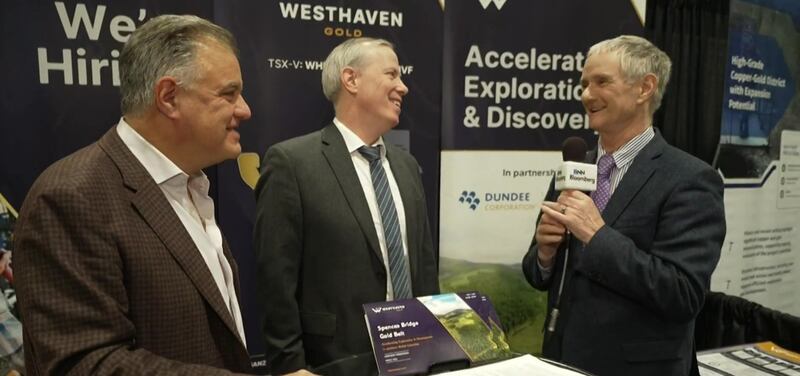
BNN Bloomberg spoke with Ken Armstrong, president and chief executive of Westhaven Gold, and Jonathan Goodman, president and chief executive of Dundee Corporation, at the PDAC convention about the structure of the partnership, the project’s grade profile and the timeline toward potential mine development.
Key Takeaways
- Dundee can earn up to a 60 per cent interest in four Spences Bridge Gold Belt projects by funding $85 million in staged expenditures.
- An initial $30 million commitment by February 2029 would secure a 25 per cent stake, with further milestones tied to higher ownership levels.
- The first phase includes 50,000 metres of drilling aimed at expanding and upgrading resources at Shovelnose.
- The deposit carries a resource grade of just over six grams per tonne gold, with additional silver credits, positioning it as a higher-grade epithermal system.
- A 2025 preliminary economic assessment outlined an 11-year underground mine with a $454 million after-tax net present value and a 43.2 per cent internal rate of return based on base-case assumptions.
Read the full transcript below:
ROGER: Our Andrew Bell is at the PDAC Mineral Exploration & Mining Convention today, catching up with some of the sector’s most influential voices. Let’s go to him now. He’s standing by with the CEOs of Westhaven Gold and Dundee. Andrew?
ANDREW: Thanks very much, Roger. Yes, we’re at PDAC, the world’s largest mining convention, and of course doing deals is one of the main reasons for this gathering. I’m joined by two mining executives who struck a deal in December.
Ken Armstrong is president and chief executive of Westhaven Gold. Great to have you here.
KEN: Thanks for having me.
ANDREW: And we’re also joined by Jonathan Goodman, president and chief executive of Dundee Corporation. Jonathan, great to see you.
JONATHAN: Thanks, good to see you, too.
ANDREW: Let’s talk about the project. You’re in southern British Columbia. A lot of the buzz has been about the Golden Triangle in the north, but your focus is on building a mine at Shovelnose.
KEN: Yes, southern B.C. is less talked about than the Golden Triangle, which has been well marketed in northern B.C., but southern B.C. has just as strong an endowment in terms of mineral potential. There are operating copper mines nearby, including Highland Valley, the largest copper mine in Canada, which is close to our project.
We’re advancing a gold project — an epithermal gold-silver deposit discovered by Westhaven about six or seven years ago. It’s in a great location, about a two-and-a-half-hour drive from downtown Vancouver along the Coquihalla Highway. Anyone travelling from the Lower Mainland into the Interior has crossed our claims. We reached the point where we needed to determine the best way to fund and advance the project.
ANDREW: Jonathan, when you did the deal with Westhaven, you committed up to $85 million to earn into what is effectively a joint venture. Westhaven’s market capitalization was about $40 million at the time, which limited its ability to raise large amounts of capital. You saw an opportunity to accelerate development.
JONATHAN: That’s right. We didn’t believe the market capitalization reflected the quality of the asset at Shovelnose. When projects reach the stage where infill drilling and development work are needed, raising that scale of capital can be difficult.
We saw an opportunity to structure a win-win transaction that would allow the project to be advanced more quickly and appropriately funded. We’re very excited about it, and there’s shared enthusiasm on both sides.
ANDREW: Ken, talk about the grade of the deposit.
KEN: The current resource grade is just over six grams per tonne gold, with roughly 30 grams per tonne silver on top. It’s an epithermal style of mineralization, which is relatively rare in Canada compared with Archean deposits.
Globally, comparable deposits would include Fruta del Norte. That’s the style of system we see here and the type of upside potential we believe exists.
ANDREW: And these rocks are relatively young by Canadian standards.
KEN: Yes. They’re about 100 million years old, which in Canadian geological terms is quite young.
ANDREW: Jonathan, tell us briefly about Dundee. You have a sizeable mining-focused portfolio.
JONATHAN: We have about a $450 million portfolio, along with close to $200 million in cash. We invest in mining companies and rely on a strong in-house technical team.
We look for projects that may be overlooked and conduct thorough due diligence before committing capital. That includes reviewing geology, resource estimates and project organization. In this case, we were impressed with how the data was presented and managed.
ANDREW: Ken, under the agreement, Dundee can earn up to a 60 per cent interest, with Westhaven retaining 40 per cent. This is structured as a partnership.
KEN: Exactly. Dundee can earn up to 60 per cent, while Westhaven retains 40 per cent. It’s structured as a true partnership. In recent years, some joint ventures have left juniors with very small residual stakes. That’s not the case here.
This structure allows us to meaningfully invest in the project and move it forward at a pace we couldn’t have achieved independently.
ANDREW: Jonathan, mining projects still take years before production begins.
JONATHAN: They do. The process is deliberate for a reason. We need to complete the technical work and de-risk the project properly. While timelines can be long, that discipline helps avoid costly mistakes and improves the likelihood of long-term success.
ANDREW: Ken, briefly about your background.
KEN: I began my career with Kennecott and Rio Tinto at the Diavik mine. I’ve worked within this group for much of my 30-year career. My background is technical, and this partnership gives us the opportunity to build on the discovery and move toward production. We also believe there is potential for additional deposits along the belt.
ANDREW: Jonathan, you’ve attended many PDAC conferences. What has changed?
JONATHAN: The event has grown significantly. With stronger gold prices, there’s optimism in the sector. But fundamentally, PDAC remains the premier global mining conference and an important place to build relationships and evaluate opportunities.
ANDREW: Ken Armstrong, president and chief executive of Westhaven Gold, and Jonathan Goodman, president and chief executive of Dundee Corporation. Thank you both.
---
This BNN Bloomberg summary and transcript of the March 2, 2026 interview with Jonathan Goodman, president and chief executive of Dundee Corp. and Ken Armstrong, president & CEO of Westhaven Gold Corp. are published with the assistance of AI. Original research, interview questions and added context was created by BNN Bloomberg journalists. An editor also reviewed this material before it was published to ensure its accuracy and adherence with BNN Bloomberg editorial policies and standards.

