As gold trades near record highs and capital flows back into junior miners, one of Canada’s most prominent mining executives is advancing a new gold search in Botswana while helping steer projects in British Columbia and Alaska.
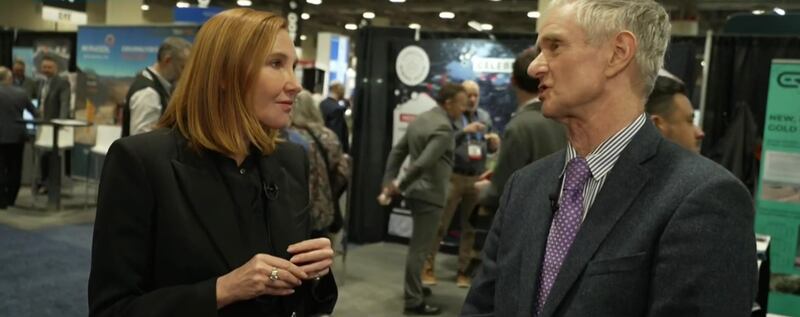
BNN Bloomberg spoke with Eira Thomas, CEO of North Arrow Minerals, at the PDAC convention in Toronto about exploring the Kraaipan greenstone belt in southern Botswana and her role as chair of Westhaven Gold as it advances its Shovelnose project in B.C.
Key Takeaways
- Gold prices near record highs are driving renewed capital flows into junior mining companies after first benefiting major producers.
- Exploration in Botswana’s Kraaipan greenstone belt is targeting underexplored geology masked by relatively shallow Kalahari sand cover.
- Modern exploration techniques, including airborne geophysics and rapid drilling programs, are lowering early-stage discovery costs.
- Strong financing markets can accelerate development timelines, but investors must remain selective as higher commodity prices lift valuations.
- Industry leaders say global demand for critical minerals tied to electrification and energy transition is reshaping long-term mining investment themes.
Read the full transcript below:
ROGER: All right, let’s head back down to Andrew Bell. He’s on the floor of the PDAC Mineral Exploration & Mining Convention, speaking with leaders who shape Canada’s resource sector, including the CEO of North Arrow Minerals. Andrew, take it away.
ANDREW: I’m here with Eira Thomas. She’s been called the queen of diamonds. Sorry, Eira. Of course, she was well known for her role in developing the Diavik diamond deposit, then Stornoway, and more recently she headed Lucara Diamonds in Botswana. She’s broadly out of diamonds for now, but you’ve always got a lot on the go. Thanks for joining us.
EIRA: It’s a pleasure to be here. Thank you very much.
ANDREW: You’re CEO of North Arrow Minerals, right?
EIRA: Yes, I am.
ANDREW: What’s the main focus at North Arrow right now?
EIRA: We’re excited to be exploring an entire greenstone belt situated in southern Botswana. Greenstone belts are known globally for their endowment of all types of metals and minerals. This one hasn’t had a lot of attention, so we’re excited to go in and try to understand the opportunity.
ANDREW: And it’s covered in Kalahari sand?
EIRA: That is the challenge, and that’s the reason it hasn’t had much attention. We’re using modern technology to see beneath the sand cover — a combination of remote sensing techniques using airborne drones. We also have a proprietary drilling setup that allows us to rapidly drill scout holes. Last year, for just over $1 million, we drilled 175 holes and covered more than 70 kilometres of the belt with airborne magnetics. It’s very cost-effective exploration. We identified six anomalous areas that we’re now following up. It’s early days, but we’re excited.
ANDREW: You’re also involved with Westhaven Gold. We spoke to them earlier about a potential mine in B.C.
EIRA: Yes, I’m very excited about that as well. In today’s market, with very strong gold prices, it’s about picking companies that have a real chance of seeing their projects through to the finish line during this gold cycle. What I like about what Westhaven is doing is that it’s on the path to full-scale feasibility and ultimately a production decision, while continuing to explore. I’m also involved in a third project in Alaska that has the potential to advance during this cycle.
ANDREW: Tectonic Metals?
EIRA: That’s right, Tectonic Metals.
ANDREW: With gold above $5,000, do you just have money being offered to you?
EIRA: It’s a big change from where we were even a year ago, particularly in the junior space. We’ve seen buoyant gold prices for a while, which first benefited the majors and mid-caps. Now that capital is flowing into juniors. Funding is more readily available. Tectonic is a case in point. We aimed to raise about $30 million to advance a new discovery in Alaska, and the financing was significantly oversubscribed. We’re closing at about $92 million versus the $30 million we initially targeted. That shows there’s appetite for quality projects in strong jurisdictions with experienced management teams.
ANDREW: There’s always a risk that higher gold prices make marginal deposits look attractive.
EIRA: That’s true. But there are still many quality projects that haven’t received attention. I don’t think we’re at the stage where it’s so frothy that we’re looking at the bottom of the barrel. There are good projects still waiting for their moment. Investors do need to be discerning, though.
ANDREW: How deep is the Kalahari sand where you’re working?
EIRA: I’m glad you asked. Many people assume the sand is hundreds of metres thick. In the areas where we’ve made early discoveries, we’re dealing with less than 10 metres of sand cover. That’s very manageable in a mining context.
ANDREW: Do you detect a buzz at this year’s PDAC, with copper and gold near record highs?
EIRA: There’s definitely a buzz. Anthony Vaccaro from The Northern Miner mentioned recently that mining is cool again. There’s growing recognition globally that we’ll need minerals of all types to support the energy transition. At the same time, the geopolitical environment is also contributing to positive momentum. It’s a very interesting time to be in minerals exploration and development.
ANDREW: Our economies run on real things, not just apps and AI.
EIRA: Absolutely. Your smartphone alone contains dozens of critical minerals. That reality is becoming more front and centre. It’s also important as we try to attract younger generations into the industry. If you look around this convention, there’s a lot of grey hair. We need geologists, finance professionals, lawyers, environmental scientists — the next generation of leaders.
ANDREW: Any plans to retire?
EIRA: Not anytime soon. This is more fun than it has been in a long time. The past few years were challenging, but I’m delighted to keep doing what I love — searching for the minerals the world needs.
ANDREW: When you were running Lucara Diamonds, you were living in Antwerp.
EIRA: Yes, I was. I loved it. Being in the same time zone as the mine made travel easier, and gaining a European perspective was valuable.
ANDREW: Eira, thank you very much.
EIRA: Thank you.
ANDREW: Eira Thomas, CEO of North Arrow Minerals.
---
This BNN Bloomberg summary and transcript of the March 2, 2026 interview with Eira Thomas are published with the assistance of AI. Original research, interview questions and added context was created by BNN Bloomberg journalists. An editor also reviewed this material before it was published to ensure its accuracy and adherence with BNN Bloomberg editorial policies and standards.

