Oracle shares jumped after the company beat third-quarter earnings estimates and raised its revenue guidance, underscoring strong demand for artificial intelligence infrastructure.
BNN Bloomberg spoke with Rob Oliver, senior research analyst at Baird, who says Oracle’s expanding cloud business and role in AI computing position the company for potential long-term growth despite heavy capital spending.
Key Takeaways
- Oracle’s third-quarter results beat expectations, with revenue rising more than 20 per cent year-over-year and cloud revenue growing at a significantly faster pace.
- Demand for cloud infrastructure tied to artificial intelligence training and inference is accelerating faster than supply across the industry.
- Cloud computing is becoming a larger share of Oracle’s overall business as enterprises increase spending on AI infrastructure.
- Large-scale capital spending on data centres is weighing on free cash flow but reflects the investment needed to support AI workloads.
- Analysts say the combination of enterprise data, software applications and cloud infrastructure could support several years of above-average growth.
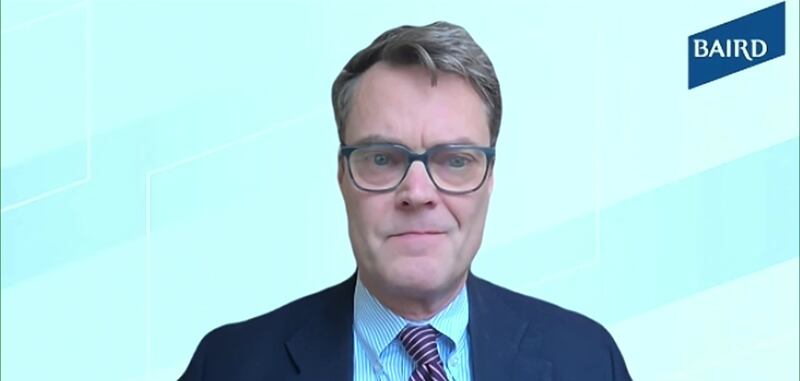
Read the full transcript below:
ROGER: Oracle is soaring after it beat third-quarter earnings estimates and raised its revenue guidance. The stock is still about 15 per cent in the red for the year — roughly 16 per cent right now. It has slipped a little more today, but my next guest sees a path for Oracle to rebound as revenue increasingly shifts toward cloud. Let’s hear from Rob Oliver, senior research analyst at Baird. Rob, thanks very much for joining us.
ROB: Great. Good afternoon. Thanks for having me.
ROGER: What do you like about this earnings report? What’s standing out for you?
ROB: Well, I think first of all the setup into the earnings report was pretty good. Expectations for Oracle were fairly modest. As you said, the stock had underperformed and had pulled back all the way to flat over the trailing 12 months. It was trading directly in line with the IGV software index in terms of performance.
So a lot of the AI hype was out of the stock. Still, there was concern the company was going to have to raise capex, and that was really the main issue. Our view coming into the quarter was that there were some positive things to hang your hat on with Oracle. One was that Oracle’s main customer for infrastructure is OpenAI, and OpenAI secured a US$110 billion funding deal during the quarter. About 60 per cent of Oracle’s backlog, or remaining performance obligations, is associated with that.
That, plus Oracle’s own funding and financing program announced during the quarter, provided investors with more comfort. So I think the stock reaction you’re seeing today is partly some short covering on rising short interest, but also some investors revisiting the longer-term story around Oracle’s ability to manage costs during this very complicated buildout. But also the longer-term story — which I hope we can talk about — which is why Oracle is so well positioned for AI.
ROGER: Well, let’s hear it. Let’s talk about it right now then.
ROB: Yeah. If you go back a decade or so, we saw a lot of big companies that were not infrastructure-as-a-service native players become infrastructure players. Amazon built Amazon Web Services, Google had Google Cloud Platform and Microsoft had Azure. Each of those businesses had other operations they used as a foundation to build those services.
Now we sort of take that for granted. Oracle is attempting something similar with its pivot to become an infrastructure provider, and it’s happening at a pace that’s really unprecedented. Importantly, it’s building on what we think are two of the most important elements driving AI — data and outcomes.
Oracle is the number one provider of enterprise databases globally. And when it comes to outcomes, or inference, Oracle has had a strong position for many years. That goes back decades in terms of turning data into applications and outcomes.
Because of that, we think Oracle sits in a pretty advantageous position relative to where AI is going. In fact, you heard them talk about that last night. I thought it was good they addressed it. Larry Ellison talked about the so-called “death of SaaS trade” and concerns around software. Your previous guest touched on that as well.
It’s obviously a big topic and very important in my world because I follow software. I do think there are legitimate concerns when you have these massive tectonic shifts in technology. But what Oracle said last night was that platform players with data that solve real problems — such as what they’re trying to do with OCI — will be fine. They won’t be disintermediated by AI.
They said the SaaS apocalypse might apply to some companies, but it won’t apply to them. So overall we heard some really good messaging — very crisp messaging — around the finances, the numbers and the plan, along with an overall beat and raise. I think there were also strong indicators about the future of AI for Oracle.
ROGER: You’ve got to admire Ellison when he calls a company the size of Oracle a disruptor. That’s ambitious for a company that big. He says the company can still move and pivot.
ROB: Yeah, it’s pretty amazing. If you go back to the examples I mentioned, Microsoft was flat for the better part of a decade under Steve Ballmer. Many had written it off. Then Satya Nadella came in and turned the business around with a completely different perspective.
At the risk of oversimplifying, we’re in a position right now where every tectonic shift in technology — and I’ve lived through a few going back to the 1990s — brings newcomers that disrupt industries. We’re already seeing that. Some of those companies will make it and some will even become household names.
But there are also companies that, because of scale, presence and most importantly a culture of innovation, can reinvent themselves at key moments. I would say Oracle has really embraced that path when many thought it would not be able to do it.
They’re leaning heavily into OCI infrastructure, which they see as a vehicle not just to deliver infrastructure for AI but also the full AI experience. That goes back to what I was saying earlier about data and outcomes.
ROGER: And I know Larry Ellison — he’s not running the company day-to-day anymore, but he’s still executive chair and technology chief. Any concerns about his involvement in the Paramount deal and whether that could take his focus away from Oracle?
ROB: Good question. I know his son is involved with that and Larry has made some comments about it as well. We’ve gotten questions from investors about it. I’m not a media expert by any means, so we don’t have an official view.
To the extent that it starts to affect Oracle or Ellison’s stock holdings, we would obviously look into it more closely. But at this point I would say Oracle is executing on a master plan. It’s a complicated one — taking a historically asset-light software company and transforming it into a much more asset-intensive infrastructure business. That’s not easy.
They’re doing that right now, and I think last night’s quarter indicated they’re on good footing early on. They also provided updated comments on gross margin for the infrastructure business, which came in above 30 per cent and was viewed positively by the Street.
Another concern had been whether they might be losing money on some of these deals. They’re not, and management has been clear that they won’t.
ROGER: Okay, we have to wrap it up there. Rob, thanks very much for joining us.
ROB: Great. Thanks for having me.
ROGER: Rob Oliver, senior research analyst at Baird.
---
This BNN Bloomberg summary and transcript of the March 11, 2026 interview with Rob Oliver are published with the assistance of AI. Original research, interview questions and added context was created by BNN Bloomberg journalists. An editor also reviewed this material before it was published to ensure its accuracy and adherence with BNN Bloomberg editorial policies and standards.

