Descartes Systems reported stronger-than-expected fourth-quarter results, with revenue, profit and cash flow rising year over year as the company expands artificial intelligence capabilities across its global logistics network.
BNN Bloomberg spoke with Edward Ryan, CEO of Descartes Systems, about how tariffs, geopolitical tensions and supply chain disruptions are influencing demand for logistics software and shaping the company’s strategy for acquisitions and AI integration.
Key Takeaways
- Revenue rose 12 per cent to $729 million while adjusted EBITDA increased 16 per cent, reflecting continued demand for logistics and supply chain software solutions.
- Artificial intelligence is already improving research and development productivity, shortening product development cycles from roughly a year to as little as one or two months.
- AI is expected to shift some enterprise software pricing models away from seat-based licences toward transactional or usage-based structures.
- Tariff changes and trade policy uncertainty are increasing demand for tariff, duty and sanctions data used by global supply chain participants.
- Geopolitical disruptions that affect shipping routes and transit times can increase reliance on logistics optimization and trade compliance software.
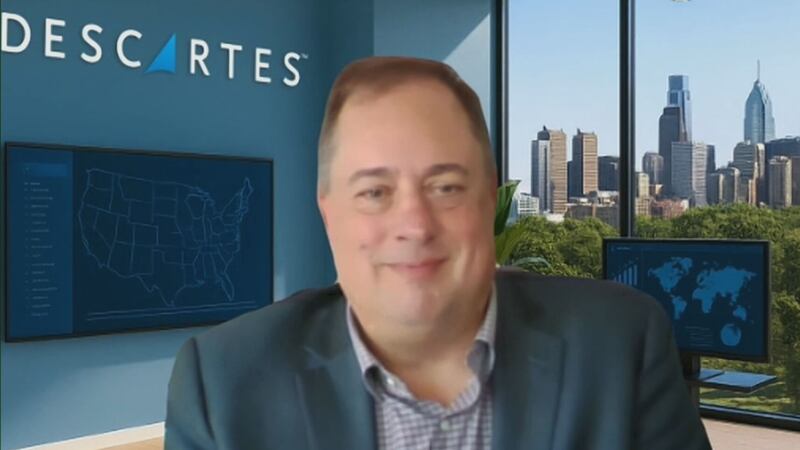
Read the full transcript below:
ROGER: Descartes Systems reported a beat in its fourth quarter, exceeding expectations across all key metrics and showing early momentum in its AI strategy. Let’s get more now from Edward Ryan, CEO of Descartes Systems. Edward, thanks very much for joining us today.
EDWARD: Thanks for having me.
ROGER: Your revenue was up in a year when a lot of people may have been worried about where software — and the broader tech sector — might be heading. You had a good year. What did you do right in 2025?
EDWARD: Yeah, things are good. Things are going great. There was a little turmoil in our industry in the early parts of the year with all the tariff uncertainty, and people weren’t sure whether they should ship or not. That’s largely going away now, and the new tariff regime in the U.S. is a lot simpler for people to deal with.
So that’s been very good for us. Shipping has picked back up, and the number of transactions that we’re processing is going right along with it. That’s where you’re seeing great numbers out of us.
Then there’s the other part of it. We run the largest database of tariffs and duties and sanctioned parties in the world, and that’s always been going well because people are trying to access that information on our network to figure out what to do. We had strong momentum there the whole year.
Unfortunately, some of the tariff issues in the beginning of the year slowed shipping down. But since then — over the last two quarters — it’s been going great, and I expect that’s going to continue.
ROGER: And have you found that, in some ways, tariffs have been a bonus for you?
EDWARD: Oh yeah. We operate the largest tariff and duty database in the world and the largest sanctioned-party database in the world. Most supply chain participants use our information to figure out what they’re going to do and where they’re going to ship things to and from.
Every day those tariffs are changing. There’s more reason for people to use our systems to deal with the complexity they’re facing in the market, and that’s been good for us all the way through.
ROGER: And you’re sitting on about $356 million in cash and another undrawn $350 million credit facility. What are you looking to do with that capital?
EDWARD: We’re a very inquisitive company. We always have been. A lot of tech companies have been hit with AI concerns, but we think it’s a big tailwind for us and a big advantage over time. I think you’re going to see us continue to buy assets in the space to take advantage of it.
ROGER: Any particular areas you can talk about, or are you casting a wide net?
EDWARD: We have a lot of things in the pipeline — without naming names. About 20 per cent of our business is in global trade intelligence, and assets in that space are attractive to us.
Certainly, any network that competes with us in the logistics and supply chain space is something we’re very interested in. Transportation management tools and supply chain visibility tools are also great spaces for us. There are a lot of assets there that we think could be a good fit in the long run.
Finally, the e-commerce space is one where we’ve probably done about 10 acquisitions over the past seven or eight years. I think you’ll see us continue to deploy more capital to buy things in that space because the first ones went so well for us.
ROGER: You called AI a tailwind for you. A lot of people are looking at AI as a headwind for software. How are you incorporating it, and how do you see it as an advantage?
EDWARD: First of all, people lump us in with enterprise software. I’d say we’re probably more inter-enterprise software. We run something called the Global Logistics Network that processes transactions for our customers.
We think that gives us a proprietary set of data that’s going to be very valuable in the future to run AI routines and generative AI agents against. It’s going to provide a big opportunity for our customers to operate more efficiently and save money.
ROGER: You’re running about 15 per cent of revenue through seat-based pricing. As AI agents become more common, how do you integrate that into your pricing model?
EDWARD: It’s 15 per cent of our revenue. It’s a minor part of our business. We’ll probably end up changing that as agents come into the space. We’re likely going to provide customers with a lot of those agents, and we may change the pricing model.
But even today, customers pay a certain amount per month and have a monthly minimum. I don’t think there will be a material change in the near term. Over the next five years, you might see it evolve toward something more like transactional pricing or a bundled package based on the size of a customer’s business.
ROGER: You reduced headcount by about seven per cent. As AI adoption grows, do you expect larger reductions, or might staffing grow in other areas?
EDWARD: We’re already getting efficiency gains from AI. But we’re largely reinvesting those savings back into the business and adding more functionality for customers.
Right now, we haven’t been using AI to lay employees off. We’ve been using it to improve efficiency and deliver more functionality. We think that’s the right way to handle it.
ROGER: Can you put a number on those efficiency gains?
EDWARD: I probably shouldn’t put a specific number on it, but it’s significant. We’re able to produce a lot more code right now and roll out functionality that five years ago might have taken a year. Now we’re talking about a month or two.
Ideas come to fruition much more quickly. We don’t need as many developers to do it, and the nature of the work is changing. We have more product managers coming up with ideas and helping execute them. That’s been a real positive for us.
ROGER: One last question — geopolitical tensions and the conflict involving Iran. Is that having any impact on your company?
EDWARD: Minor right now, but I think it could have more impact in the future. These events put pressure on our customers, increase transit times and add complexity.
Customers usually end up using our systems more to figure out what to do. These kinds of disruptions have typically been a net benefit for us, and I suspect the same will happen here. Over the next couple of months, we’ll see how long the conflict continues.
ROGER: Edward, thanks very much for joining us today.
EDWARD: Thank you, Roger.
ROGER: Edward Ryan is the CEO of Descartes Systems.
---
This BNN Bloomberg summary and transcript of the March 12, 2026 interview with Edward Ryan are published with the assistance of AI. Original research, interview questions and added context was created by BNN Bloomberg journalists. An editor also reviewed this material before it was published to ensure its accuracy and adherence with BNN Bloomberg editorial policies and standards.

