The technology sector is watching closely as Nvidia opens its annual GTC conference, where chief executive Jensen Huang is expected to outline the company’s next generation of artificial intelligence chips and infrastructure.
BNN Bloomberg spoke with Dan Rohinton, portfolio manager at iA Global Asset Management, about Nvidia’s growing role in AI computing and how geopolitical tensions tied to oil markets and U.S.-China relations may influence broader market volatility.
Key Takeaways
- Nvidia’s GTC conference is expected to focus on new AI infrastructure and potential next-generation chips following the Blackwell architecture.
- The company may showcase technology designed to strengthen its position in AI inference, the stage where trained models generate real-world responses.
- Investors are watching whether Nvidia can extend its dominance beyond AI training into inference workloads.
- Nvidia’s valuation remains a key debate for investors despite strong demand from major cloud and data centre spending.
- Geopolitical tensions tied to oil supply routes and U.S.-China relations could continue to drive market volatility.
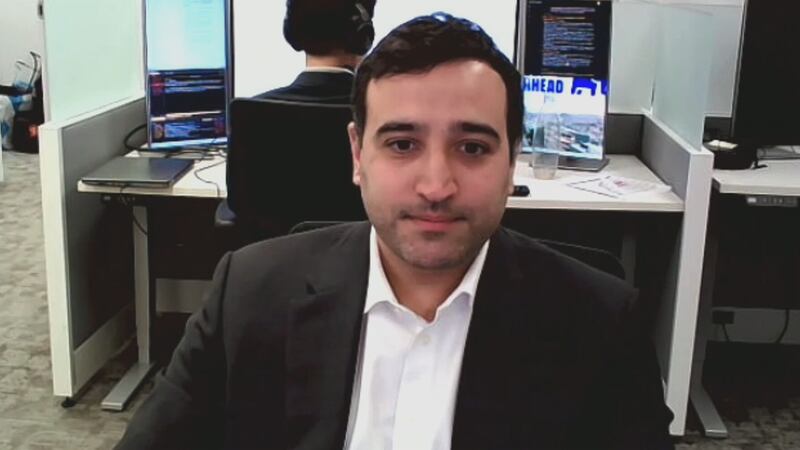
Read the full transcript below:
LINDSAY: Well, all eyes in tech will be on Jensen Huang today as Nvidia kicks off its GTC conference. It’s expected that a brand-new chip will be unveiled. Here to tell us more is Dan Rohinton, portfolio manager at iA Global Asset Management. It’s good to have you join us. Thanks so much.
DAN: Deal.
LINDSAY: Okay, Dan, let’s talk about this new chip that’s expected to be announced today. What are you expecting around this announcement and around this new chip?
DAN: Yeah, so there are two elements to it, right, Lindsay? There’s the server — the Groq chip, which is ultra-fast for really specific use cases — a platform they’re expected to talk about. Then there’s also the next generation after Blackwell, which is Fineman, and that’s something that’s going to be rolled out in mid-to-late 2028.
We actually saw adjacent with the Nvidia news and expectations that Meta is partnering with Nebius, and that half of that Nebius allocation is the new-generation Fineman chip. So Nvidia is already racking up orders for product they haven’t fully even announced yet.
So it should be clearly bullish. The question is just how bullish it is for investors versus their already high expectations.
LINDSAY: You say this is the first time Nvidia is putting another company’s processor directly into its own server racks. Can you talk about just how significant that is?
DAN: It’s actually one of the biggest criticisms of Nvidia, despite everything Jensen has done well — the belief that they don’t have the same monopoly in inference, which is us actually talking to ChatGPT or Claude or what have you, versus training those models.
So Nvidia dominates training, but it’s a little more nebulous whether they dominate the inference side. This type of chip is very inference-focused and very fast at it, especially for things like coding use cases.
So what you see here is really an opportunity for Nvidia to prove through their Groq platform that they are winners not just in training, but also where the future is going, which is inference. I think they’ll do a good job at it, but that is the real tale of the tape this afternoon.
LINDSAY: Do you expect to see the stock price go up after this? What are you expecting to see this week after this announcement is rolled out by Nvidia? Maybe a little bit of good news for the company?
DAN: I think the stock is pretty cheap at this point. When we’re talking about all of the positive data points we hear about memory or the big cloud computing companies spending all this capital, all roads effectively lead through Nvidia.
I know the stock has been up almost 60 per cent over the last year, but the valuation is actually some of the cheapest it’s been in a decade. So I think Nvidia is a buying opportunity today, and I think this event is the start of a catalyst path for us to start seeing the stock cross into the $200-plus range.
So we’re pretty optimistic, and we’re buyers today.
LINDSAY: Okay, let’s move on. We’re going to talk about the volatility in the market, but obviously that’s influenced by a lot of geopolitical factors happening right now.
I want to hone in on that meeting between U.S. President Donald Trump and Chinese President Xi Jinping that was supposed to happen at the end of the month. Donald Trump is saying he may delay that meeting if China doesn’t step into what’s happening in the Middle East and try to intervene in some way.
What do you think about what’s going on there? Do you think Donald Trump will actually delay this meeting? It’s supposed to be March 31.
DAN: I think there’s a lot of back-and-forth negotiation that goes on with these types of high-stakes issues. I’ve always said when we’ve had conversations that all roads lead to the U.S. and China. Everywhere we talk about it, that rivalry is driving every single decision.
So the fact that China is looped into the Iran situation is inevitable, because China buys almost 40 per cent of the oil that comes out of that strait, and the vast majority of Iran’s oil goes to China.
So this is basically Trump saying to China — it’s not that there’s going to be a military escort with Chinese characteristics. It is effectively Trump telling China to tell Iran to stop attacking U.S. ships. That’s effectively the way I see it.
If China says yes, the summit is probably on. If China says no, thank you — which they’re likely to do — then it’s probably going to get more complicated from here.
LINDSAY: And if China does say no, thank you, then delaying this meeting could actually be a win for China.
DAN: Potentially a win for China — it depends what China is giving up. One thing I would say at a high level — and this is a slight tangent — is that every day oil prices are $100 or higher is bad news for China.
When you think about the biggest oil importer on a dollar basis, that is China itself. So China does not want crude prices up 40 per cent year over year. They would much rather have $30 crude than $100 crude.
So it is in China’s best interest that crude flows freely, consistently and at low prices, because they are consumers of energy, along with India, Pakistan and much of the Pacific Rim.
So they could win from a rhetorical standpoint by delaying the summit, but from an economic standpoint this is doing disproportionate harm to the Chinese economy.
LINDSAY: When we take a look at markets, we’ll probably see more volatility, particularly when it comes to the price of oil this week. Dan, as we enter the third week of this war in the Middle East, what do you expect to see there?
Are there any developments in the near future? Obviously the Strait of Hormuz is apparently shut — more controlled than actually shut — but not a lot of oil is getting through that avenue at the moment.
DAN: I would say there’s a belief that the U.S. is losing this war. I would take the opposite side of that. I think it’s very obvious the U.S. is winning — it’s just a question of timeline.
Conflicts, even short ones, last weeks if not months. Saying it’s been a few weeks and things aren’t going exactly to plan misses the point that Iran doesn’t have ballistic missile launches coming through, the suicide drone attacks have come down significantly, and their command and control is in disarray.
So I would say by most military metrics the U.S. is winning.
Where the economic impact happens from here is if the Strait of Hormuz operates as it is now. I don’t think it’s sustainable where Iranian and Chinese crude gets through but U.S. and allied crude does not.
So either we see a full closure — which I don’t think anyone wants, including Iran, because that’s where they earn their income — or a complete reopening. I think we’re approaching that binary outcome.
LINDSAY: Interesting stuff. Okay, we’ll leave it there. Dan Rohinton, portfolio manager at iA Global Asset Management. Always good to get your opinion. Thanks so much.
---
This BNN Bloomberg summary and transcript of the March 16, 2026 interview with Dan Rohinton are published with the assistance of AI. Original research, interview questions and added context was created by BNN Bloomberg journalists. An editor also reviewed this material before it was published to ensure its accuracy and adherence with BNN Bloomberg editorial policies and standards.

