Porter Airlines is accelerating its growth strategy with the launch of a new airport in Montreal, expanding its network and increasing capacity across key markets.
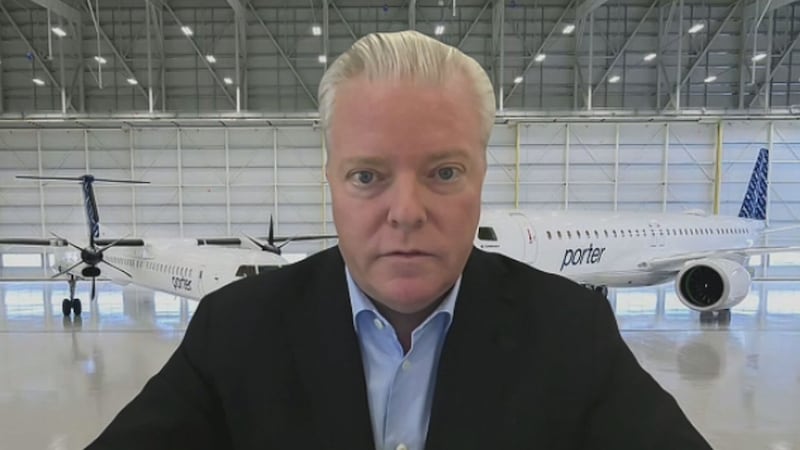
BNN Bloomberg spoke with Michael Deluce, CEO of Porter Airlines, about how the Montreal Metropolitan Airport, fleet expansion and shifting cost pressures are shaping the airline’s next phase of growth.
Key Takeaways
- Porter is launching operations at the Montreal Metropolitan Airport with 12 domestic routes and 138 flights in its first week.
- The new airport is positioned as a major alternative hub, offering shorter travel times for many Montreal-area passengers.
- Strong early demand suggests appetite for additional airport capacity and alternatives to existing infrastructure.
- Expansion is supported by a growing fleet of Embraer E195-E2 aircraft, enabling broader North American reach.
- Rising fuel prices remain a key watchpoint, though strong fares and demand are supporting revenue growth.
Read the full transcript below:
ROGER: Porter Airlines is facing expansion with a growing fleet and more routes. It’s partnered with Macquarie Asset Management on a multi-million-dollar investment to build and operate a new terminal in Montreal. Here to discuss how regulation, infrastructure and growth plans could impact the airline’s long-term outlook is Michael Deluce, CEO of Porter Airlines. Michael, thank you very much for joining us.
MICHAEL: Yeah, thank you for having me.
ROGER: We have to get it out of the way. I want to ask you your thoughts on what’s unfolding with Air Canada. Can we get some thoughts on the news that the CEO is stepping down?
MICHAEL: It’s not really our place to comment. I had a lot of respect for Michael Russo and thought he did a great job at Air Canada, and it’s unfortunate, sort of, the recent events that really led to this. But Michael did a very strong job leading Air Canada, and the recent sort of events are unfortunate.
ROGER: Okay, and let’s talk about what’s happening with Porter. Montreal airport — you’re getting ready to take off in June. What are we going to see coming out of that airport? That’s an ambitious project.
MICHAEL: So last Tuesday, we opened to the media the new terminal at Montreal Metropolitan Airport, also known as the MET, and it is the single most ambitious launch of a new airport by any airline in this country. We are starting on June 15, 12 new destinations all in the first week of operations, with 138 flights, and the MET terminal and its location will transform air travel in Montreal. The airport is conveniently located for 50 per cent of the residents of Montreal. It’s a faster on-the-ground drive time to the MET. But for visitors coming into Montreal, this is a much easier way to get to downtown Montreal. And you can see on the photos you’re showing that, much like the Billy Bishop airport, which we developed back in 2006, this is a comfortable, business-class lounge-type environment for all passengers, regardless of aircraft type or which airline you travel with, and it will truly transform and make Montreal air travel easy again.
PHILIP: Michael, it’s Philip Peterson. I have to ask, with oil prices where they are and jet fuel prices increasing, how is Porter adjusting to this higher price regime?
MICHAEL: Well, everyone’s watching that closely. We’ve seen fuel prices rise fairly dramatically over the last month. We are seeing a very strong revenue environment at Porter. Fares are up significantly on average as we continue to see maturation of our route network. But all airlines worldwide are really watching what happens over the coming weeks and months with fuel prices and see if further adjustments are needed.
ROGER: And going back to the Montreal airport, the Metropolitan — still not officially a metropolitan, if I’m not mistaken — you’re only doing domestic flights. Is that enough? Is there enough volume there for you?
MICHAEL: Absolutely. We’ve launched 12 domestic routes, really coast to coast — Vancouver, Calgary, Edmonton, all the way out to Halifax and St. John’s. And I can tell you, we launched sales last Tuesday, and the demand for this airport and an alternative within the Montreal marketplace overwhelmed even our greatest expectations. So there is very strong demand. This clearly is something that will differentiate itself in the market, and eventually, over time, as the airport takes hold, the community loves the airport. If there is a desire for us to look at international flying, whether that be to the U.S. or Mexico, Caribbean, that’s certainly something we’ll look at with all the stakeholders.
ROGER: Now, how would you be able to get that? I thought Trudeau Airport has the exclusivity for international flights.
MICHAEL: Well, back in 1992 they were granted a monopoly over international flying, though that was in a context where the MET didn’t exist, and the MET will be in the marketplace, and really it will divide the city and residents between which airports they each go to. Whenever you have a multi-airport system, people go to the airport that’s most convenient to them. And so the context of ADM having a monopoly over international routes, I think will be something that will be discussed quite extensively, because if you live five minutes away from the MET, why would you subject yourselves to a 50-minute drive across the city in traffic, both from an environmental, ESG perspective, but as well just serving the community? That makes no sense. And so I think the parties will all come together. And there are additional factors as well. Obviously, YUL faces very severe capacity constraints, and so ultimately relieving some of that pressure is a good thing.
PHILIP: And we’ve seen this expansion play out over the last couple of years, expanding into Pearson, expanding into Hamilton, not only with more regional routes but long-haul routes as well. How do you balance or prioritize between the two when you think about expanding to other areas?
MICHAEL: Well, really, we’ve focused our expansion on Eastern Canada, out of Toronto, Ottawa, Montreal, Halifax, but as well out of Hamilton, as you mentioned. And now serving both Toronto airports, and soon to serve both great Montreal airports, we will be the only airline serving both extensively with operations. It is a balance where we dedicate the aircraft resources, but we have taken on a delivery stream of up to 100 Embraer E195-E2 aircraft, which is a state-of-the-art narrow-body aircraft that allows this expansion to really touch all of North America from Eastern Canada.
ROGER: And now going to Billy Bishop in Toronto. The province has said it wants to take over the city’s portion of it. You’ve long pushed for jets there with the port lands developing. How do you balance those two things in that city? Because jets coming in, if I’m not mistaken, would have an impact on any kind of development in the port lands.
MICHAEL: Development in the city has certainly co-existed with the airport for many years. Nothing will change with regard to that whether jets are allowed or not allowed at Billy Bishop. The same parameters exist between development and the airport. Flight paths are protected, and so jets have no downward impact on development of the city compared to what exists today. And the Billy Bishop airport is a clear economic driver for the City of Toronto. Over 90 per cent of residents are highly supportive of the airport, and the province recognized that it is a key economic driver, not only for the City of Toronto but for the province of Ontario, and really that’s why you saw them step in last week with some changes to the overall governance structure of the airport.
ROGER: All right, one last question. Talk of an IPO — is that talk, or is that something that may be happening?
MICHAEL: Right now, we’re focused on executing on our growth plan. We’re fully financed, so there’s not an imminent IPO, but it’s something that, in the longer-term horizon, of course, we’ll eventually look at.
ROGER: Okay, Michael, thank you very much for joining us today.
MICHAEL: Thanks for having me.
ROGER: Michael Deluce is the CEO of Porter Airlines.
---
This BNN Bloomberg summary and transcript of the March 30, 2026 interview with Michael Deluce are published with the assistance of AI. Original research, interview questions and added context was created by BNN Bloomberg journalists. An editor also reviewed this material before it was published to ensure its accuracy and adherence with BNN Bloomberg editorial policies and standards.

