Agnico Eagle Mines maintained its full-year outlook after reporting a revenue beat, supported by strong gold prices and disciplined cost control. The company continues to generate significant cash while advancing long-term growth projects.
BNN Bloomberg spoke with Ammar Al-Joundi, president and CEO of Agnico Eagle Mines, about capital allocation, project development and how the company is positioning itself through gold price volatility.
Key Takeaways
- The company reiterated full-year guidance, citing strong first-quarter production and cost control.
- Elevated gold prices are driving significant cash generation and strengthening the balance sheet.
- Capital allocation remains focused on dividends, growth investment and maintaining financial flexibility.
- Major projects in Canada are expected to support long-term production growth into the next decade.
- The company is positioning itself to perform through both rising and falling gold price cycles.
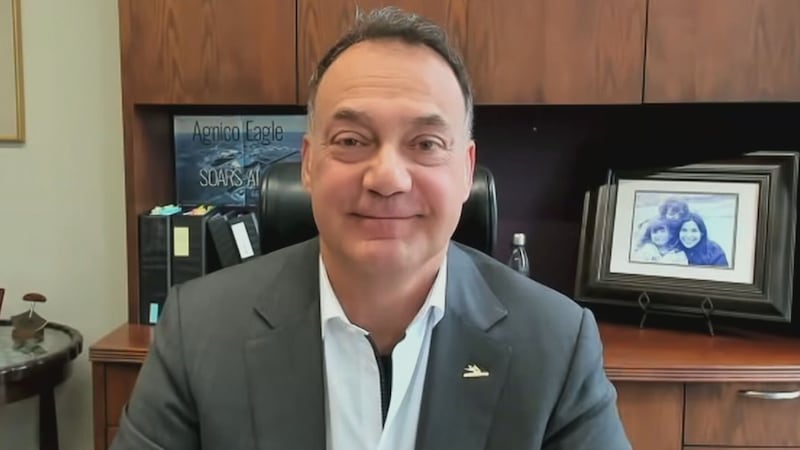
Read the full transcript below:
LINDSAY: Shares of Agnico Eagle Mines are slightly lower, despite reporting a beat in revenue. The Toronto-based company maintained guidance for the year. Joining us now is Ammar Al-Joundi, president and CEO of Agnico Eagle Mines. It’s great to have you join us. Thanks so much.
AMMAR: Nice to be here, Lindsay.
LINDSAY: You reiterated guidance this time around. Why did you make that decision? Why not raise it?
AMMAR: Well, it’s early in the year. It’s the first quarter of the year. We had solid production, very good cost control, and it just seemed the prudent thing to reiterate guidance.
LINDSAY: Is there any geopolitical conflict around the world that is stopping you from maybe raising guidance this early in the year? Is there some uncertainty that you’re seeing later in the year?
AMMAR: No. We look at our business very proactively. Of course, the obvious question is oil price sensitivity. We manage that very well. We have materially less oil price sensitivity versus most of our peers, both structurally in how we operate and in some proactive things that we’ve done. Other than that, Lindsay, the business is going quite well, and we don’t anticipate major issues. And to your question, really, that’s why we wanted to go out and reiterate to our owners that things are going well and our guidance is still sound.
LINDSAY: You also returned meaningful capital to shareholders this quarter. How did you weigh that decision against growth and buybacks?
AMMAR: We’re generating an awful lot of cash in this gold price environment, like our peers. The first thing we do is pay our dividend. We’ve paid a dividend every quarter for 43 years. That’s pretty good for a cyclical company. We are investing heavily into our business. We invested over $400 million in growth projects. We expect to grow the business by about 20 to 30 per cent over the next decade — again, I think the best growth profile in the industry. We made a big tax payment to the Government of Canada, and we were still able to increase our cash position to over $3 billion.
LINDSAY: Which of your projects are going to be fuelling that growth? Is there any one in particular that you have high hopes for?
AMMAR: We have high hopes for a handful of them. Let me go through them. Detour Lake — we think we’re going to be able to get that to producing over a million ounces a year for decades. Canadian Malartic — we think we’re going to be able to get that to over a million ounces a year for decades. We are going to be bringing people up to Hope Bay in the Canadian Arctic to talk about a likely go-ahead decision in May. That will be over 400,000 ounces a year, again, we think for decades. And we’re building Upper Beaver now very quickly. In the entire world, there are maybe only three mines producing a million ounces a year, only one in the Western world. So we expect by the early 2030s, between Detour and Malartic, to have two of only three mines in the Western world producing over a million ounces a year. That says something.
LINDSAY: I wanted to ask about the Finnish acquisition as well, because Finland is obviously a bigger part of the story now with the proposed consolidation in central Lapland. What advantages does this new region offer?
AMMAR: We’ve been there for over 20 years with our Kittilä mine, which is 50 kilometres away. What Agnico has done for almost 70 years successfully is go to regions where there’s a lot of geologic potential and political stability, and try to consolidate land and build a competitive advantage. What this does, by giving us an additional 2,500 square kilometres of what our team thinks is the most prospective land for minerals in all of Northern Europe, is allow us to take the same strategy into Finland — get the best land positions in the best districts in the safest parts of the world, build a competitive advantage, and go from there.
LINDSAY: Is there a timeline for this project? When do you expect permitting to start?
AMMAR: That’s a very good question. It’s a big land package. We’re going to focus initially on the Ikkari project. What we want to do first is freeze the project so that we can start permitting, and the permitting will take a few years.
LINDSAY: Gold prices remain elevated, though they’re down today. With geopolitical and macro uncertainty, we’re seeing volatility to start the year. How do you think about planning the business around these prices?
AMMAR: We have to. We are in a cyclical business. What we do is focus on generating a lot of cash and maintaining a very strong balance sheet. We’ve got over $3 billion of cash and under $200 million of debt. We are among the lowest-cost senior producers. We operate in safe jurisdictions. I think there’s no other senior gold mining company in the world that is as well positioned as Agnico Eagle, not just for increases in gold prices, but also for potential decreases.
LINDSAY: Your company also recently published a sustainability report. Can you give us some key points?
AMMAR: Sustainability isn’t just words. It’s environment, communities and First Nations. Our strategy is to go into regions and stay there for decades, so by definition our business has to be sustainable. I think our team is ahead when it comes to sustainability.
LINDSAY: We’ve seen some of your peers look south of the border for listings and capital access. How do you think about listing geography, and does Agnico feel well served by the Canadian market?
AMMAR: We are extremely well served by the Canadian market, and we have access to investors in the United States and around the world. We’re very happy with our position and don’t see any reason to change that.
LINDSAY: We’ll leave it there. Ammar Al-Joundi, president and CEO of Agnico Eagle Mines. Great to have you on the show again.
AMMAR: My pleasure.
---
This BNN Bloomberg summary and transcript of the May 1, 2026 interview with Ammar Al-Joundi are published with the assistance of AI. Original research, interview questions and added context was created by BNN Bloomberg journalists. An editor also reviewed this material before it was published to ensure its accuracy and adherence with BNN Bloomberg editorial policies and standards.

