Doman Building Materials posted a first-quarter EBITDA beat despite ongoing weakness in plywood, softwood lumber and engineered wood pricing. The company credited disciplined cost management, strategic lumber purchasing and stable demand volumes for helping offset volatility across North American building materials markets.
BNN Bloomberg spoke with Amar Doman, CEO of Doman Building Materials, about the company’s first-quarter earnings, margin pressures tied to Canadian lumber markets, freight optimization efforts and expansion plans across the United States.
Key Takeaways
- Doman Building Materials reported first-quarter EBITDA of $68.1 million, ahead of analyst expectations despite lower pricing across several wood product categories.
- The company said disciplined cost controls and strategic lumber purchasing helped support margins during a volatile quarter.
- Canadian lumber markets remained under pressure as producers competed aggressively for domestic demand amid steep U.S. tariffs on exports.
- Doman said freight optimization initiatives and software rollouts across U.S. operations are expected to improve long-term efficiency and reduce transportation costs.
- The company plans to continue pursuing acquisitions in the United States, with expansion targets including the U.S. northeast, Florida, Colorado and Utah.
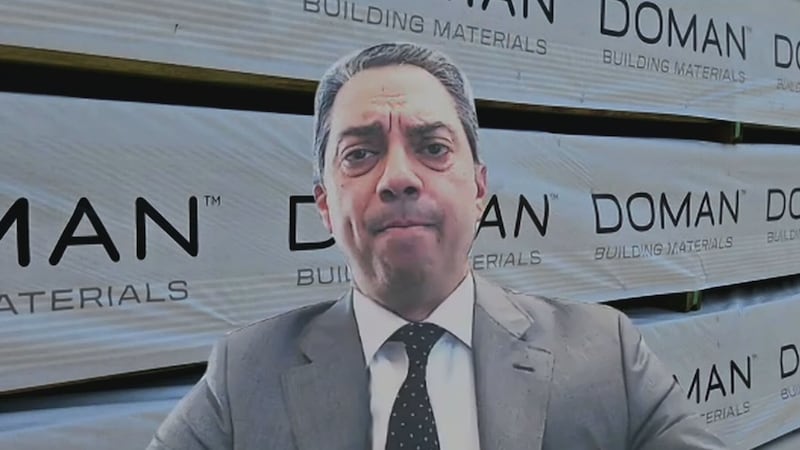
Read the full transcript below:
LINDSAY: Doman Building Materials posted an EBITDA beat in the first quarter despite lower pricing for plywood, softwood lumber and engineered wood. The company says Doman’s focus on cost management is allowing it to navigate these volatile macro trends. Here to tell us more is the CEO of Doman Building Materials, Amar Doman. It’s great to have you join us. Thanks so much.
AMAR: Thanks for having me on.
LINDSAY: A beat in EBITDA this first quarter — what’s behind that?
AMAR: Yeah, a few things factored in. Number one, the volumes were not as bad despite the tough weather we had all over North America. That’s kind of normal, but it was a little more severe. Having said that, we had a little bit of a push in the south on OSB pricing. Our cost control and discipline was excellent.
The Canadian lumber market is very, very tough, with the non-tariff lumber competing for a home, if you will, so that put a damper on that side. As you mentioned, on OSB, plywood and Canadian lumber, the U.S. gave us a little bit of a push toward the end of the third month in the quarter, and that gave us a little push as well.
The gross margins were super strong for us coming out of the gates in the first quarter, so we’re very proud of a strong first quarter for the company.
LINDSAY: You mentioned your strategy for navigating these volatile prices when it comes to plywood, softwood lumber and engineered wood. Can you go into a little more detail on what that looked like?
AMAR: I sure can. A few things happened in the lumber market. Last year, we produced about 2.7 billion feet, which is a ton of pressure-treated lumber for the backyard category in North America. We sell to retailers and pro dealers.
What happened last year was the lumber market was quite poor as the year went along. We’ve got some very seasoned buyers in our company, so we were loading up a lot of lumber to get ready for the spring season, as we normally do. We went a little bit heavier due to the pricing being poor, and some of that reflection came back to us here in the first quarter as we saw pricing improve and got to take advantage of that. So our timing worked out very well.
LINDSAY: You mentioned off the top something about non-tariff Canadian lumber. How exposed are you to U.S. softwood lumber tariffs?
AMAR: The good news with Doman is we’re not exposed at all. Maybe one per cent of our lumber goes across the line. But in Canada, the lumber market is very poor. The Canadian sawmills are in tough shape and they’re competing for Canadian business, which is non-tariff.
Of course, everything that goes over the border faces severe tariffs and duties, so that makes the Canadian market a bit of an auction, and that’s been tougher for us on our margins. Volumes haven’t been terrible in Canada coming out of winter, but it’s the margin that’s been a different story.
LINDSAY: Some analysts see your freight optimization technology and increased fencing production as key drivers of organic growth and margin improvement going forward. Can you tell us how you plan to use these segments of your business to offset some of the volatility you’re seeing?
AMAR: Yeah, we’re doing the best we can with the freight issue. Of course, we try to pass along as much as we can. We can’t pass along everything to our customers. It’s a line item for us. If it costs X to go from A to B and it costs X plus 20, we’ve got to charge the 20.
Of course, we get pushback from our customers and we have to work through that. We’ve had some good freight recovery start to happen from mid-March into April, into the second quarter here, where customers realize it’s a reality.
The Iran situation — anyone’s guess — but it’s not going away anytime soon, so we need to charge those freight surcharges and have them recovered such that they don’t damage our margins. As you can see, we did okay with that in the first quarter. More of that was good buying of lumber, but certainly we’re trying to recover the best we can.
We’re also rolling out freight optimization software across the United States. About 75 per cent of our revenue now comes from the U.S., so we’re really trying to get our freight optimization strategies into all of our branches, where we’re going to see freight costs continue to go down through efficiencies, finding trucks in different regions and really scrutinizing that.
Although trucking has become tougher in the United States due to a lot of drivers going away, it’s been harder and harder, so we’re trying to manage that the best we can.
LINDSAY: I want to talk about Prime Minister Mark Carney’s announcement last month about a $6-billion plan to train 100,000 skilled workers over the next five years. How meaningful of an impact do you think this will have on the industry as a whole, as well as your company?
AMAR: I feel for those workers and I hope they get retrained. I think there have been a lot of press releases over the last decade, and I haven’t seen a lot really materialize from some of these large announcements.
I’d rather see the government help the industry or the workers with some base hits, not these grandiose plans that don’t seem to materialize. Let’s hope they do. That would be good for Canada in general. Let’s hope some of these press releases come to fruition.
LINDSAY: But if it does come to fruition, would that have a meaningful impact for your business to have more skilled trades workers?
AMAR: It would absolutely help, I think, for us and really the construction industry one level away from us — where the nail hits the wood, if you will.
I think trained workers coming out of the sawmills that have sadly closed in Canada are looking for long-term work, and I think that sector would definitely benefit if they’re retrained.
LINDSAY: Looking ahead, does Doman Building Materials have any plans for M&A on the horizon?
AMAR: We do, and we’ve grown through acquisition. We’ve completed 17 since 2009. We’ll continue on the acquisition trail, mostly in the United States. There’s a little bit left in Canada to do in our sector.
When the right valuation comes into play, we will certainly look at buying those businesses. We’re very serious acquirers, and we will continue to buy businesses that make sense, fit into our fold and allow us to leverage volume.
The bigger we get, the better the margins will become because of those operational efficiencies as we continue to grow our footprint in North America.
LINDSAY: That’s what I wanted to ask you about. What do plans for growing your footprint across the U.S. look like?
AMAR: We’re pretty much from Hawaii all the way to the East Coast and down to the Carolinas. The areas where we’re not in the U.S. in any significant way are the northeast and Florida — again, two high-volume regions that we’d like to get into. We’ll get into them when the right transaction comes along, or we’ll greenfield.
Then in the west, Colorado and Utah are areas we would like to be in, and we will be in them — it’s just a matter of time.
LINDSAY: We’ll leave it there. Amar Doman, CEO of Doman Building Materials, thanks for your time.
---
This BNN Bloomberg summary and transcript of the May 11, 2026 interview with Amar Doman are published with the assistance of AI. Original research, interview questions and added context was created by BNN Bloomberg journalists. An editor also reviewed this material before it was published to ensure its accuracy and adherence with BNN Bloomberg editorial policies and standards.

