Agnico Eagle is moving ahead with a major investment in Canada’s Arctic, approving a US$2.4 billion redevelopment of its Hope Bay gold project in Nunavut. The company says the mine could become a multi-decade operation and a major contributor to the territory’s economy.
BNN Bloomberg spoke with Ammar Al-Joundi, president and CEO at Agnico Eagle Mines, about the economics behind the Hope Bay decision, the company’s long-term exploration strategy and plans to expand renewable energy use at the remote Arctic operation.
Key Takeaways
- Hope Bay is expected to produce roughly 450,000 ounces of gold annually at estimated cash costs of about US$950 per ounce.
- Agnico Eagle expects the project to evolve into a multi-decade operation as exploration continues across the broader greenstone belt.
- The company says Nunavut operations account for about 25 per cent of the territory’s economy through employment, procurement and payments to Inuit organizations.
- Plans for Inuit-led wind power projects could eventually provide enough renewable energy to supply the entire mine site.
- The redevelopment underscores growing interest in large-scale Canadian mining investments tied to strategic northern infrastructure and resource development.
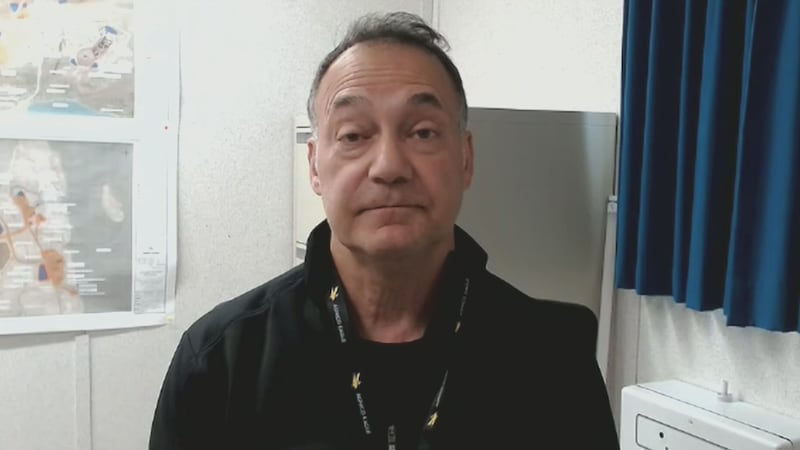
Read the full transcript below:
ROGER: Agnico Eagle is placing a massive bet on the Canadian Arctic. The gold giant announced yesterday that it is greenlighting a US$2.4-billion redevelopment of its Hope Bay project, located in Nunavut, one of the biggest capital commitments in the mining sector this year. Joining us now is Agnico Eagle president and CEO Ammar Al-Joundi. Ammar, thank you very much for joining us.
AMMAR: My pleasure. Great to be here.
ROGER: A big bet you’ve got going on there, US$2.4 billion. Why pull the trigger now?
AMMAR: Well, I think it’s a very safe bet. I think it’s a great investment. This is a fantastic project. It will be producing almost 450,000 ounces a year at cash costs of about US$950. Roger, you know the cash generated by this based on current prices is in excess of US$3,500 per ounce. You work out the numbers, that’s about US$1.3 billion every year of cash generated. So you might say it’s a bet, but I think it’s a pretty fantastic bet, and it’ll make a lot of money for our owners.
At the same time, it’s great for Nunavut. This will be our third operating mine in Nunavut. To put this into perspective, Roger, we represent about 25 per cent of the entire economy in Nunavut. We purchase and do business with over US$1 billion in local entities. We employ 3,700 people up here. We pay about US$600 million a year to various Inuit organizations.
Finally, this is great for Canada. This is a large industrial investment, a large economic investment for the communities in a very strategic part of Canada’s North, right on the Northwest Passage. So it’s a great investment for our owners, it’s a great investment for the community and it’s a great investment for Canada.
ROGER: Now you’ve got the other two mines going up there. Is this one fairly similar, or are there new challenges with this one?
AMMAR: This will be the fourth mine we’ve built in Nunavut. We’ve been here for 20 years. The process plant is really just a copy of something we’ve just built at Meliadine, which is also in Nunavut. Agnico Eagle — I’m proud of everything we do around the world — but I think we are exceptionally good at operating in this kind of environment. Again, we’ve been here for over 20 years and we run a very successful business in Nunavut.
ROGER: I guess one of the things always is power up there, energy costs up there. You’re looking at the $25 million federal funding from the government, a 37-megawatt diesel plant and the 4.2-megawatt Inuit-led wind farm. Is that going to be enough? And diesel — how much of a concern is that? It’s, I believe, 10 per cent of your operating costs?
AMMAR: Yeah, roughly. In this part of the world, you’re not connected to any hydro grid. The distances are massive, as you can imagine. So we operate primarily with diesel. We’ve been doing that for 20 years.
The one thing I would say as an engineer is that while we operate with diesel, we can run much more efficiently because we take all of the heat off the engines to heat the plant and the accommodations.
But you raised a very interesting point. The government is helping us and helping the Inuit community put in place a windmill. It’ll be owned and operated by the Inuit communities. We will buy power from them. So it not only allows us to have green energy, but it creates a long-term sustainable business for the Inuit communities around us.
We’re starting with one windmill, but we’re hoping to have up to five or six. If we get those five or six, that will be enough effectively to supply power to the entire mine — clean power — and create a lot of long-term revenue and business opportunity for the Inuit communities in addition to what they’re already doing with us.
ROGER: You expect an initial 11-year lifespan. Do you think you can expand that? And where do you get the confidence for that?
AMMAR: This is going to be, in my opinion, a multi-decade operation. The way it works, Roger, is you spend money exploring. We’ve hit this very hard. We acquired this five years ago from a company that was going to have a Chinese owner, and the Canadian government wasn’t comfortable with that given the strategic location.
We acquired this five years ago. We hit it hard with exploration. We’ve got a project now that is very profitable. But the way it works in our business is you do exploration until you know you have a profitable project, then you move forward.
We have only just started to scratch the surface on exploration. We’re only at the first 12 kilometres of two parallel 80-kilometre greenstone belts. The areas in this first 12 kilometres are still open at depth, so we are exceedingly confident that this is going to be a multi-decade world-class mine with world-class costs in the best place in the world.
ROGER: My apologies, I have to wrap you up there. We’ve run out of time. We’re on a tight schedule. But thank you very much for joining us today.
AMMAR: Our pleasure.
ROGER: Ammar Al-Joundi, president and CEO of Agnico Eagle Mines.
---
This BNN Bloomberg summary and transcript of the May 20, 2026 interview with Ammar Al-Joundi are published with the assistance of AI. Original research, interview questions and added context was created by BNN Bloomberg journalists. An editor also reviewed this material before it was published to ensure its accuracy and adherence with BNN Bloomberg editorial policies and standards.

