Canada’s ability to attract technology investment is being tested by weak productivity, trade uncertainty and intensifying global competition. Advanced manufacturing could help the country strengthen its position in the clean-energy economy.
BNN Bloomberg spoke with Faisal Kazi, president and CEO of Siemens Canada, about the company’s long-term approach to Canada and the opportunities emerging across several technology-intensive industries.
Key Takeaways
- Canada’s educated workforce, stable political and economic environment, infrastructure and innovation ecosystem support its investment appeal.
- Siemens has invested about $14 million in its Drummondville, Que., factory as demand grows for electrification products.
- Data centres, transportation electrification, semiconductor design and battery manufacturing are among the company’s targeted growth areas.
- Siemens recently announced a $150-million investment in AI manufacturing research and development in Canada that is expected to create 90 jobs.
- Digital-twin technology could shorten production timelines, improve product quality, reduce scrap and make Canadian manufacturing more competitive.
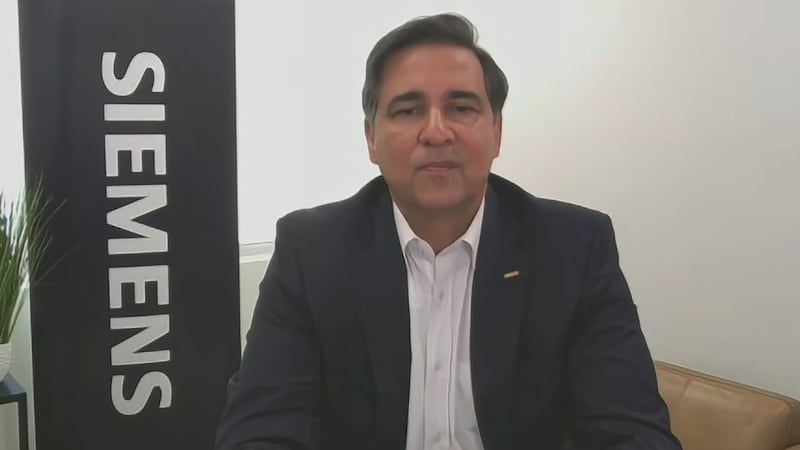
Read the full transcript below:
ROGER: Despite trade tensions and productivity challenges, the CEO of Siemens Canada says he sees opportunity to invest in Canada. He says our stability and high-quality talent pool make it attractive for growth. Joining us now is Faisal Kazi, president and CEO of Siemens Canada. Faisal, thank you very much for joining us.
FAISAL: Thank you very much for having me on your show.
ROGER: Okay, let’s talk about the positives first. What—what’s—what are the things that you’re looking—you’re liking here in Canada right now?
FAISAL: Yeah. So, from a Canadian perspective, I think Canada offers a lot. It has a stable political-economic environment. It has one of the most educated workforces in the world. It has a very strong infrastructure. It’s a government which supports innovation, which is very important for a technology company like Siemens, and it has an innovation ecosystem—you know, the universities, the research institutions—and it’s a very diverse and inclusive environment.
So, and also when it comes to work permits and bringing global teams to Canada, it has a facilitated work permit regime. So, I think these are all factors which help us, you know, invest in Canada. And the most important factor is also the values. For a German company like Siemens, we feel the Canadian values and our values pretty much match, and that makes Canada a very attractive place for us to invest.
ROGER: Now, Siemens has a lot going on. Let’s just start, say, with AI and data centre infrastructure demand. Where do you see the opportunities? We’re starting to see them pop up more so in Alberta, but where do you see the opportunities for Siemens?
FAISAL: Yeah, so, from Siemens’ perspective, you know, Siemens has a long history in Canada. We, you know, laid one of the first telegraph lines in 1874 already, and since then, we have been investing and building our footprint in Canada.
So, from a current perspective, we see opportunities in electrification, and that is the reason we have invested around 14 million in our Drummondville factory in Quebec, which produces electric products. So, we see a huge demand coming, also, as you mentioned, from data centres, but also from the electrification of the transportation sector.
We see with the AI boom that chip manufacturing and semiconductor design technologies are very critical for global growth, actually. And so, we see investment there, and that is the investment we have done in Saskatoon.
Another sector which we are optimistic about is battery manufacturing. Canada has laid out clear—or articulated—an ambition to be a global leader when it comes to battery manufacturing and going from mines to mobility. That means the entire supply chain. So, those are areas where we are looking at and investing.
ROGER: Now, there have been concerns recently about productivity in Canada. We had a technical recession. Some will argue whether it was technical even or not. How are you approaching those? How are you dealing with that to try and improve productivity?
FAISAL: Yeah, I think the advantages—I mean, Siemens is, as you know, a more than 180-year-old company, and we always look at the long term. And I think the advantages which I mentioned just previously, which Canada brings to the table, are much more than a quarter of technical recession. So, we are thinking long term. We’ve always thought long term, and that’s why we continue to invest in Canada.
ROGER: All right, and, of course, the other big thing right now: tariffs, the U.S.-Canada trade uncertainty. Tariffs have had an impact on Siemens’ profitability. What tack are you taking here?
FAISAL: Yeah, so, definitely, you know, uncertainty is never good for any business, and that’s something which is challenging. On the other hand, Siemens, being a global company, we are very, very—you know—very sure and very confident that we will be able to manage any uncertainties because we have a global supply chain. We manufacture in multiple locations across the world. We operate in 190 countries, and during the COVID crisis, it was proven that the Siemens supply chains were very, very strong and resilient.
So, we—yes, there is uncertainty, but we are confident that we will continue to serve our customers in a good manner, like we did during the COVID crisis.
ROGER: Any consideration to move some of the operations here down to the U.S.?
FAISAL: I mean, the U.S. is a very important market for Siemens. Siemens—of course, our investment strategy is built on potential, market potential—and Siemens continues to invest in the U.S. But, as I mentioned, we have made significant investments, especially recently, in Canada. So, we continue to invest in Canada, and we see it as a very interesting and upcoming market, a strong market for Siemens in Canada.
ROGER: Do you see opportunities with the Chinese EVs coming in, possibly building plants here? Could you see any kind of relationship there?
FAISAL: Yeah, for us, you know what—what we have now, we recently announced a $150-million investment in global AI manufacturing R&D technologies in Canada, and this is supported also by the federal government. So, basically, we want Canada to, you know, produce, compete and succeed when it comes to the global clean-energy economy.
So, what we are focusing there with this 150-million-dollar investment, which will create 90 jobs, is to, you know, focus on digital-twin technologies. And what the digital-twin technology is doing is, basically, it allows you to design manufacturing facilities, irrespective—it’s Chinese or so—for any other manufacturer. These facilities in the virtual world, test them and optimize these facilities even before ground is broken.
So, what this—this technology is going to do is going—enhance, you know, reduce—significantly reduces time to market. It ensures that there is a consistent battery quality, or whatever you are manufacturing, the quality is increased, reduces scrap rates, increases productivity and, I think very importantly for Canada, the goal of this R&D centre is to basically ensure that the competitiveness of Canadian manufacturing is such that it can also compete in the global environment.
So, that is our goal of this investment which we are doing, and we see any car manufacturer coming here can utilize digital-twin technologies.
ROGER: Okay, we have to wrap it up there. But, Faisal, thank you very much for joining us today. We appreciate it.
FAISAL: Thank you very much for having me on the show.
ROGER: Faisal Kazi, president and CEO of Siemens Canada.
---
This BNN Bloomberg summary and transcript of the July 14, 2026 interview with Faisal Kazi are published with the assistance of AI. Original research, interview questions and added context was created by BNN Bloomberg journalists. An editor also reviewed this material before it was published to ensure its accuracy and adherence with BNN Bloomberg editorial policies and standards.

