Aritzia’s latest earnings eased concerns about whether the fashion retailer could maintain its growth momentum. Strong U.S. demand helped lift results as the company raised its full-year forecast.
BNN Bloomberg spoke with Mauricio Serna, executive director at UBS, about Aritzia’s appeal across age groups, its product assortment and where it could be gaining ground against competing retailers.
Key Takeaways
- UBS forecasts average annual earnings per share growth of 27 per cent over the next five years, supported by sales growth in the mid-teens.
- Second-quarter comparable sales growth exceeded consensus expectations by 500 basis points, while third-quarter guidance implies growth in the high teens despite tougher comparisons.
- E-commerce sales grew 68 per cent in the quarter, accelerating from 55 per cent in the previous quarter.
- Stores remain an important source of new customers, alongside investments in digital marketing, the mobile app and website personalization.
- Customer demand has prompted some men’s product launches, but women remain the central focus of Aritzia’s strategy.
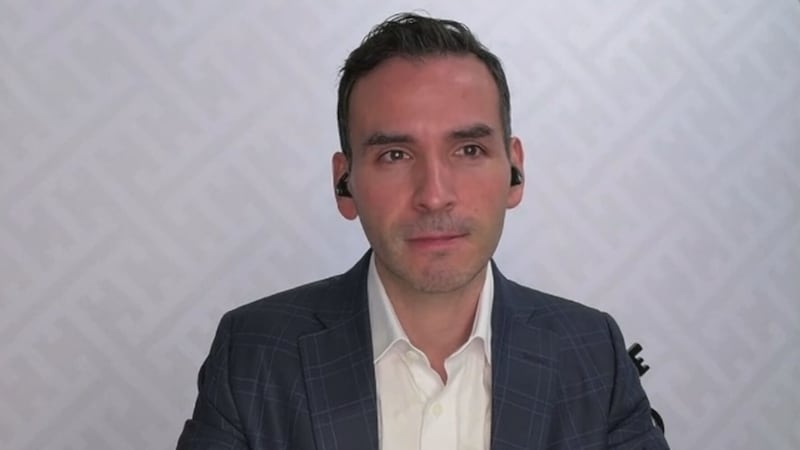
Read the full transcript below:
ANDREW: Aritzia profit soared in the company’s latest quarter, and the company’s hiking its full-year forecast, citing strong U.S. demand and digital growth. Let’s get more from Mauricio Serna, executive director at UBS. Thanks very much indeed for coming on the show.
MAURICIO: Good morning, Andrew. Thanks for having me.
ANDREW: You think of its type — this kind of retail, softlines retailing — Aritzia as one of the premier stocks.
MAURICIO: Yes, we continue to believe Aritzia is one of the most attractive softlines growth stories out there. You know, we forecast them delivering 27 per cent earnings per share growth on average over the next five years, supported by a mid-teens sales growth algorithm, which, you know, as you’ve indicated earlier on, is driven by strength in the U.S., but also in Canada, their, you know, their home market.
ANDREW: There had been pessimism that they’ve done so well that the so-called comp results, year on year, quarter — they just would have trouble maintaining the growth, and the stock’s off its high. But it looks like those fears may have been exaggerated.
MAURICIO: Yes, I would agree with that point. You know, coming into the quarter, into the earnings result, we’ve seen a derating in the stock price, and our conversations with investors suggested that there was a lot of concern regarding, first of all, if the quarter, the Q2 performance in terms of comparable sales growth, was going to be above the expectation of consensus.
And they essentially delivered a 500-basis-point outperformance. And the other concern was about the guidance coming into Q3 because they’re going to be lapping this very extraordinarily successful launch of their mobile app.
But even with that headwind or tough compare coming up, they still delivered an implied comp sales growth expectation for Q3 of high teens, which, when we’ve discussed with investors beforehand, nobody really anticipated that level of sustained growth, considering the difficult compares.
ANDREW: And is it just a broad demographic of women? Is that one of the reasons the company is doing well? A broad range of ages appeal to — are appealed to here?
MAURICIO: I mean, I think that’s part of the element on why the brand, the concept, has been so successful. But I think it’s a combination of, you know, the very careful work that they put to the product assortment, the digital marketing investments that they’ve really amplified over the last two, three years, and, you know, it’s also about the distinctive experience that they create.
That — what they call this everyday luxury experience that they’ve really been able to replicate. You know, not just in, in Canada, where, you know, they originated, but also in the U.S. And they’ve been able to improve on, on their execution across all these fronts.
And that’s just really coming together and making this customer, which is very broad, yes, in, in terms of, like, the age that they target, but, you know, it’s making this customer, you know, go to, go to their stores and, you know, choose to shop with Aritzia rather than to go, you know, with another retailer or another competitor.
ANDREW: That’s interesting. Apparently, they just have cult status on TikTok. People exchange funny stories about changing-room mishaps, etc. They just have this social media buzz.
MAURICIO: Yes, yes, I would say social media is one of their focuses. I mean, I think the other very successful customer acquisition vehicle that we, you know, should not overlook is, like, the stores. The stores, they really drive a lot of attention and traffic.
And, you know, as I also mentioned, I think one of the biggest changes that they have and they continue to put more money behind is the digital marketing, and this is not just social media. That also — this also includes the mobile app that I mentioned earlier, but also, you know, the redesign of the website.
You know, making sure that there’s personalization and things that, you know, make the customer experience more satisfying when they’re shopping online. And, you know, that’s one of the reasons why, for instance, you look at their e-commerce growth this quarter, and it grew 68 per cent, and that’s actually an acceleration from 55 per cent the previous quarter. So pretty astonishing numbers.
ANDREW: In the States, who do you think they could be taking market share from?
MAURICIO: You know what? It’s kind of difficult to pinpoint a specific player because the matter of — as a matter of fact, like, you know, they participate in many different categories.
So you could make the argument, you know, on the workwear side, they’re probably taking shelf space on some of the department — some of the, you know, channels which have been struggling over the last few years. The one that comes to mind, and we’ve written extensively about, is department stores.
But then you also see they have, like, athletic wear, and we’ve seen other brands in athletic wear, in athleisure, where, you know, things have slowed, and I think the, you know, Aritzia has been able to capitalize on that.
So I wouldn’t really be able to pinpoint, like, a specific retailer. It’s just, like, a collection of retailers where Aritzia is outperforming them with the, you know, very strong product assortment.
ANDREW: The management have talked about the potential of going into men’s. Do you think that could be a winner for them? I’m sorry, we only have about a minute left.
MAURICIO: No, no worries. I mean, I would say on the men’s side, we actually talked about this after the earnings call, and they, you know, started launching some products like the Super Puff and the Sweatfleece for men’s.
But that’s because essentially they’ve seen that demand already in the request for customers about that. But Aritzia as a concept will primarily stay dedicated to women, and that’s kind of like that — should, you know, it’s still part of, like, the management’s main strategy going forward.
ANDREW: Thanks very much, Mauricio. Really appreciate it. Mauricio Serna, executive director at UBS.
---
This BNN Bloomberg summary and transcript of the Oct. 9, 2026 interview with Mauricio Serna are published with the assistance of AI. Original research, interview questions and added context was created by BNN Bloomberg journalists. An editor also reviewed this material before it was published to ensure its accuracy and adherence with BNN Bloomberg editorial policies and standards.

