North American stocks weakened again Friday as shifting expectations for U.S. rate cuts added pressure to tech shares. Investors continued to grapple with volatility driven by central bank signals and a flood of delayed economic data.
BNN Bloomberg spoke with Earl Davis, head of fixed income and money markets at BMO Global Asset Management, about why rate expectations have swung sharply, where he expects volatility to rise next, and how his team is positioning for a stronger 2026 growth backdrop.
Key Takeaways
- Expectations for a December U.S. rate cut have dropped sharply, adding pressure to tech stocks and broader risk assets.
- Upcoming employment, inflation and growth releases in the U.S. are expected to be noisy due to reopening delays, fueling near-term volatility.
- Davis expects one final Fed rate cut in December, calling it a “hawkish” move ahead of what he sees as strong U.S. growth in 2026.
- Credit markets are showing early signs of strain, particularly in subprime and private lending, increasing the need for active management.
- Despite volatility, Davis remains constructive on risk assets into 2026, supported by consumer spending, government incentives and easy financial conditions.
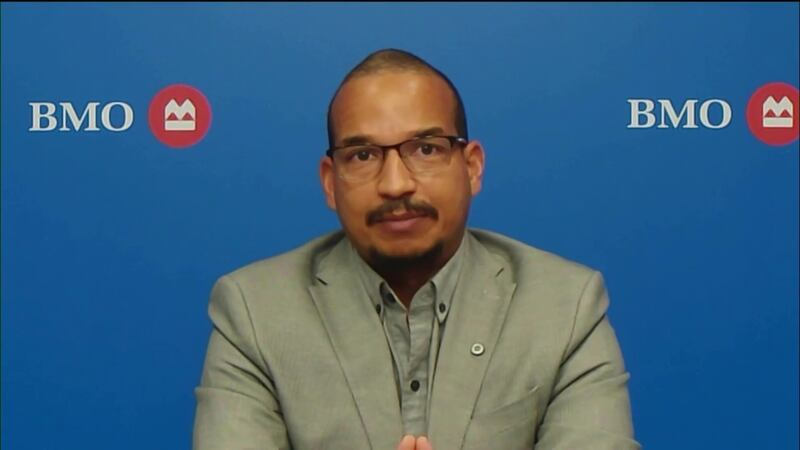
Read the full transcript below:
ANDREW: So we’ve had fresh weakness this morning in North American stocks in particular. The focus right now is on tech. Let’s get more on the markets from Earl Davis, head of fixed income at BMO Global Asset Management. Earl, great to see you. Thank you very much indeed for joining us.
EARL: Good morning.
ANDREW: What do you think has caused this malaise in tech stocks this week? I mean, nothing keeps going up forever, I know.
EARL: Yeah, I think the main thing is monetary policy expectations in the U.S. What we’ve seen this week is a reduction of an expected ease in December by the FOMC. At the beginning of the week, we were discounting close to an 80 per cent chance that the Fed would cut rates in the December meeting. That has reduced to 50 per cent just based off of Fed speak this week. So that means financial conditions won’t be as easy as they could be with an ease — or potentially won’t be as easy — and that’s one of the catalysts for the selloff in tech stocks and stocks in general this week, and risk assets.
ANDREW: Right, so the Dow, which actually hit a record high this week, is still ahead over the past five trading sessions. Let’s put up the Nasdaq Composite. Do you think, Earl, part of it, though, is people weighing the incredibly extravagant, large-scale projections for AI spending? As you know, OpenAI are talking about spending more than a trillion dollars over the next decade.
EARL: Yeah, I’ll turn that on its head a little bit. So yes, but from a valuations perspective — which speaks to the same thing — we’ve had a tremendous valuation acceleration this year in tech stocks, and they’re still up on the year. So it’s not surprising, with this volatility, that even if you have a positive outlook, you’d take some chips off the table. So we believe this is just some profit-taking combined with the volatility. We’re still very positive on risk assets heading into 2026 but we believe there’s going to be a lot of volatility this year for several reasons. One is, as we mentioned, the Fed — chances of them easing in December. The other one is the data releases that we’re going to see coming out of the U.S. now with the catch-up for the reopening of the U.S. So we’re going to get all the data releases: employment numbers, more details on CPI and inflation. So these things are going to add to the volatility over the next months or so of catch-up.
ANDREW: And sorry, just give us that again. You do think you’re in the camp that says the Fed will cut again in December, Earl?
EARL: Yes, we are. We do believe they will cut, but if they do cut, it’s going to be the last one. So whether they do or don’t, 25 basis points in the whole scheme of things may not have that significant impact. We think it will be a very hawkish cut if they do, saying, basically, “We’re on hold now.” And the reason why we think if they do, it’s the last one: our outlook for 2026 in the U.S. economy is very good. You have to think the U.S. consumer is still spending, the regulations and the Big, Beautiful Bill kicks in — which is basically government spending — and financial conditions are very easy. They’re very conducive for longer-term investment. So these three things combined give us a favourable outlook for 2026, which is why we see this volatility and selloff as an opportunity to accumulate and buy risk assets.
ANDREW: What about signs of fractures in portions of the credit market, including subprime lending, rising delinquencies for some players there, and also some private lending? Apparently, that market — it’s an opaque market — but problems emerging. Are you paying a lot of attention to that right now?
EARL: Yes, we are, and you’re seeing it actually in recent headlines — not only from them, but you’re seeing a lot of the big Canadian pension plans pulling away from private equity and their investments. There were some headlines today of that in regards to the restructuring of outlooks for private equity and stuff. I think there was a headline today on Bloomberg on that, but nonetheless. So yes, we are concerned, but this is why you want active management. We think overall there’s going to be a lot of good in the market, but there’s also going to be some bad. So this is where you get active management. You want to make sure you’re selecting the assets that you want to own and be aware of upcoming danger. So yes, that is an awareness. I wouldn’t say it’s a concern, but it’s definitely an awareness.
ANDREW: The Globe and Mail has a piece today about the emergence of exotic, aggressive, leveraged ETFs, and suggests that in some cases they blur the line with gambling. Would you agree with that?
EARL: I didn’t read the article, so I wouldn’t say that necessarily, but what I would say is a lot of these more complex structures are in the hands of more sophisticated investors, not retail investors. And I think that’s the thing that central banks are most worried about: can these risks become systemic? And I would say no. They would be isolated and be able to be cut off by central banks. So that’s why it’s not a concern, but it is an awareness and will impact the volatility overall.
ANDREW: Just looking now at the futures again — where is the Nasdaq? Yeah, it looks like we’re going to get another drop for the Nasdaq. What is your — I know this is a philosophical thing and hard to pin down — but do you think there is a gambling mentality, though, in the market? Not, of course, on the part of all investors, but is that because we’ve got players like Robinhood coming in with these so-called prediction markets? Do you think there is, I don’t know, a change in the culture that people are willing to take flyers these days?
EARL: Yeah, you know what — so I smile because it’s tomato, tomahto. I call it speculation, right? They’ve always called it speculation. Nothing is promised. The only thing that’s promised is investing in government debt, basically — or taxes and debt — and then investing in government debt, next best thing, even though you don’t know what the currency will be worth when you get it back, but at least you get back your money. So it is speculation. That’s why I’m in the business that I do, where I am. You’re privy to more information, a wider array of information, which is important in regards to doing the assessments. You’re able to do analysis. We have dedicated credit analysts that look into the market. So I would say being able to pick and choose what you want to own is very important in this environment after especially such a long global growth run — which we do expect to continue to 2026. So is it gambling? Is it not? I don’t look at it that way, but there is speculation involved here.
ANDREW: Earl, thank you very much indeed for joining us. Earl Davis, head of fixed income and money markets at BMO Global Asset Management. And I would recommend that you read that article in The Globe today — Tim Shufelt, the reporter, talking about how in some cases these speculative ETFs do appear to be blurring that line between the casino or the horses and so-called investing.
---
This BNN Bloomberg summary and transcript of the Nov. 14, 2025 interview with Earl Davis are published with the assistance of AI. Original research, interview questions and added context was created by BNN Bloomberg journalists. An editor also reviewed this material before it was published to ensure its accuracy and adherence with BNN Bloomberg editorial policies and standards.

