Market volatility is rising as weak breadth, widening credit spreads and shifting rate expectations weigh on investor sentiment. AI-linked debt issuance, climbing Japanese bond yields and uncertainty around major earnings events have contributed to a risk-off tone.
BNN Bloomberg spoke with Diana Avigdor, vice-president, portfolio manager and head of trading at Barometer Capital Management, about the firm’s tactical shift into higher cash, the “no-buy” stance and the signals she is watching as markets navigate a period of elevated tension.
Key Takeaways
- Market breadth has deteriorated for weeks, prompting a move to roughly 20 per cent cash and a tactical pause on new purchases.
- Rising credit spreads, heavy tech-sector debt issuance and Japanese bond yield moves are contributing to a risk-off environment.
- Despite strong corporate earnings, markets are trading on fear rather than fundamentals, creating a “healthy checkback.”
- Gold and Celestica positions were trimmed after strong rallies, with partial re-entry into gold as conditions evolved.
- Nvidia’s earnings are seen as a major sentiment catalyst that could either extend AI-driven strength or reinforce current caution.
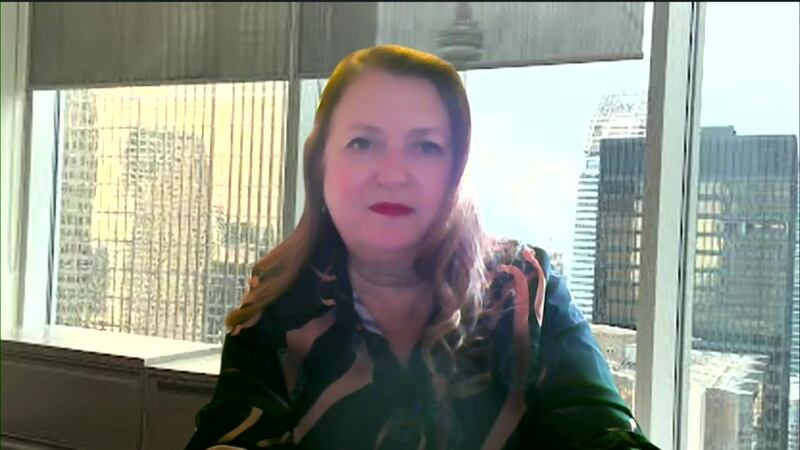
Read the full transcript below:
ANDREW: Let’s get more on this market weakness. We’re joined by Diana Avigdor, portfolio manager and head of trading at Barometer Capital Management. Diana, thank you very much indeed for joining us.
DIANA: Thanks for having me.
ANDREW: What’s your feeling in the market? Are you getting a sense of fear and nervousness that this AI thing has been overdone?
DIANA: Definitely. We can see the CDS spreads blowing out. I think it all started when they began raising debt. We had Amazon raise more debt yesterday, and the demand for that debt has been multiple times covered. So it’s not like people don’t want to have access.
And let me just add, for context, the Nvidia earnings. Tomorrow, we’re expecting 57 per cent growth on the top line and 55 per cent growth in EPS, and 73 per cent margins. It’s trading at 30 times next year’s earnings. I just want to say that so we can have context for how big the numbers are. And it is 10 per cent of the Nasdaq, 10.8 per cent of the S&P. So, you know, yeah, it’s normal and probably healthy, what’s going on right now — a little checkback. The market is having a bit of a tantrum. There’s a pile-on of negativity, and breadth, which we watch very carefully, has been deteriorating in the last few weeks. For our tactical, active strategy, that means as stocks break down, we just leave it in cash. We’re in a no-buy zone.
And one other point before we move on: you really have to mind your time horizon. If I’m talking to short-term traders right now, they’re going to stay away until this stabilizes. But for longer-term investors who put money in their RRSP every month, that strategy should not change.
ANDREW: It’s interesting you mention the debt these tech companies are taking on. There’s a headline on Bloomberg: “AI debt supercycle isn’t nearing the end — likely just beginning,” because AI capex is projected to soar toward US$3 trillion over the next five years. And debt is becoming the funding tool of choice. As you mentioned, Amazon and other tech giants are issuing bonds.
DIANA: Yeah. And the other thing that seems to coincide is when JPMorgan reported a few weeks ago, when the U.S. earnings season had just started, they mentioned one investment that went sour. Market participants are split almost evenly on whether that’s something more substantial to watch. Jamie Dimon said where there is one cockroach, there could be more, and that’s certainly true. But there are those who think this was a one-off, and sometimes there are just not-so-great investments.
But when you look at the larger spreads — the investment-grade and high-yield spreads — they’ve moved up slightly, but meaningfully. And the other thing triggering fear, and adding to the pile-on of negativity, is everybody watching Japanese bond yields moving up and how that might suck money out of the North American market or U.S. Treasuries. But we’ve seen U.S. Treasury buying as well. So the facts don’t always match the narrative.
And yes, we might have a little tantrum on the JGB trade everybody’s watching. Again, this could be healthy. We’re coming into this with about 20 per cent cash because, as I’ve mentioned, as breadth deteriorates and stocks move down, we tend to be disciplined sellers. When gold started trickling down, we got out. We booked nice profits, but we’ve since added them back in a bit — maybe three to four per cent of portfolios.
We’ve also taken some profits in Celestica. We didn’t sell it out, just brought clients back to a regular weight from a high weight. It ebbs and flows, and we ebb and flow with it.
ANDREW: So Celestica — let’s pull up a one-year chart. You’re not out of CLS because they’ve built a strong franchise in installing data-centre equipment.
DIANA: It really is. And you have to have some growth in the portfolio. This is where growth in the Canadian stock market exists. We’ll see. If it breaks down, we let pricing tell us what to do. If it breaks down, we’ll take it further down, and there will be opportunities to get back in.
This is not about return right now. This is about risk management. And again, if I’m talking to short-term traders, they know exactly what I mean. This is not the time to step in, but there will be a better time to add to positions or start new ones.
So for now, it’s a no-buy zone. We will watch. We will re-engage — say Nvidia reports tomorrow and legitimizes all this AI fear and gives us another leg — we’ll re-engage. But should it not, and lately the volatility around Nvidia earnings has subsided, the options market is pricing in about a six per cent move tomorrow. We used to have more. Lately, the stock hasn’t moved much given its size.
So we’ll see. Everybody is watching. And perhaps people are worried that with the U.S. government reopening, we’re going to have a pile-on of economic data. There’s been talk about softness in the labour market, but ADP came in line, jobless claims this morning were benign, and Canadian unemployment and inflation at 2.2 per cent is okay. If this is healthy, it’s a good checkback.
ANDREW: Diana, thank you very much for joining us. That’s interesting — you’re not buying stocks right now. You’re saying it’s about risk management.
DIANA: It’s about risk management right now, and we’re not buying until it settles down.
ANDREW: Diana, thank you very much. Diana Avigdor, vice-president, portfolio manager and head of trading at Barometer Capital Management.
---
This BNN Bloomberg summary and transcript of the Nov. 18, 2025 interview with Diana Avigdor are published with the assistance of AI. Original research, interview questions and added context was created by BNN Bloomberg journalists. An editor also reviewed this material before it was published to ensure its accuracy and adherence with BNN Bloomberg editorial policies and standards.

