U.S. markets softened ahead of interest-rate decisions in Canada and the United States, with investors widely expecting the Federal Reserve to cut while the Bank of Canada holds. Diverging policy paths come as earnings remain solid and economic momentum appears stronger south of the border.
BNN Bloomberg spoke with Sadiq Adatia, chief investment officer at BMO Asset Management, who said the U.S. continues to lead on growth and earnings, while Canada faces pressure from weak employment signals, heavy consumer debt and uncertainty tied to tariffs and the USMCA. He added that gold and broadening AI-related gains remain key themes for 2026.
Key Takeaways
- The Fed is expected to cut rates while the Bank of Canada is likely to stay on hold, with U.S. employment trends driving the policy split.
- Canada faces headwinds from soft labour signals, high household debt, housing weakness and tariff uncertainty heading into USMCA talks.
- U.S. economic momentum remains stronger, supported by broadening earnings, fiscal measures and reshoring trends that favour continued equity outperformance.
- Gold is expected to strengthen in 2026 as central bank and retail demand stay firm and a weaker U.S. dollar could provide added support.
- AI-related gains appear earnings-driven rather than speculative, though performance is expected to increasingly separate high-quality firms from weaker player
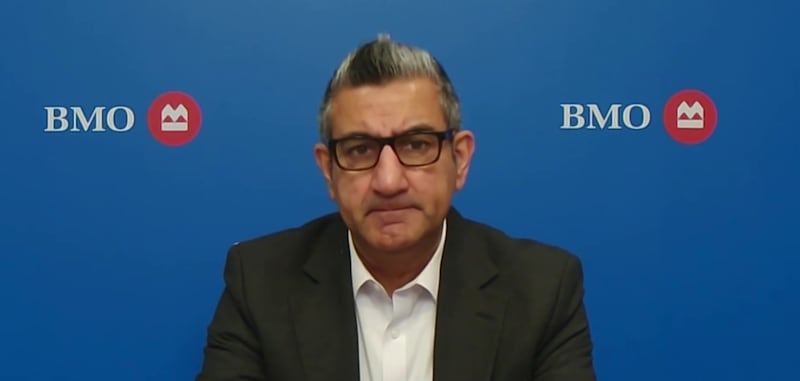
Read the full transcript below:
ANDREW: We’ve got interest-rate announcements in Canada and the U.S. tomorrow. Let’s get more from Sadiq Adatia, CIO at BMO Asset Management. Sadiq, thanks very much. Start off with Canada. What are you looking out for in terms of commentary from the bank, and do you think there could be a cut in rates?
SADIQ: Yeah, thanks for having me. I don’t think Canada cuts rates tomorrow. I think they have a lot to still decipher. When you look at it, they’re at the bottom end of the range on interest-rate cuts, and you’re seeing inflation probably still a little bit stickier than they would like to see. I think the Bank of Canada sits on the sidelines now and probably for the immediate future. And you contrast that with the U.S., where I think you will start to see a rate cut tomorrow. They’re a little bit more concerned about what’s going on on the employment side. Inflation has been a bit more tame there, and I think they’re happy with that. Earnings still look relatively good, but I think it’s the employment side that has caught their attention. And therefore, I think you see a rate cut tomorrow, and then I think you see that continuing in 2026 as well.
ANDREW: You’re tending to underweight Canada in your portfolios. Why is that, Sadiq?
SADIQ: Yeah, I think if you look at it just from a fundamental perspective, when we look at the U.S. in particular, it’s a much stronger economy, better earnings there, and actually a bit more broad-based earnings now, which I think is even better for a continuation of that momentum. When you look at Canada, the issues are still employment — though we had a good report last month, it’s still something that I think is a weaker part of things. Housing is still, I would say, underwhelming. You’ve seen consumers with a lot of debt, and again, if we’re not getting further rate cuts, I think that puts more pressure on the consumer. And then we still have, obviously, the overhang of the tariff situation and the upcoming USMCA. So I think there’s a lot to be cautious about when it comes to Canada, whereas in the U.S., I think there’s still a lot of momentum there, even though you might be seeing a little bit of softness coming through on the employment side.
ANDREW: And generally, the American economy — our interest rates are, of course, much lower than the States. We’ve done far more cutting in this country, but kind of Goldilocks for the U.S., then: decent corporate profits and borrowing costs coming down. You’re broadly overweight the U.S., then. Just go over that again briefly, if you would.
SADIQ: Yeah, absolutely. I mean, the U.S. has been one of our overweights for a few years now. And I think when you look at it, as you mentioned, they’re now playing a little catch-up on the interest-rate front, which will be good for their consumers. You have a big, beautiful bill coming through in 2026 that should be good for corporations and consumers. You also still have great earnings coming through across the board — and again, as I mentioned earlier, not just within tech but now more broadly — so that will allow a more broad-based rally in markets, not just tied to tech or the Magnificent Seven. And then you think about some of the key themes that we see around the world, and the U.S. is at the forefront of that. So a lot of good pauses coming there. You also can add in reshoring, and that sets up, I think, a pretty good environment for the U.S. to continue to do well again next year, albeit I don’t expect to see as strong returns as we’ve seen over the last few years, but still enough to outperform bonds or cash.
ANDREW: And gold. Do you see more strength in 2026? Why is that, Sadiq?
SADIQ: Yeah, I think all the fundamental reasons that you own gold over the last few years — and why it’s done well — still seem to be the reasons you want to own it in 2026 as well. You’re still seeing sovereign banks around the world continue to buy more gold, so I think that’s one bullish line. We’re still seeing momentum on the retail side of buying gold. I still don’t think it’s fully overvalued when you look at it from fundamentals. And then you look at the fact that it’s still a great hedge against uncertainty out there. A weakening U.S. dollar — if we get rate cuts, we could see that happening at least in the first half of the year. So all those things still tell us gold can continue to go higher from here and continue the momentum we saw for most of this year as well.
ANDREW: Sadiq, tell us, when you’re in conversations with your colleagues — whether over a pint of beer or a coffee or a more formal meeting session — is there a camp in there who say, gosh, maybe we should get off this AI escalator? It’s just gone up so much.
SADIQ: Yeah, I think the debate is not that we don’t believe in AI. I think everybody believes in that. And again, it’s not just a tech story — it’s a broader sector story. But I think the question that we always ask ourselves is, has it run too far, too fast? Has the capex spending translated into the right amount of savings or efficiencies across the board? And what we come up with is that the key companies continue to deliver well. We’ll still see capex spending. We should see improved efficiencies. We should see future growth of jobs kind of get minimized as AI continues to reshape and reform how things are being done. And yeah, I think you can still say that there are valuations that have gone up. But if I look at the broad market in particular, and you look at the beginning of this year to where we’re at today — yes, we’ve seen multiples go up, but it’s because earnings have actually gone up and not as much of a change in re-rating coming through. So it really is coming from an earnings story. And therefore, I feel confident that we should continue to see this AI story continue to build and develop over time, be more broad-based across sectors and geographies. So I don’t think we’re in an AI bubble by any means here, but that doesn’t mean you don’t get pullbacks like we saw in November, or if people question it along the way, which causes some additional pullbacks as well. I think the story is true. I think the companies are live. There will be more breakdown between the quality companies in the space and those that are lesser quality.
ANDREW: Sadiq, thank you very much indeed.
SADIQ: Glad to be here.
ANDREW: Sadiq Adatia, chief investment officer at BMO Asset Management.
---
This BNN Bloomberg summary and transcript of the Dec. 9, 2025 interview with Sadiq Adatia are published with the assistance of AI. Original research, interview questions and added context was created by BNN Bloomberg journalists. An editor also reviewed this material before it was published to ensure its accuracy and adherence with BNN Bloomberg editorial policies and standards.

