Choppy trading near record highs has renewed debate over whether heavy artificial intelligence spending and elevated expectations could pose risks to equities. However, market performance has broadened beyond the largest technology stocks, suggesting underlying resilience across regions and sectors.
BNN Bloomberg spoke with Andrew Slimmon, senior portfolio manager at Morgan Stanley Investment Management, about why valuation discipline may be limiting bubble risks, how financials fit into the outlook, and where markets could be vulnerable heading into 2026.
Key Takeaways
- Recent volatility in AI-linked stocks reflects valuation concerns rather than deteriorating earnings fundamentals.
- Technology sector valuations have compressed this year despite strong profits, complicating claims of an AI bubble.
- Limited capacity and cautious financing could support pricing power for companies supplying AI infrastructure.
- U.S. banks may benefit from deploying excess capital, potentially driving faster earnings growth outside technology.
- The biggest market risk remains a negative surprise tied to inflation or Federal Reserve policy, not valuation alone.
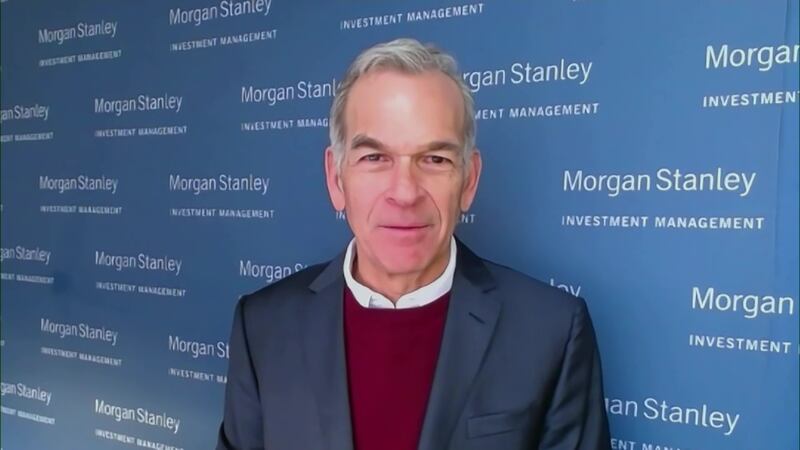
Read the full transcript below:
A. BELL: Let’s focus now on the U.S. stock market and global equities, along with expectations and concerns surrounding artificial intelligence. We’re joined by Andrew Slimmon, senior portfolio manager at Morgan Stanley Investment Management. Andrew, great to see you, and thanks for joining us.
A. SLIMMON: Thank you, Andy. Nice to see you.
A. BELL: Let’s start with the current atmosphere. December markets have been trading near, or even at, record highs, but it’s been choppy.
A. SLIMMON: That’s correct. The reason the AI-related names rallied yesterday is that the night before we received a very strong earnings report from a chip company, saying business was very strong. When earnings come out and these companies keep telling us they can’t keep up with demand, the stocks rally.
But between earnings reports, when there’s less fundamental news, the market gets anxious about deals and spending, and these stocks sell off. It’s definitely a bipolar environment for these stocks right now.
A. BELL: That’s interesting. Micron, for example, has been assuring investors that demand for memory chips used in AI is massive. If you had to hazard a prediction for the rest of the year, what do you think we might see through the balance of December?
A. SLIMMON: At the end of the day, a bubble is about excessive valuation. The reality right now is quite remarkable: the S&P 500 technology sector is trading at a lower forward price-to-earnings ratio than it was at the beginning of the year.
That’s because there’s so much anxiety about an AI bubble that valuations have been reined in. Only two of the so-called Magnificent Seven have outperformed the S&P 500 this year, meaning most have not, even though earnings have been very strong.
In many ways, all the discussion around an AI bubble is constraining valuation, and that’s ultimately a good thing. You don’t want these stocks to run to extremes. That might help the market in the short term, given their large index weightings, but it would be bad in the long term. So I think this concern is actually positive over time.
A. BELL: We know companies have talked about massive investment. I read recently that some of the large hyperscalers are announcing multiple data-centre projects, even knowing some may face local opposition and never be built.
A. SLIMMON: Exactly. You also heard about a private credit firm pulling back from helping finance a data centre because it’s publicly traded and the market is worried about how much money is being poured into AI.
What that tells me is that capacity will continue to struggle to keep up with demand, which ultimately gives more pricing power to those that do have capacity.
A. BELL: One of the issues people raise with data centres is noise, especially when they’re close to residential areas.
A. SLIMMON: I live in the city, so I’m used to noise, but that’s news to me.
A. BELL: Let me ask you about U.S. banks. Would you be a buyer of U.S. bank stocks for the long term?
A. SLIMMON: It depends on what you mean by long term, but I do think there’s more upside. If you look closely at last quarter’s earnings, the reason banks delivered strong results is that they have more capital to deploy.
Capital being freed up should accelerate earnings growth, and these stocks still trade at large discounts to the broader market. That creates what I would call the nirvana of investing: accelerating earnings growth combined with multiple expansion. I think that started this year and can continue next year. So yes, I think these stocks are buys.
A. BELL: Because they’re sitting on large amounts of undeployed capital?
A. SLIMMON: Exactly.
A. BELL: The Financial Times has reported that JPMorgan has been moving money out of the Federal Reserve and into U.S. bonds as rates come down. Looking ahead to 2026, do you think investors are underestimating any major risks or surprises?
A. SLIMMON: The key question is always: when is the market vulnerable? We started 2025 very strong, with lofty price targets on Wall Street. Then we had the surprise around tariffs, which washed out a lot of bullish sentiment and reset the market for another run.
As we head into 2026, optimism is building again, which means the market could be vulnerable to a negative surprise. Historically, what tends to end bull markets is the Federal Reserve, not valuations.
If inflation were to reaccelerate, investors might question how quickly the Fed can cut rates. Historically, after large inflation spikes like we saw in 2021 and 2022, you often see a resurgence a few years later. That’s probably the biggest risk to the market right now.
A. BELL: As William McChesney Martin once said, the job of the Fed is to take away the punch bowl just as the party gets going.
A. SLIMMON: That’s exactly right.
A. BELL: Andrew Slimmon, thanks very much for your time.
A. SLIMMON: All the best, Andy. Thank you.
---
This BNN Bloomberg summary and transcript of the Dec. 19, 2025 interview with Andrew Slimmon are published with the assistance of AI. Original research, interview questions and added context was created by BNN Bloomberg journalists. An editor also reviewed this material before it was published to ensure its accuracy and adherence with BNN Bloomberg editorial policies and standards.

