Canadian energy stocks steadied after recent losses as investors weighed geopolitical uncertainty tied to Venezuela against broader economic forces driving global growth expectations.
BNN Bloomberg spoke with Zachary Hill, head of portfolio management at Horizon Investments, about why markets are largely discounting near-term geopolitical risk, how monetary easing and fiscal stimulus could support growth in 2026, and where investors are becoming more selective across sectors and regions.
Key Takeaways
- Markets are largely looking past Venezuela-related geopolitical risk until it has a clear and lasting impact on economic fundamentals.
- Broader participation in equities is expected in 2026 as productivity gains, stimulus and earnings growth spread beyond a narrow group of leaders.
- The AI trade is shifting from broad beta exposure toward more selective, stock-specific opportunities tied to monetization.
- Cyclical sectors, particularly banks, are favoured over defensive equities as global growth expectations improve.
- With the Fed on pause, monetary policy is expected to be less dominant in 2026, reducing uncertainty for investors.
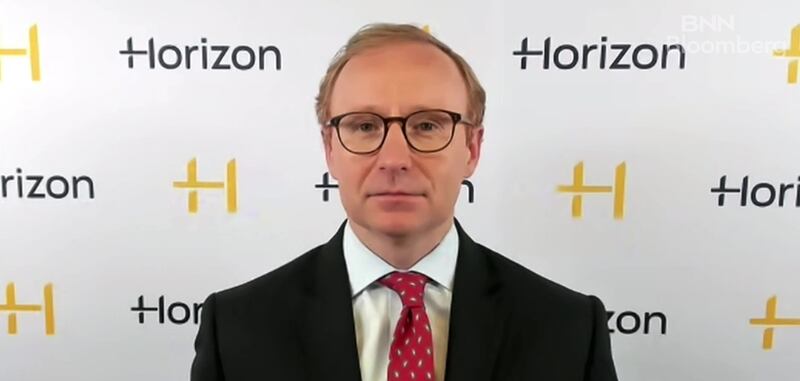
Read the full transcript below:
ROGER: The Canadian energy sector is looking to rebound today after significant losses yesterday, following news out of Venezuela. Let’s get more now on how this could affect broader markets. Zachary Hill is head of portfolio management at Horizon Investments. Zachary, thanks very much for joining us.
ZACHARY: Good to be with you today, Roger.
ROGER: Is this more of a short-term reaction, with things stabilizing after today?
ZACHARY: In terms of oil?
ROGER: Yes — what we saw yesterday into today. It seems like it’s bouncing back a little.
ZACHARY: Yes, we think so. I’m no geopolitical expert, but generally speaking, geopolitical events tend to have long-lasting impacts on markets when they interact with real economic variables. As of right now, that’s not something market participants are really factoring in. Barring any escalation or broadening of the conflict, we think this is something markets will look past. Over the last few days, at least in U.S. markets, it does seem investors have been looking through some of these growing risks.
ROGER: I was doing the math on the markets over the first three days of the year, and if this continues, markets will be up 72 million per cent by the end of the year. We’re off to a good start. It’s not going to continue, but what does 2026 look like to you?
ZACHARY: Generally speaking, we’re positive going into the year. One thing we’ve been thinking about is the opportunity for market participation to broaden in 2026. We saw a bit of that late last year, and it’s starting to get talked about more broadly. The idea that all you could do was buy the Mag Seven at the top of the market is shifting. Productivity gains and efficiencies are starting to spread throughout the economy, and there’s a lot of stimulus in the pipeline, both in the U.S. and internationally. Taken together, we think that supports broader participation across U.S. equities and the global equity universe. For diversified investors, that’s a very favourable backdrop after a few tough years.
ROGER: With the Mag Seven and AI, does this feel like a shakedown year? We heard comments today about cooling systems and memory storage that had an impact on markets.
ZACHARY: Yes, I think so. Looking at individual Mag Seven moves and trends within the AI theme, things were very correlated over the last few years — everything going up or down together. More recently, investors have become more discerning in how they express these themes. We think that’s healthy and suggests we’re moving closer to the monetization phase of this technology. For a long time, AI was a beta trade that powered the market. In 2026, we think it becomes more of an alpha trade, and that’s a meaningful shift investors need to consider when positioning portfolios.
ROGER: Where are you looking, and where are you not looking?
ZACHARY: Where we’re not looking is easier. With a more positive growth outlook and expectations for a global upswing, we’re avoiding defensive equities and long-duration bonds. What we do like in the U.S. is smaller-cap technology and equal-weight tech as ways to express AI exposure through stock selection, along with cyclicals. Banks are our favourite in that group — both large-cap and regional banks have strong tailwinds that we think continue into 2026. Internationally, we prefer owning non-U.S. equities. That worked last year, and if the dollar continues to depreciate — not to the same extent as in 2025, but enough to be a tailwind — that should support more value-oriented sectors abroad.
ROGER: International markets have outperformed New York and Canada. Any concerns about peaking?
ZACHARY: We’re watching investor flows, earnings growth and whether a global growth upswing actually materializes. Earnings season and the first quarter will be important, as will the behaviour of the dollar. Over the last few days, we’ve seen some dollar strength, possibly tied to flight-to-safety flows around Venezuela uncertainty. Those are the key indicators we’re monitoring to see whether this trend has staying power.
ROGER: And finally, the Fed — where do you see U.S. rate cuts heading this year?
ZACHARY: We think the Fed is on pause right now. The Fed has already cut about 175 basis points from the peak, including 75 basis points last year. Even if there’s a pause for a few months, those cuts will start to filter into the real economy. We see that as positive for both markets and growth. After Powell’s term ends in May, there’s more uncertainty, and we’re watching the leadership race like everyone else. Still, we don’t expect a dramatic shift in policy. The level of disagreement at the Fed right now suggests monetary policy may be less dominant in 2026 than it has been in recent years, and that’s likely a good thing for investors.
ROGER: We’ll leave it there. Zachary, thanks very much for joining us.
ZACHARY: Thank you.
ROGER: Zachary Hill is head of portfolio management at Horizon Investments.
---
This BNN Bloomberg summary and transcript of the Jan. 6, 2026 interview with Zachary Hill are published with the assistance of AI. Original research, interview questions and added context was created by BNN Bloomberg journalists. An editor also reviewed this material before it was published to ensure its accuracy and adherence with BNN Bloomberg editorial policies and standards.

