Gold prices pushed to another record this week before paring some gains, supported by heightened geopolitical tensions and continued demand for safe-haven assets. The metal has risen roughly seven per cent over the past week, extending a powerful rally that has lifted both bullion and gold-related stocks.
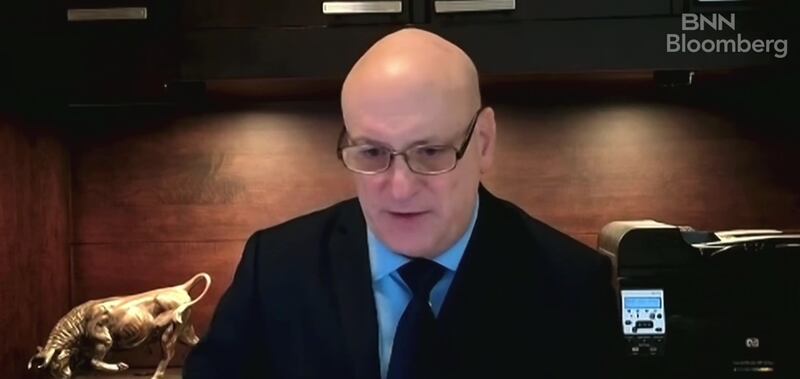
BNN Bloomberg spoke with Matt Kacur, president of FSA Valuation Service, about whether gold still makes sense after its surge, how investors should approach gold equities following steep gains, and where valuation risks are emerging across artificial intelligence and health care stocks.
Key Takeaways
- Rising geopolitical tensions and central bank buying are reinforcing gold’s appeal as a safe-haven asset.
- Gold supply constraints are intensifying as global production flattens and new mine discoveries remain limited.
- Gold equities have surged sharply, making holding existing positions preferable to adding new exposure at current levels.
- Artificial intelligence stocks continue to show strong growth, but elevated valuations increase the risk of pullbacks.
- Health care is gaining attention after years of underperformance, with improving momentum creating selective opportunities.
Read the full transcript below:
ANDREW: As of today, gold was up about seven per cent this week and has been hitting record after record. Let’s get more from Matt Kacur, president of FSA Valuation Service. Thanks very much for joining us, Matt.
MATT: Thanks for having me.
ANDREW: You can see a bullish case for gold, but you wouldn’t be putting massive amounts of money into it right now.
MATT: Yeah. Listen, we don’t do a lot of technical analysis. Ours is more quantitative work with fundamentals — revenue growth, cash flow, return on invested capital. Those are the things that really drive our decision-making.
If I asked some of my colleagues who look at charts more closely, they would probably say these moves are overdone. Some of the numbers are just astounding, and it’s really hard to recommend putting new money into this right now.
If you own some of these names, you’re probably playing with the house money at this point, so it’s likely fine to hold on. Frankly, a lot of these gold stocks don’t look that expensive on a multiples basis. The way we do our models, they don’t look crazy. It’s the stock prices — the charts are just straight up.
I’ve got some numbers if you want me to go into specifics. I’m not sure if you want me to do that.
ANDREW: Give us one or two. Anyway, Matt, thanks.
MATT: Yeah, okay. One that we’ve really liked is Aura Minerals. That’s AUGO on the NASDAQ — it used to be Canadian-listed. The return on capital is 20 per cent, which is huge for a mining company. Revenue growth last quarter was 57 per cent, so all of that looks great.
The stock price over the past year is up 454 per cent. So when a stock is up 454 per cent in one year, it’s hard to recommend buying it today. That said, it’s only trading at about 15 times EV-to-EBITDA. Everything lines up: the fundamentals are good, and I think gold is going higher based on geopolitical tensions and central banks buying more gold.
Even the stock itself doesn’t look that expensive, but a 454 per cent gain in one year makes me hesitant to say put new money to work here. If you own it, I think you’re fine.
ANDREW: We were having trouble with the chart there, but that stock is up more than fivefold in the past year. Aura Minerals. Lundin Gold is a big player in Ecuador, and they say they have significant copper potential as well. What attracts you to that stock?
MATT: Yeah, we’ve owned that one for quite a while too. The numbers are similar, though maybe not quite as gaudy as Aura Minerals. Return on capital is 44 per cent, which we love, and it’s been improving. Revenue growth was 38 per cent in the last quarter.
EV-to-EBITDA is around 19 times. That’s higher relative to some peers, but it’s not outrageous. The stock price is up about 253 per cent over the past year, according to our data. That’s substantial.
So we’re in the same boat. Everything looks great. If you own it, it’s a great company and you can hold it through what will likely be some volatility. If you don’t own it, I’d wait and look for an opportunity rather than chasing it here.
ANDREW: Can we switch over to chips? You think the outlook looks strong there. We’re hearing from a lot of those companies that they can’t keep up with demand.
MATT: Yeah, I agree. Some of the projections for this year are astounding, and there’s no sign of a slowdown. I don’t know how you sustain that kind of exponential revenue growth, but they seem to be doing it, and the projections aren’t coming down.
Fundamentals look great, but valuations are getting richer. With gold, we were talking about 15 times or 19 times EV-to-EBITDA. Nvidia is around 34 times. Broadcom is about 35 times. EV-to-EBITDA is our preferred metric, with some accounting adjustments.
The fundamentals are excellent across the board. To me, the big four are Nvidia, Broadcom, Taiwan Semiconductor and ASML. I’d call those the core four — and that’s a pretty good core four.
ANDREW: And finally, in health care, you’d be interested in putting new money into Novo Nordisk.
MATT: Yeah. We’re trying to think about what comes next beyond gold and AI. Health care hasn’t been great for the past few years, so there should be opportunities there.
We’ve owned Novo Nordisk and suffered through some of the downside, but it’s an excellent company and the financials have remained strong. They recently received approval for a GLP-1 pill for weight loss. That’s significant because it’s the only pill approved so far — even Lilly doesn’t yet have approval for a pill version.
Given the pullback in the stock and the broader weakness in health care, this looks like an attractive opportunity for investors looking at areas that have been beaten down.
ANDREW: Thank you very much, Matt. Really appreciate it. Matt Kacur, president of FSA Valuation Service.
---
This BNN Bloomberg summary and transcript of the Jan. 23, 2026 interview with Matt Kacur are published with the assistance of AI. Original research, interview questions and added context was created by BNN Bloomberg journalists. An editor also reviewed this material before it was published to ensure its accuracy and adherence with BNN Bloomberg editorial policies and standards.

