Investors are awaiting the U.S. Federal Reserve’s latest interest rate decision as signs of easing inflation and slowing job growth fuel debate over the policy path ahead. Expectations for economic growth, equity leadership and capital spending are shaping investment strategies heading into 2026.
BNN Bloomberg spoke with Clay Khan, managing director at Neuberger Berman, about the outlook for U.S. interest rates, global equities, emerging markets and how accelerating artificial intelligence investment is influencing market leadership.
Key Takeaways
- The Federal Reserve is expected to pause on rates near term, with room for two or three cuts in 2026 as inflation cools and job growth slows but remains positive.
- Global equities remain favoured, with emerging markets viewed as especially attractive due to lower valuations and improving earnings prospects.
- Developed international equities were reduced to market weight after strong performance narrowed valuation gaps with U.S. stocks.
- Value stocks and smaller-cap shares have outperformed growth early this year, signalling investor confidence in a reflationary economic backdrop.
- Artificial intelligence capital spending by large U.S. companies is accelerating and increasingly benefiting emerging market firms tied to semiconductors and digital infrastructure.
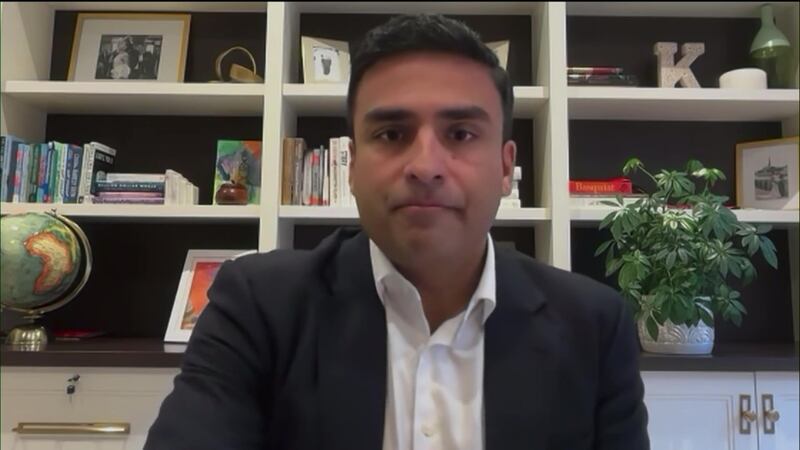
Read the full transcript below:
ROGER: We are waiting to hear from the U.S. Federal Reserve on whether it will cut interest rates. Let’s get more on what this could mean for U.S. economic growth in 2026. We’re joined now by Clay Khan, managing director at Neuberger Berman. Clay, thanks, as always, for joining us.
CLAY: Thanks for having me.
ROGER: Let’s talk about the Fed announcement this week. What do you think we’re looking at?
CLAY: Taking a step back, if you look at where we are in the cycle, inflation continues to decline and jobs are holding steady. If you look at the Fed’s dual mandate of employment and inflation, and the fact that it cut rates a few times last year, we think this upcoming meeting points to a pause. That said, with the policy rate around 3.75 per cent, when you put all the pieces together, there is room to cut another 75 basis points to about 3 per cent, which we think would be stimulative for both markets and the economy.
ROGER: So you’re thinking maybe two or three more cuts?
CLAY: Yes, two or three more cuts. Our fixed-income team reviews the data daily and works closely with our broader asset allocation team across public equities, fixed income and private markets. There’s a tailwind from economic strength and another from easing inflation. The yellow light is really on the jobs side. About 12 months ago, we were seeing job creation well above 100,000 per month. Now we’re talking about five-digit gains, which is a meaningful deceleration, though still positive. That gives the Fed enough reason to pause at this meeting, but potentially cut rates two or three times in 2026.
ROGER: How do you position portfolios with those opposing forces at play? Where are you looking?
CLAY: In short, we like equities, particularly global equities. Last year, when I was on the show, we also favoured equities and were overweight international stocks, including developed markets outside the U.S., such as Europe, Japan and the U.K. In 2025, it was a banner year across the board. The S&P 500 rose about 18 per cent, which is a strong year by any standard, but developed markets outside the U.S. gained roughly 32 per cent, while emerging markets rose about 34 per cent. That represents meaningful outperformance relative to the S&P 500. We’ve since reduced developed international equities to a market weight, largely because valuations now look fair relative to the S&P 500. Emerging markets, however, remain very attractive at about 16 times forward earnings, compared with roughly 26 times for the S&P 500 and about 18 times for developed international markets.
ROGER: Let’s focus on developed markets outside the U.S. You’ve scaled back there. Can you expand on that?
CLAY: There’s a lot to unpack, but if you look at the S&P 500, it trades at roughly 26 times forward earnings. The so-called Magnificent Seven account for about 35 per cent of the index. If you strip those out and look at what we call the S&P 493, valuations are closer to 20 times earnings. Developed international equities trade at around 18 times earnings. Given the stronger growth and earnings profile in the U.S., we’re comfortable being neutral on both. What’s interesting this year, even just a few weeks in, is that value stocks have meaningfully outperformed growth. The Russell 1000 Value Index is up roughly four to 4.5 per cent, while growth stocks are down, creating a spread of about five to six percentage points. The Russell 2000 has also posted high single-digit gains. These parts of the market tend to be more economically sensitive, suggesting investors are buying into a reflation narrative. Many international and emerging markets also have more cyclically oriented, value-sensitive sectors, which supports the thesis. Another important part of the story is artificial intelligence exposure in emerging markets.
ROGER: Let’s talk about that. What do you like about AI in emerging markets?
CLAY: Broadly speaking, around 2022, capital spending by the major U.S. hyperscalers on AI and related infrastructure was about US$400 billion. That figure is expected to double by 2026, partly due to tax incentives that encourage capital investment. To put that in context, the combined market capitalization of Canada’s five largest banks is about US$650 billion. This is very significant spending, and it should flow through to the companies providing the picks and shovels for AI infrastructure. Many of those firms are based in emerging markets, including China, South Korea and Taiwan. South Korean equities rose roughly 70 per cent last year and have continued to perform strongly this year, while Taiwan has also seen significant gains, largely tied to AI-related businesses such as semiconductors and digital infrastructure.
ROGER: We’ll have to leave it there, Clay. Thanks very much for joining us.
CLAY: Thanks for having me.
ROGER: Clay Khan, managing director at Neuberger Berman.
---
This BNN Bloomberg summary and transcript of the Jan. 26, 2026 interview with Clay Khan are published with the assistance of AI. Original research, interview questions and added context was created by BNN Bloomberg journalists. An editor also reviewed this material before it was published to ensure its accuracy and adherence with BNN Bloomberg editorial policies and standards.

