The U.S. Federal Reserve held interest rates steady in a move widely viewed as a neutral pause, as policymakers balance still-elevated inflation against a resilient economy and stabilizing labour conditions. Investors are now turning their attention to bond yields, earnings season and whether AI spending is delivering tangible returns.
BNN Bloomberg spoke with Chhad Aul, chief investment officer and head of multi-asset solutions at SLGI Asset Management Inc., about the Fed’s latest decision, how bonds fit into portfolios at current yield levels, and why markets are becoming more selective around AI investment and stock leadership.
Key Takeaways
- The Federal Reserve delivered a textbook neutral pause, citing steady economic growth and a stabilizing jobless rate while inflation remains near the upper end of its comfort range.
- Markets are increasingly looking beyond Chair Jerome Powell’s term, with expectations building for rate cuts later in the year rather than immediate action.
- High bond yields are restoring the role of fixed income as both an income generator and a source of downside protection in diversified portfolios.
- Investors are demanding clearer returns on massive AI capital spending, rewarding companies with strong top-line growth while punishing those that fall short.
- Market participation has broadened beyond mega-cap tech, with strength in resources, staples and industrials, even as AI remains a dominant theme.
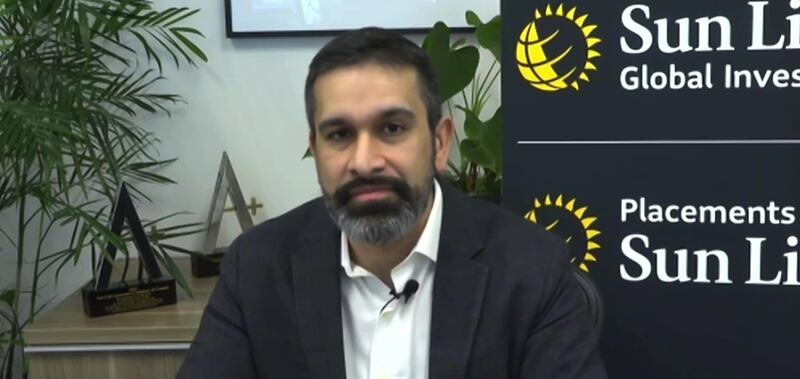
Read the full transcript below:
ANDREW: U.S. President Donald Trump, speaking in Davos, asked a rhetorical question. He said, “Why is the yield on U.S. debt so much higher than other countries?” For example, on the 10-year, the American government is still paying more than four per cent, whereas Japan pays about two-and-a-half per cent, and China less than two per cent.
David Malpass, former U.S. Treasury secretary, wrote in The Wall Street Journal that one of the reasons is that the Fed is still keeping rates too high. Let’s get more on this from Chhad Aul, chief investment officer and head of multi-asset solutions at SLGI Asset Management Inc.
Chhad, I know we’re venturing into politics here, but is there a case to be made that the Fed should be cutting more aggressively?
CHHAD: At this point in time, the Fed has a little bit of time. I think that was the main message we took away from the meeting yesterday — this was very much a textbook neutral pause for now.
The main concerns in the prior couple of meetings had been around the labour market, and it looks like the jobless rate from the most recent data may have arrested that upward climb, at least for now. So they can wait and see and look at the data. The economy still appears relatively strong.
Inflation is still a bit of a question mark, probably at the higher end of an acceptable range, so it makes sense for them to pause at this point. The market is looking kind of past Chair Powell and the end of his term and is still expecting some rate cuts to come in the latter half of this year.
ANDREW: I should clarify that David Malpass was undersecretary of the Treasury under President Trump, has been a Trump adviser, and also worked for Ronald Reagan and George H.W. Bush.
How are you playing bonds right now? Are you interested in U.S. or Canadian bonds with, say, a five-year time horizon?
CHHAD: We have core allocations that are globally diversified, but the U.S. and Canada make up a good chunk of that core bond allocation.
In our base case for this year, U.S. bonds in particular really drive the point home in terms of still-high yields, making them a very good income play. If you look back over the prior five years, investors are not used to deriving that sort of income.
Within the portfolio, in a base case, we think about that high-quality bond allocation primarily as a yield play. You’re getting pretty good income, but the fact that yields are higher also means that if our base case of a strong economy does not play out and you begin to see deterioration or unexpected downside risk, there is a lot of room for yields to fall. That would mean capital appreciation in the bond portfolio.
So you get portfolio insurance against the riskier assets you hold. Bonds remain a very important strategic holding — both for income and for protection if the economy begins to derail.
ANDREW: You think the big takeaway from tech earnings right now — especially looking at stocks like Meta and Microsoft — is that the market will tolerate heavy AI spending, but investors want to see results?
CHHAD: Absolutely. One of our main themes for this year is AI, and that theme is not going away. We see it as a multi-year, beyond-the-cycle theme.
But this year, the focus is definitely shifting toward return on investment, and we’re already seeing that in this first batch of results. The market is becoming more discerning. We’re seeing huge amounts of capital spending on AI, with the hyperscalers planning to spend even more than last year.
As long as top-line growth is keeping pace with or exceeding expectations, the market will tolerate that — and even cheer it. We’re seeing that with Meta. On the flip side, Microsoft is also planning to grow spending, but if sales growth does not keep pace, the stock gets punished.
The market is differentiating between companies that are delivering a return on their AI investments and those that are not. That’s actually a good thing for the theme, especially for investors worried about bubble-like behaviour. The fact that the market is holding companies accountable for top-line growth improves the durability of the AI theme.
ANDREW: And finally, your thoughts on small caps? The Russell 2000 is near record highs, but over the past week or so, small caps have lagged the big names.
CHHAD: In the first couple of weeks of the year, we saw a clear broadening in size, with small-cap stocks playing catch-up to their large-cap peers, particularly the tech-heavy large caps. That reflected a view that the economy is still relatively strong and, in some cases, exceeding expectations.
We also saw broader participation across sectors, with resource stocks leading, but also strong performance from consumer staples and industrials.
More recently, large caps have had a strong run again as earnings have come into focus. It’s a reminder that while market breadth is healthy, the AI theme around mega-cap stocks is not going away. It remains a major theme for this year.
ANDREW: Chhad, thank you very much.
CHHAD: Thank you.
ANDREW: Chhad Aul, chief investment officer and head of multi-asset solutions at SLGI Asset Management Inc.
---
This BNN Bloomberg summary and transcript of the Jan. 29, 2026 interview with Chhad Aul are published with the assistance of AI. Original research, interview questions and added context was created by BNN Bloomberg journalists. An editor also reviewed this material before it was published to ensure its accuracy and adherence with BNN Bloomberg editorial policies and standards.

