Chevron and Exxon reported their weakest annual profits in years, despite record production levels, as lower oil prices and geopolitical uncertainty continue to shape investor sentiment.
BNN Bloomberg spoke with Brian Kessens, senior portfolio manager at Tortoise Capital, about how commodity prices, capital discipline and political risk are influencing investment decisions across the global energy sector.
Key Takeaways
- Lower oil prices, not production levels, were the primary driver behind weaker profits for major energy producers.
- Venezuela represents a long-dated opportunity but carries high political and investment risk that limits near-term capital deployment.
- U.S. assets such as the Permian Basin remain core due to low break-even costs and infrastructure advantages.
- Power demand growth, including from data centres, is creating opportunities across natural gas pipelines and electricity generation.
- Capital discipline, dividends and share buybacks continue to underpin investor appeal in the energy sector.
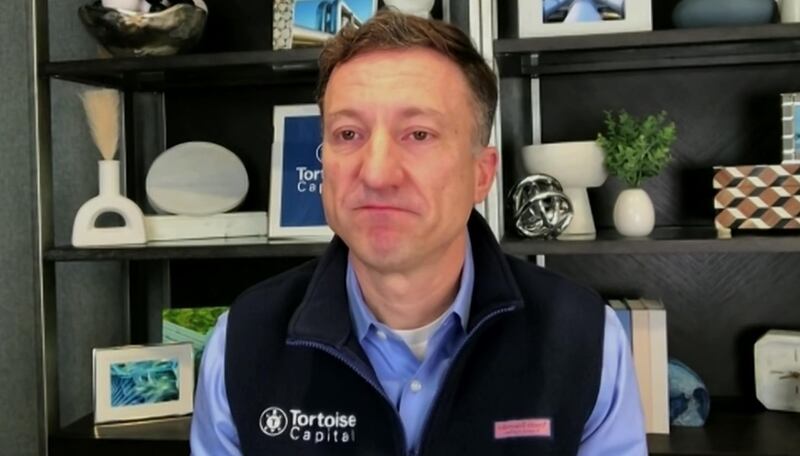
Read the full transcript below:
LINDSAY: Chevron and Exxon reported their lowest annual profits in years, with Venezuela a key focal point. Joining us to dive into the details is Brian Kessens, senior portfolio manager at Tortoise Capital. It’s good to have you with us. Thanks so much for joining.
BRIAN: Hi. It’s my pleasure. Thank you.
LINDSAY: What’s going on here? Despite very high oil production, why did we see such weak profit numbers?
BRIAN: I think it really comes down to commodity prices. Crude oil generally traded lower through 2025, starting around April, and we ended the year fairly weak, with prices in the US$50 range. Despite the fact that both Chevron and Exxon are producing at record levels operationally, commodity prices are a key driver of overall profitability.
LINDSAY: It’s also hard to talk about these two companies without discussing Venezuela, especially given developments over the past few weeks. Chevron has pointed to Venezuela’s potential to deliver more oil in the future. How do you see the opportunity there for each company?
BRIAN: It’s going to be a major topic on both conference calls. Chevron still has operations in Venezuela and appears optimistic it can increase production by at least 50 per cent over time. That said, this is not a short-term opportunity. It likely plays out over an 18- to 24-month period.
For Exxon, it’s an even bigger question mark. The company is not operating in Venezuela today and would need long-term security and investment guarantees before considering a return. It’s an interesting opportunity, but there are many factors that will influence any decision.
LINDSAY: What are some of those factors beyond the long timeline you mentioned?
BRIAN: Venezuela has nationalized assets multiple times, most recently in 2007, when both Chevron and Exxon were operating there. Exxon chose to exit entirely at that point. For either company to reinvest, they would need confidence that political stability will hold over the long term, that their investments would be protected, and that the U.S. government would support their interests if nationalization were attempted again. That’s a very high bar for both companies.
LINDSAY: I wonder if too much expectation is being placed on Venezuela, given those risks and how long it could take to see results.
BRIAN: I think that’s fair. I’d also add that current commodity prices don’t necessarily support increased investment in Venezuela. Break-even costs there are higher than in other parts of both companies’ portfolios, so it may not be the best use of marginal capital right now.
LINDSAY: What about Greenland? There has been talk about Exxon — and potentially Chevron — exploring opportunities there. What do you make of that?
BRIAN: Greenland may be somewhat more constructive than Venezuela. While there is still uncertainty, working with Denmark and other European partners offers more stability. Beyond oil and gas, there’s also potential for other energy commodities and critical minerals, which could make the region strategically attractive over time.
LINDSAY: Let’s talk about the Permian Basin. What’s the latest on Exxon’s operations there?
BRIAN: The Permian is really a crown-jewel asset for Exxon. The company reiterated recently that it’s targeting production of about 2.5 million barrels per day by 2030. We expect continued investment there. Relative to the rest of its portfolio, the Permian has some of Exxon’s lowest break-even costs, so it remains a core focus in the U.S.
LINDSAY: Beyond Exxon and Chevron, are there other energy names you’re watching closely?
BRIAN: One is Williams Companies. It’s not a producer, so it’s less directly tied to commodity prices. Williams operates one of the most valuable natural gas pipeline networks in the U.S., moving gas from the Gulf Coast to the eastern seaboard, including the New York City area. The company is also exploring ways to support power demand from data centres and LNG exports, which we see as a creative use of its existing assets.
LINDSAY: Constellation Energy is another name you’ve mentioned.
BRIAN: Yes. Constellation is an independent power producer, which allows it to benefit from higher electricity prices. In regions like the Northeast and Mid-Atlantic, reserve margins are thin. With rising demand through 2030 and recent cold weather driving power usage, spot prices have already spiked early this quarter. That sets up the potential for outsized profits.
LINDSAY: And finally, the largest U.S. exporter of natural gas.
BRIAN: That would be Cheniere Energy. It’s the largest publicly traded LNG exporter in the U.S. and globally. The company continues to expand export capacity without issuing new equity, while also buying back shares and growing its dividend, all while maintaining an investment-grade balance sheet.
LINDSAY: Fascinating insights. That’s all the time we have. Brian, thanks so much for joining us.
BRIAN: My pleasure. Thank you.
LINDSAY: That was Brian Kessens, senior portfolio manager at Tortoise Capital.
---
This BNN Bloomberg summary and transcript of the Jan. 30, 2026 interview with Brian Kessens are published with the assistance of AI. Original research, interview questions and added context was created by BNN Bloomberg journalists. An editor also reviewed this material before it was published to ensure its accuracy and adherence with BNN Bloomberg editorial policies and standards.

