Canada’s inflation rate slowed to 2.3 per cent year over year, reinforcing expectations that price pressures are stabilizing even as investors grapple with volatility tied to AI spending and sector rotation.
BNN Bloomberg spoke with Sadiq Adatia, chief investment officer at BMO Asset Management, who said the Bank of Canada is unlikely to cut rates in the near term and that investors are rotating away from high-valuation technology shares while maintaining conviction in gold and emerging markets.
Key Takeaways
- Inflation in Canada and the U.S. is expected to remain relatively tame, reducing pressure on central banks even as tariffs create modest headwinds.
- The Bank of Canada is unlikely to cut rates in the coming quarters unless USMCA negotiations deteriorate significantly and weigh on growth or employment.
- AI-related capital spending remains elevated, but investor concern over debt-funded expansion is fuelling volatility and rotation away from high-valuation technology stocks.
- Gold remains overweight as a hedge against geopolitical risk, currency uncertainty and broader market volatility.
- Emerging markets are viewed as offering stronger structural growth than Canada, supported by trade developments, expanding middle classes and technology leadership in parts of Asia.
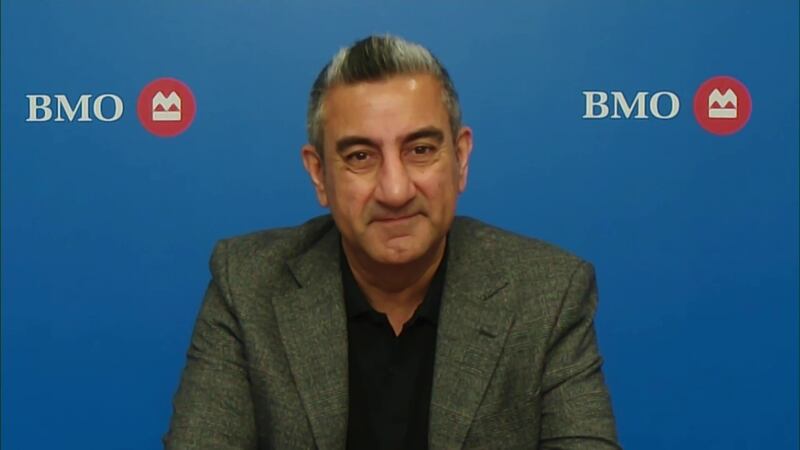
Read the full transcript below:
ANDREW: The headline inflation rate slowed slightly to 2.3 per cent year over year last month, though some of that was distorted by base-year effects related to gas prices. Let’s get perspective from Sadiq Adatia, chief investment officer at BMO Asset Management. Sadiq, always great to have you with us. Thanks for joining us.
SADIQ: Thanks for having me.
ANDREW: Did anything jump out at you in these inflation numbers?
SADIQ: No, this is largely what we were expecting. Inflation is likely to remain relatively tame in both Canada and the United States. Tariffs have had some impact, but not as severe as initially feared. We’re seeing broad-based steadiness in inflation across most categories, and that’s a positive sign for consumers. Costs are not surging, particularly at a time when many households are carrying significant debt. With interest rates in Canada unlikely to fall soon, stable inflation is encouraging.
ANDREW: Last week, Citi said it continues to see signs the Bank of Canada is moving slowly toward cutting rates again. What is your expectation for the Bank of Canada this year?
SADIQ: At this point, we don’t expect the Bank of Canada to cut rates. Inflation is near the lower end of its target range, but the bar for cutting is high. We’re not seeing a significant rise in job losses, and the economy is not deteriorating sharply. A rate cut would likely require either a clear economic downturn or inflation falling well below target.
The key risk is the USMCA negotiations. If talks deteriorate and that weighs on growth or employment, then the Bank of Canada could be forced to respond. But over the next few quarters, we don’t see rate cuts as the base case.
ANDREW: Looking at the Canadian dollar, we haven’t seen a dramatic move. Surprise cuts would typically pressure the loonie, wouldn’t they?
SADIQ: Yes. Over the past year, the U.S. dollar has generally weakened against global currencies as capital flows shift and markets price in potential U.S. rate cuts. With Canada not expected to cut, the interest-rate differential has supported the Canadian dollar.
That said, much of the U.S. dollar’s weakness may already be reflected. In the coming months, the U.S. dollar could hold its ground against the Canadian dollar, especially amid uncertainty around USMCA negotiations. Any pressure on Canada would likely strengthen the U.S. dollar and weigh on the loonie. There is still a lot to watch on both rates and currency.
ANDREW: What about gold? It’s off its highs. Do you believe portfolios should maintain some exposure?
SADIQ: We remain bullish on gold. We’ve held an overweight position since 2023 for a variety of reasons, and while those drivers have evolved, geopolitical risk remains central. Recent pullbacks have not changed the broader trend, and gold has still outperformed this year.
Central banks continue to add to their holdings, investors are hedging against U.S. dollar risk, and geopolitical uncertainty remains elevated. Gold plays both an upside and a defensive role in portfolios, particularly in volatile environments.
ANDREW: On technology and AI, you don’t see a bubble, but how are you approaching the sector?
SADIQ: We believe AI will continue to drive productivity and transformation, and selective companies can still outperform. Capital spending remains strong. The risk is less about a bubble and more about perception. If investors believe valuations are stretched, volatility increases.
That’s why risk management and diversification are critical. We’re seeing rotation out of high-valuation names into lower-multiple companies, including more traditional sectors. The AI story remains intact, but positioning needs to be balanced.
ANDREW: What about traditional software names? Have they been oversold?
SADIQ: In some cases, yes. Valuations had become expensive, and we’re seeing rotation within technology — for example, into certain hardware segments such as memory. Some software names have experienced sharp pullbacks not fully tied to long-term fundamentals.
For long-term investors, these dislocations can present opportunities. The key is to scale in gradually rather than commit all at once, allowing valuations to stabilize.
ANDREW: Let’s talk about the significant capital spending on AI infrastructure in the U.S., particularly data centres. Is there a risk it has gone too far, especially if companies are funding it with debt?
SADIQ: That’s a major debate among investors. When capital spending shifts from being funded by cash flow to debt, the required return threshold rises. Some companies have already faced scrutiny for that.
However, it’s difficult to bet against leading technology firms that have historically transformed industries. The benefits of AI — productivity gains, margin expansion and new business models — are already emerging. The question is timing: how quickly will returns justify today’s spending?
We expect capital spending to remain elevated this year, reinforcing the long-term commitment to AI infrastructure.
ANDREW: If a company like OpenAI were to significantly reduce spending, could that create ripple effects across suppliers?
SADIQ: There are clear interconnections across the ecosystem — chipmakers, software providers and data-centre operators. A pullback by one major player could have spillover effects.
That said, demand remains strong globally. China is advancing rapidly in AI, and other regions continue to invest. There are also supply constraints in areas such as chips, energy and land for data centres. While risks exist, it is still too early to conclude they outweigh the long-term benefits.
ANDREW: The TSX recently hit a record high. Do Canadian equities offer better value than U.S. stocks?
SADIQ: From a valuation perspective, Canada looks more attractive than the U.S. and some other regions. It can also provide relative resilience in volatile markets due to its exposure to commodities and precious metals.
However, from a growth standpoint, we see stronger prospects in the U.S. and emerging markets. Canada relies heavily on gold, financials and energy leadership. In contrast, the U.S. offers broader sector diversification, and emerging markets provide structural growth opportunities.
ANDREW: So you see emerging markets as more attractive than Canada?
SADIQ: Yes. Countries such as India and China have large and expanding middle classes. Recent trade developments, including agreements involving India and the European Union, support growth prospects. While China faces property-sector challenges, there are signs of stabilization.
Emerging markets also include technology leaders such as Taiwan and South Korea, as well as commodity producers like Brazil. After a strong year globally, we believe emerging markets could deliver another solid year of returns.
ANDREW: Sadiq, thanks very much. Sadiq Adatia, chief investment officer at BMO Asset Management.
---
This BNN Bloomberg summary and transcript of the Feb. 17, 2026 interview with Sadiq Adatia are published with the assistance of AI. Original research, interview questions and added context was created by BNN Bloomberg journalists. An editor also reviewed this material before it was published to ensure its accuracy and adherence with BNN Bloomberg editorial policies and standards.

