Loblaw shares slipped after fourth-quarter results that met earnings expectations but missed on revenue, while National Bank reported improving credit trends and steady growth in key divisions. Both stocks are trading at premiums to historical valuation levels, prompting a more cautious stance from some investors.
BNN Bloomberg spoke with Garnet Anderson, head of portfolio management at Tacita Capital, who said elevated valuations across defensive retail and Canadian banks could limit near-term upside, even as underlying fundamentals remain relatively solid.
Key Takeaways
- Loblaw posted modest same-store sales growth in grocery of 1.5 per cent, trailing food inflation, while pharmacy sales were stronger, reflecting the ongoing contribution from Shoppers Drug Mart.
- The grocer trades at roughly 26 times forward earnings, near the high end of its historical range, raising questions about how defensive the stock would be in a broader downturn.
- Loblaw’s $2.4 billion 2026 capital plan includes 70 new stores, 191 renovations and continued distribution centre investment, with spending equivalent to roughly two per cent of total assets.
- National Bank reported lower provisions for credit losses year over year, as economic conditions proved more resilient than feared earlier in 2025.
- Canadian banks are trading at roughly a 25 per cent premium to long-term valuation averages, suggesting future share price gains may depend more on earnings growth than multiple expansion.
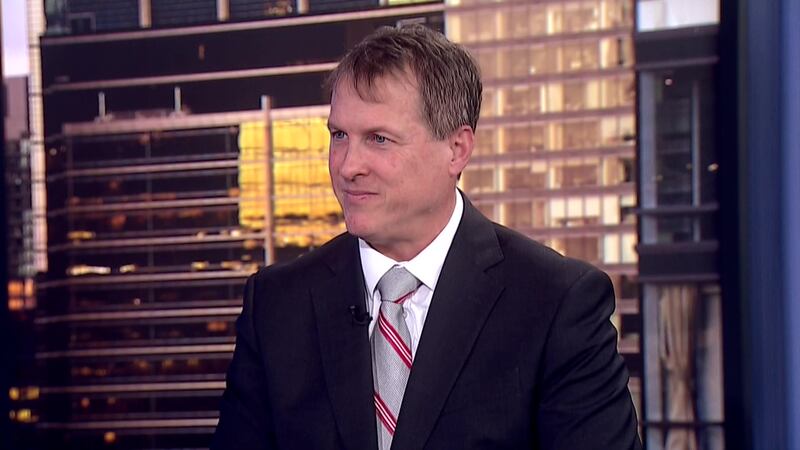
Read the full transcript below:
ANDREW: So investors are kind of “meh” about those Loblaw numbers, the stock slipping. Let’s get more from Garnet Anderson, head of portfolio management at Tacita Capital. Thanks for joining us.
GARNET: Good morning.
ANDREW: You reckon this is an expensive stock, so any slip, it could be vulnerable?
GARNET: Exactly. If you’re just meeting target — I mean, by a penny — I don’t think the market’s going to get overly excited about that. You mentioned same-store sales. On the grocery side, up one and a half per cent, which is lower than what food inflation was. So that’s not a great bell ringer. The pharmaceuticals, or the pharmacy aspect, that’s doing well. I think that was very much a positive. We were just chatting about how the purchase of Shoppers Drug Mart a number of years ago, yeah, it’s looking like a great step there. So when you take a look at a stock that’s up at 26 times next year’s earnings, which is interesting for something that’s supposed to be a defensive stock —
ANDREW: Yeah.
GARNET: It’s kind of an interesting little oxymoron there.
ANDREW: But such a high-growth industry.
GARNET: No, it’s not. I mean, and when you’re talking about revenue up and then profit up, but profit up — but, you know, so they came in a little bit light versus expectations, year over year. Growth, OK, positive. You can see where they continue to stretch out and adjust to the economic cards that they’ve been dealt. So what is that? Muted population growth, to the Canadian consumer that’s a little bit stretched. When you take a look at their big development plan for 2026, it’s continue to go and complete the construction of their distribution centres. It’s to go and target new stores, geared more at the more cost-conscious consumer, and go out and refurbish stores with the eye of trying to drive up those same-store sales, right? Because you take a look at how they’re placing merchandise and how they’re doing non-groceries. Now, that’s a decent part of their market, and that saw a little bit of same-store sales growth up in the two per cent range. So that was a bit of a positive. So how they move those chess pieces around to try to maximize the assets, they’re certainly paying attention. They announced their Google Gemini shopper tool. Haven’t seen it yet, but I’m sure it’s wonderful. Again, a step in trying to maximize the efficiency of the stores, using AI, because they’re competing against the Walmarts and so forth that are certainly going in there hard and heavy on those investments. So Walmart, I think, had to step up to the plate. And that’s when you’ve got a big capital distribution plan coming up, the market will take a step back. As a share of its total assets, it’s two per cent, give or take, for 2026, this big spending plan. Two per cent I don’t think is going to shock the market into retreat, sort of thing. How they go and fund it — and also, if they did — and they will — if they had to raise equity, good price to raise equity at. They certainly have debt capacity, if need be. Their credit rating is fine, triple B plus. So no concerns, but not surprised at a step back today. It remains a hold in our portfolio, not something we’re necessarily looking at adding to. We would love to add more to the defences in the portfolio, but at these valuation levels, not sure how much defence we will get for the first 10 or 20 per cent drawdown whenever the next bear market is.
ANDREW: I wonder if you open new stores, is there a risk of cannibalization? Because, I mean, they’ve got so many stores already.
GARNET: Well, they certainly do. Having said that, they’ve been doing this for a long time, and they would surely understand. They’re using something more than just the census data that we would have access to when deciding where they’re putting down those new stores, and the type of new stores. And like their T&T, there was a lot of news about that last week, as analysts came out with a good profile on that.
ANDREW: They did a mega report.
GARNET: Yeah, they did a great job there. So where are you going to put one of those stores? Well, you’re figuring out the demographics and the growth in the demographics, the income characteristics of those households, and can it support a store or not? So they’re disciplined.
ANDREW: Yeah. T&T — I was hoping to do something on commodities tomorrow. I glanced at the report, because that’s their Asian supermarket, and they’re expanding those into America as well.
GARNET: Well, they’ve got two in the U.S., and they have two down there right now, out on the West Coast, and they’ve done very well. They’ve benchmarked against other local competitors. And so the goal is — or that report spoke to — the ability to take a look at the Asian, or the Eastern Asian, population in the States, how many stores that could support. Take away the competitive stores that are already there. What’s that opportunity? They say it was a big number. Now, that will be a longish buildout. And before we ring the bell on that, I always kind of go, retailer going into the U.S. — let’s just see how they march it out. We watched Dollarama step it down in Latin America. You just have to go at a measured pace.
ANDREW: What about National Bank? Are you interested in that stock?
GARNET: Yes, we’ve got it in our portfolio. It has done well. It trailed and then it hurried up and caught up and did very well. And then the past couple of months has kind of settled back a little bit. Again, when you take a look at not just National, you take a look at the other banks, they are trading, call it about a 25 per cent premium on their valuation metrics compared to historical norms. So again, not cheap. But are they firing on all cylinders? You take a look at National, which, again, when I checked this morning, it was up nicely. Their loan book, their commercial and their personal banking, that was up over the year. Their loan-loss provisions came in a little bit, which is nice to see compared to where we were a year ago. You know, everybody was running around going, “Oh my goodness, what are the bad-loan provisions going to have to be?” But no, those have kind of come back as the economy’s proven a bit resilient. The wealth management arm — if wealth management divisions aren’t doing well with the bull market that we’re in, something’s wrong. So they pumped out the numbers there. And capital markets — I thought capital markets for National was a little bit lighter than I would have thought, but not dramatically. So not surprised to see that. And they still have the Canadian Western Bank acquisition coming in that they’re digesting. They seem to be making progress quite well, and the market remains excited about that opportunity set.
ANDREW: Let me just very briefly touch on — I didn’t know Dollarama tried going into the States. They did go into Latin America.
GARNET: Yes, it was Latin America.
ANDREW: Yeah. I don’t know if they’ve tried the States yet, but I’m sure they’re thinking about it. Garnet, thank you very much indeed. Garnet Anderson, head of portfolio management at Tacita Capital.
---
This BNN Bloomberg summary and transcript of the Feb. 25, 2026 interview with Garnet Anderson are published with the assistance of AI. Original research, interview questions and added context was created by BNN Bloomberg journalists. An editor also reviewed this material before it was published to ensure its accuracy and adherence with BNN Bloomberg editorial policies and standards.

