U.S. President Donald Trump’s State of the Union address provided little new insight into the administration’s next economic steps, as attention turns to how trade policy will evolve following the Supreme Court’s tariff ruling.
BNN Bloomberg spoke with Preston Caldwell, chief U.S. economist at Morningstar, who said the speech was largely backward-looking, with the more meaningful economic implications likely to stem from pending Section 301 tariff investigations and the eventual pass-through of tariff costs to consumers.
Key Takeaways
- The State of the Union speech did not introduce major new economic proposals expected to alter the near-term U.S. outlook.
- The outcome of Section 301 investigations will determine tariff levels after the 150-day Section 122 measure expires.
- Tariffs have generated more than US$100 billion in revenue but are viewed as an inefficient tax applied to a narrow base.
- Limited pass-through to consumers has so far muted the economic drag from tariffs, though that could shift if duties remain in place.
- U.S. private fixed investment would be contracting if not for AI-related spending, with manufacturing showing little sustained benefit from tariffs.
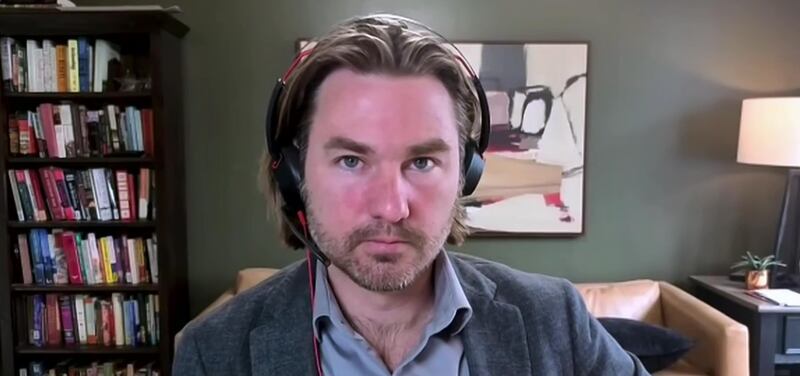
Read the full transcript below:
ANDREW: U.S. President Donald Trump, in his State of the Union address, said the U.S. economy has never done better. That comes after the U.S. Supreme Court’s decision to overturn some of his global import levies. Let’s look at the broader economic impact, including here at home.
Preston Caldwell is chief U.S. economist at Morningstar. Preston, thank you for joining us.
President Trump, as politicians do, praised his own record. Did anything concrete stand out to you economically in the State of the Union address?
PRESTON: No. It was a fairly backward-looking speech making the case for the administration’s performance so far. I didn’t glean much about what’s to come for tariffs.
We’re going to have to wait weeks, and even months, to see how the tariff situation shakes out. What’s key are the Section 301 tariffs that could come into place for various countries after the 150 days of the Section 122 tariffs expire.
Those Section 301 investigations take quite a bit of time. If you think back to 2018 and 2019 in the first Trump administration, when those were levied on China, that was a prolonged, multi-month process. It’s not like the IEEPA tariffs that were just struck down, which could be put in place with the stroke of a pen. There’s a massive amount of paperwork, documentation and argumentation required. So we’ll be waiting a while to see what the longer-term tariff regime looks like.
ANDREW: Tariffs have been a money machine for the U.S. government, generating well over US$100 billion in revenue. Some have likened them to a sales tax, which would be politically difficult at the federal level. Broadly, have tariffs been a win for the United States?
PRESTON: In our analysis, tariffs are a significant efficiency drag on the economy in the long run.
What I will say is that many of the ill effects haven’t yet materialized in the U.S., because very little of the tariff cost has been passed on to final consumers. As a result, there’s been relatively little change in economic decision-making.
In 2025, companies were still selling pre-tariff inventory, so they didn’t feel compelled to raise prices. They were also waiting on the Supreme Court decision. Now, with high tariffs lasting at least another 150 days — and possibly longer, depending on the Section 301 investigations — companies may pass on more of those costs. Once that happens, the negative economic consequences will likely become more apparent.
ANDREW: In the sense that goods more efficiently produced outside the United States will cost more?
PRESTON: Precisely. You mentioned the revenue benefits, and that’s a few tenths of a percentage point of GDP — not insignificant.
But tariffs are generally considered an inefficient way to tax. They involve a high tax rate applied to a narrow tax base. All taxes have efficiency costs, but tariffs are typically viewed as particularly distortionary.
ANDREW: And rebuilding America’s manufacturing base — if that’s possible — would take decades. These are slow-moving shifts.
PRESTON: We haven’t seen evidence of that yet. Manufacturing employment and output have been flat to down over the past couple of years. There hasn’t been a clear boost to U.S. manufacturing from tariffs so far.
That ties back to the fact that consumer prices haven’t moved much. Without a price signal, consumers haven’t shifted meaningfully from imported to domestic goods.
ANDREW: There’s also been relatively weak business investment in the U.S., something Canada is grappling with as well.
PRESTON: As of the fourth quarter of 2025, private fixed investment in the U.S. would have been in negative growth territory if not for AI-related spending. Artificial intelligence is the single largest driver propping up fixed asset investment right now.
Other sectors are still feeling the effects of high interest rates, among other factors. Private fixed investment remains vulnerable, and it’s an open question how long the AI investment boom will last.
ANDREW: We’re out of time, but we’d love to have you back to discuss the sustainability of that AI investment curve. Thank you, Preston.
PRESTON: Thank you.
ANDREW: Preston Caldwell, chief U.S. economist at Morningstar.
---
This BNN Bloomberg summary and transcript of the Feb. 25, 2026 interview with Preston Caldwell are published with the assistance of AI. Original research, interview questions and added context was created by BNN Bloomberg journalists. An editor also reviewed this material before it was published to ensure its accuracy and adherence with BNN Bloomberg editorial policies and standards.

