Global stocks remain under pressure as oil prices top $100 a barrel and investors assess the risk that the conflict in the Middle East could drag on longer than expected.
BNN Bloomberg spoke with Johnny Russell, portfolio manager of global equities at Amova Asset Management, about how massive AI-related capital spending and shifting investor sentiment are driving major rotations across sectors and regions.
Key Takeaways
- Oil rising above $100 a barrel is adding pressure to equities as investors weigh the risk of a prolonged Middle East conflict.
- Massive AI infrastructure spending — expected to reach roughly $650 billion in 2026 — is shifting investor focus toward industrial and energy supply chain companies.
- Companies tied to power infrastructure, cooling systems and electrical equipment are benefiting from rising demand tied to data centre expansion.
- Software stocks have faced an indiscriminate selloff as investors reassess pricing power and competitive advantages in the age of AI.
- Higher gasoline prices act as a tax on consumers, potentially weighing on consumer-facing sectors while favouring more defensive businesses.
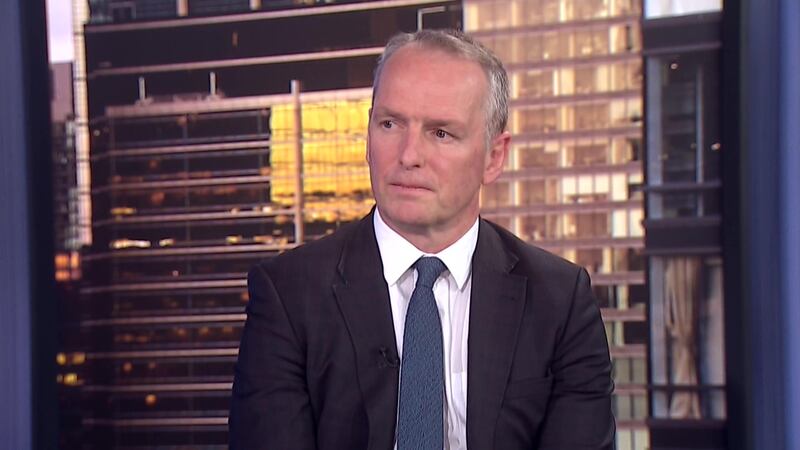
Read the full transcript below:
ANDREW: Right. So the price of oil topped $100 this weekend. Investors are worried this conflict in the Middle East could drag on. We’re joined by Johnny Russell, portfolio manager of global equities at Amova Asset Management. Johnny, thanks very much for joining us.
JOHNNY: Good morning.
ANDREW: We’ve heard from at least one guest today that this will blow over and that the oil price will come down. Is it factoring into your strategy at all right now when it comes to picking stocks?
JOHNNY: Yeah, well, we’d probably expect that as well. History would suggest that when you get a spike like that, you sell into the spike rather than actually go after it. We’re long-term investors as well, so we need to consider what the price would be longer term. So really thinking about the fundamental supply and demand. It does impact how we think about risk around the portfolio, but actually it throws up opportunities in other parts of the market, and that’s where we’re looking for our ideas.
ANDREW: You and other observers say there has been this major shift out of the AI hyperscalers into other stocks.
JOHNNY: Yeah. I mean, it’s like shoving an elephant into a small jam jar. There’s so much money involved. You’re looking at about $650 billion-plus for 2026 in terms of capex being spent across industrials, materials, some energy, power markets, cooling for data centres and construction. There’s a long list, but relatively small whenever you think about the scale of that spend. Because that spend is so big, it’s the equivalent of the GDP of Sweden. So it’s hard to actually imagine the scale of that spend.
ANDREW: Sorry — inflating prices for electrical equipment and things like that.
JOHNNY: Yeah, absolutely. It provides pricing power for these companies. They have to increase capacity and some of them have order books out to 2030, so a very strong position for those companies.
ANDREW: Not necessarily talking about any individual stocks here, but a name like Eaton, for example — not necessarily meaning that company.
JOHNNY: Yeah. There are companies like Eaton. In Europe, a competitor would be Schneider Electric. We hold in Japan Hitachi, which is a leader in transformers and switchgear. So companies like that are really benefiting from the scale of the spend. We’ve also seen really strong results from a U.S. company like Vertiv, which operates in electrical infrastructure, HVAC and the data centre space.
ANDREW: So these old industrial stocks are gaining big time here.
JOHNNY: Yeah. The market is on to that. Investors realize the businesses are doing very well. It’s quite unusual for that part of the industrial space to do so well, but they are benefiting from this investment cycle.
ANDREW: What about consumer stocks? Are you seeing bargains in North American consumer stocks at all?
JOHNNY: You can’t really ignore what’s happening in the Middle East whenever you think about consumer stocks. Higher gasoline prices are effectively a direct tax on the consumer, so that has an impact. The opportunities we’re seeing are more in defensive areas — companies that have been left behind. You had a guest talking about Walmart and Costco. Not companies like that, but other businesses that may have been sold off in the last few months where valuations are low and there are opportunities there.
ANDREW: What about software names? We have seen a bounce in things like Thomson Reuters. I’m not even sure about Salesforce — that’s been a poster child for companies being hammered. Do you see bargains in some of those traditional software stocks?
JOHNNY: Yeah. The whole group has been sold off very aggressively, and it’s been fairly indiscriminate. Whenever there is a selloff like that, there will be opportunities. The way we think about it is that AI is threatening these businesses in terms of their pricing power and their competitive advantage. So you need to be pretty sure the companies you select will maintain their competitive advantage and pricing power. If they can, those are good opportunities.
ANDREW: Thomson Reuters says it has exclusive data that lawyers need. You’re looking for exclusivity.
JOHNNY: Yeah, exactly. I don’t know Thomson Reuters well enough, though I also know there are AI competitors out there that are eating away at parts of that business. So there are definite question marks. The market was very willing to pay years in advance for some of these businesses, and now it’s shortening that time horizon. I think that’s probably fair.
ANDREW: You’re from Belfast and based in Edinburgh.
JOHNNY: Yeah.
ANDREW: From a European-based portfolio manager’s perspective, how do things look under the Trump administration? Without getting too political — although you can if you want. From a European perspective there must be a lot of head scratching about what direction the White House might go next on trade.
JOHNNY: Yeah. We’ve had tariffs, and tariffs have been a huge concern globally, but equity markets have largely rolled right through that. Europe is in a difficult place politically, and we can see that even with what’s happening in the Middle East. Natural gas prices have spiked significantly — more so than crude — and that has a direct impact on electricity prices for consumers. That feeds into politics as well. Europe is having to rearm itself and confront this new environment, and it is doing that, but it will take some time.
ANDREW: U.K. stocks, as measured by the FTSE, are up about three per cent over the past year. Is there a lot of defence exposure in the British index?
JOHNNY: Yeah, there is some defence exposure. The index is largely made up of pharmaceuticals, banks, materials, energy companies and some defence stocks. You have companies like BAE Systems and Rolls-Royce. Rolls-Royce is a good example of a company that feeds into commercial aerospace, defence aerospace and also turbine production for power generation, including for data centres. So it has several growth drivers.
ANDREW: Johnny, thank you very much indeed.
JOHNNY: Thank you.
ANDREW: Johnny Russell, portfolio manager of global equities at Amova Asset Management.
---
This BNN Bloomberg summary and transcript of the March 9, 2026 interview with Johnny Russell are published with the assistance of AI. Original research, interview questions and added context was created by BNN Bloomberg journalists. An editor also reviewed this material before it was published to ensure its accuracy and adherence with BNN Bloomberg editorial policies and standards.

