The Bank of Canada held its key interest rate steady, highlighting rising uncertainty as geopolitical tensions and oil prices complicate the economic outlook.
The decision underscores a delicate balance between slowing growth at home and renewed inflation risks tied to global supply shocks.
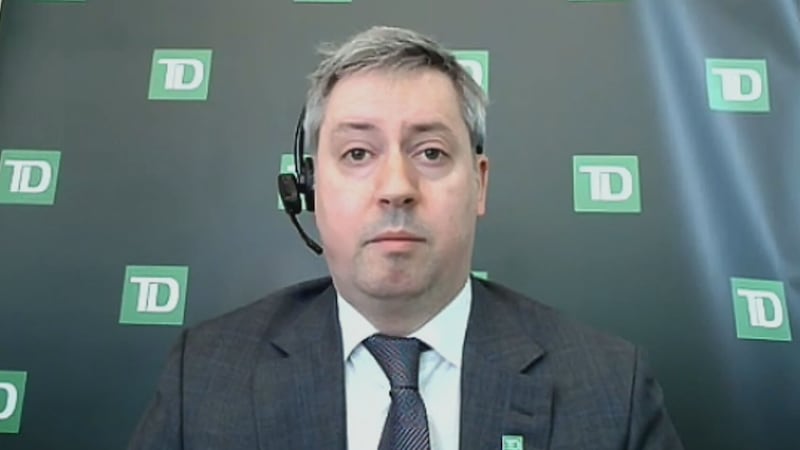
BNN Bloomberg spoke with Andrew Kelvin, head of Canadian and global rates strategy at TD Securities, who said the central bank is maintaining flexibility as it assesses weaker domestic data alongside persistent geopolitical uncertainty.
Key Takeaways
- The Bank of Canada held its benchmark rate at 2.25 per cent, as expected, while signalling increased concern about near-term economic growth.
- Policymakers see downside risks to growth from weaker domestic data, including soft labour markets and slowing household spending.
- Rising oil prices present a mixed impact, supporting the energy sector while weighing on consumers and adding inflation risk.
- The central bank is maintaining optionality, avoiding firm guidance as it assesses evolving geopolitical and economic conditions.
- Financial markets, including bond yields and the Canadian dollar, are expected to remain sensitive to oil price movements and policy expectatio
Read the full transcript below:
LINDSAY: As we mentioned, the Bank of Canada is holding interest rates as expected, despite concerns about inflationary pressures from the conflict in the Middle East.
Here to tell us what we learned today and what this decision signals about the central bank’s path forward for the rest of the year is Andrew Kelvin, head of Canadian and global rates strategy at TD Securities. Good to have you with us. Thanks so much.
ANDREW: Thanks for having me. It’s always a pleasure.
LINDSAY: We’re set to hear from the Bank of Canada governor in about half an hour, but we do have the statement. It seems to focus heavily on the conflict in the Middle East in terms of today’s decision. Do you think that factored into the decision? We did expect this, given what Tiff Macklem has said previously.
ANDREW: Yeah, it absolutely did factor in. The Bank of Canada finds itself caught between a bit of a rock and a hard place.
The interesting thing from the statement is that the Bank of Canada is quite concerned about the near-term outlook for growth. They signalled that risks to the near-term growth profile are skewed to the downside, and they declined to make an assessment on what high oil prices will mean for the Canadian economy.
The knee-jerk reaction would be to say high oil prices are good — Canada is a big energy producer — but they seem more focused on tighter financial conditions, what’s happened in equity and bond markets, and the potential for supply chain disruptions.
So they are still concerned about the state of the economy, but at the same time, with oil prices rising, they are determined not to let inflation get out of control again.
LINDSAY: What do you think about that? I’m sure Tiff Macklem will be asked how high oil prices are affecting Canada’s economy today, but do you think it’s been a benefit or a drag? Or does it depend on where you look?
ANDREW: If things stay where they are today — meaning interest rates don’t move higher further out the curve and we don’t see further tightening in financial conditions — I wouldn’t look at current oil prices as a clear positive for Canada’s economy.
On net, it will hit the household sector negatively, but it will benefit the energy sector substantially. Our rule of thumb is that a 10 per cent increase in oil prices adds about a tenth of a percentage point to Canadian GDP growth.
If prices stabilize at these levels, it could be a net positive. But this is a supply shock driven by geopolitics, and the Bank of Canada has been concerned about geopolitical uncertainty. That uncertainty has not declined, and second-order effects could offset the boost from higher energy prices.
LINDSAY: Is there a risk of reacting too soon to the conflict in the Middle East?
ANDREW: I think there is, and that’s why the Bank is trying to play for time. It’s hard to predict the path of the economy even in normal conditions, and with the duration of the conflict still unknown, it’s even harder.
So the smart thing is to sit tight and maintain flexibility. If they need to hike in three or four months — which I don’t think is likely — they can. If they need to provide more stimulus, they can do that too.
Maintaining that optionality is probably the best approach right now.
LINDSAY: You mentioned concerns about the economy. What domestic factors do you think the Bank is focused on? We’ve seen GDP contraction, a cooler housing market and job losses. What matters most for rate decisions?
ANDREW: All of those factors matter. If the labour market remains weak, that raises concerns about both inflation and growth.
The Bank will be looking closely at the health of the consumer. Household spending is the largest component of Canada’s economy, and households are still feeling the impact of high prices, even as inflation has eased somewhat.
If households pull back further — especially alongside slower population growth — that could prompt the Bank to consider providing more stimulus.
LINDSAY: Let’s talk about market reaction, starting with the loonie. What do you expect following today’s decision?
ANDREW: Given the slightly dovish tone of the statement, it would make sense for the Canadian dollar to weaken a bit.
That said, markets expected the hold, and they’re pricing in the Bank staying on hold for the next few meetings. The Bank didn’t commit to staying on hold for the rest of the year, nor did it rule out hikes.
Markets still have some expectation of a rate hike by the end of 2026. For the loonie to weaken further, you’d likely need to see that pricing disappear or a more definitive signal from the Bank.
LINDSAY: What about business investment and productivity? Do higher oil prices lead to more investment?
ANDREW: I don’t think so. It will be a test of whether policy changes make Canada more attractive for resource investment, but historically, energy companies haven’t rushed into large capital expenditures based on short-term price moves.
These are long-term projects, and with uncertainty around how long this price shock will last, it’s hard to justify major new investments.
I’d be surprised to see a significant rush of capital, especially given the uncertain global environment.
LINDSAY: Lastly, we’re also watching the U.S. Federal Reserve today, alongside stronger-than-expected PPI data. What are you expecting?
ANDREW: We expect the Federal Reserve to remain on hold. There could be a couple of dissents in favour of cuts, but overall, with inflation still elevated and the U.S. economy holding up reasonably well, we think Chair Powell will keep rates at 3.75 per cent.
Rate cuts are more likely a story for later in the year.
LINDSAY: We’ll leave it there. Andrew Kelvin, head of Canadian and global rates strategy at TD Securities. Thanks so much for joining us.
---
This BNN Bloomberg summary and transcript of the March 18, 2026 interview with Andrew Kelvin are published with the assistance of AI. Original research, interview questions and added context was created by BNN Bloomberg journalists. An editor also reviewed this material before it was published to ensure its accuracy and adherence with BNN Bloomberg editorial policies and standards.

