North American stock futures are rising on signs of potential de-escalation in the Middle East, but uncertainty around oil supply and inflation continues to weigh on sentiment.
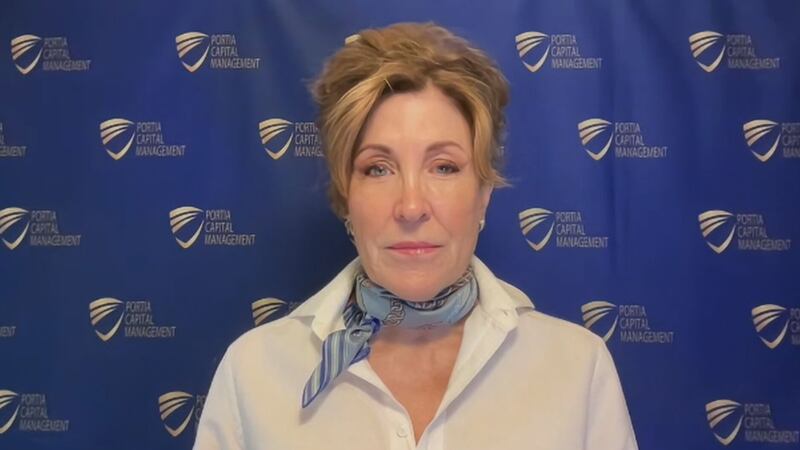
BNN Bloomberg spoke with Michelle Connell, president and owner at Portia Capital Management, about whether investors should move to cash, how energy disruptions are shaping risks and where opportunities remain in equities.
Key Takeaways
- Roughly 20 per cent of global oil and LNG supply flows through the Strait of Hormuz, raising risks of prolonged energy-driven inflation.
- Markets typically require oil prices to double before triggering major equity declines, suggesting current conditions may not derail stocks.
- Strong earnings expectations, including double-digit growth for the S&P 500 and robust tech demand, continue to support equities.
- Nvidia’s valuation has fallen sharply while demand for AI chips remains strong, with significant revenue growth projected through 2027.
- Gold miners, down about 25 per cent, offer leveraged upside and remain a hedge against persistent inflation and rising government deficits.
Read the full transcript below:
ANDREW: We have North American stock futures, or U.S. stock futures, pointing upward today. There are reports that President Donald Trump has told aides he is willing to end the war on Iran without fully reopening the Strait of Hormuz. But there’s plenty of uncertainty hanging over markets. Let’s get the latest from Michelle Connell, president and owner of Portia Capital Management. Michelle, thanks very much for joining us.
MICHELLE: Thanks for having me, Andrew.
ANDREW: What are you paying most attention to when you wake up in the morning? What do you search for on your phone first these days?
MICHELLE: It’s really hard, isn’t it? Every day there’s a different headline, a different tweet from Trump. So you have to go with the volatility and focus on the long term, not the short term and all the noise.
ANDREW: Are you seeing opportunities right now in stocks that you’ve long had an eye on but are now cheaper?
MICHELLE: Definitely. For instance, I’m a tech person by background, going back to the late 1990s. Nvidia looks very enticing here. At the end of January, Nvidia’s P/E, or price-to-earnings ratio, was 40 times. Since then, it’s been cut in half. For the first time in quite a while, its forward P/E is almost equivalent to the S&P 500. But keep in mind, Nvidia keeps raising its revenue estimates. Earlier this month, the CEO said they could sell $1 trillion in artificial intelligence chips between now and the end of 2027.
ANDREW: One trillion dollars just in the AI business?
MICHELLE: Yes.
ANDREW: It’s interesting, though — the crunch on raw materials from the Gulf, not just energy but aluminum and helium. You mentioned helium is vital for making semiconductors.
MICHELLE: Yes, you’re right. Helium is imperative, but also natural gas. That natural gas and helium being cut off to Asia is critical. Ninety per cent of artificial intelligence chips are made in Taiwan, and they need that helium and natural gas.
ANDREW: Apparently they use helium for cooling chip-making tools, and also for MRI scanners.
MICHELLE: Exactly.
ANDREW: Nvidia — are you attracted to other semiconductors, broadly speaking, or would you focus on Nvidia right now?
MICHELLE: I like Broadcom as well. It focuses less on general AI, which is more Nvidia’s strategy. Broadcom has the ability to provide customized artificial intelligence chips to its clients. I also like Taiwan Semiconductor because it’s the largest fabrication facility in the world, and it produces the majority of AI chips.
ANDREW: What about bonds? Would you be a buyer of the U.S. 10-year bond right now with, say, a five-year time horizon?
MICHELLE: I do manage balanced mandates. I’m watching bonds — there’s been a lot of volatility this year. Initially we thought rates would be cut, but with inflation rising, that may not happen as expected. So I think shorter-duration bonds make more sense. I wouldn’t go out past five to 10 years.
ANDREW: When you speak with your clients, many of them long-term investors, what are they saying about tech stocks? Are they worried about an AI bubble?
MICHELLE: It’s been an education process. We also own alternative investments, and a large portion of those are in technology — venture capital and private equity. But we’ve been very strategic and thoughtful because of the risks. We keep positions smaller so that if they perform well, they add to returns, but if they don’t, they won’t hurt the portfolio as much.
ANDREW: Let’s switch to gold. You like gold miners right now, even though gold hasn’t performed as strongly during the current conflict.
MICHELLE: There may be a few reasons. Gold performed very well earlier in 2025. The U.S. dollar has regained strength, which has weighed on gold. But long term, I still like gold. We’re likely to have inflation for a long time, and government deficits remain high. Gold is still a good place to look. Many gold miners are down about 25 per cent, which creates opportunities. With miners, you get operating leverage — more upside as production improves. I would look at gold mining ETFs to reduce company-specific risk.
ANDREW: Right, because operational issues can impact individual companies. Final thought — the U.S. market was down about seven per cent this year as of yesterday. Do you think this could be a negative year for stocks?
MICHELLE: It depends on how long this situation lasts. If it resolves in the next four to eight weeks, earnings may not be hit as hard. But the longer it continues, the more upward pressure we’ll see on inflation, which hurts profitability. That said, before this, companies were expecting earnings growth of 11 to 12 per cent for the S&P 500. Some tech companies, including Nvidia, were seeing revenue growth of around 70 per cent. I’m a long-term optimist. I don’t believe in timing the market. Cash is for opportunities, not for timing.
ANDREW: I like that. Michelle, thanks very much. One quick question — is Portia named after the Shakespeare character?
MICHELLE: Yes. I was a British literature major, and Portia represents ethics and justice.
ANDREW: A great character. Thanks again. Michelle Connell, president and owner of Portia Capital Management.
---
This BNN Bloomberg summary and transcript of the March 31, 2026 interview with Michelle Connell are published with the assistance of AI. Original research, interview questions and added context was created by BNN Bloomberg journalists. An editor also reviewed this material before it was published to ensure its accuracy and adherence with BNN Bloomberg editorial policies and standards.

