Markets are reacting to escalating tensions between the U.S. and Iran, with uncertainty around oil supply and geopolitical risks shaping investor sentiment.
BNN Bloomberg spoke with Chris White, Head of Research at 5i Research, who said investors should focus on oil price signals and sector positioning as volatility creates both risks and opportunities.
Key Takeaways
- Sustained declines in oil prices could signal easing geopolitical risk and support a broader move back into equities.
- Market volatility remains elevated, which can create opportunities for long-term investors despite short-term uncertainty.
- Investors are rotating out of gold after a strong run as momentum fades and profit-taking increases.
- Companies with significant physical assets and stable demand — such as energy, utilities and infrastructure — are attracting interest.
- A balanced approach that includes both growth areas tied to AI infrastructure and defensive sectors like energy can help manage risk.
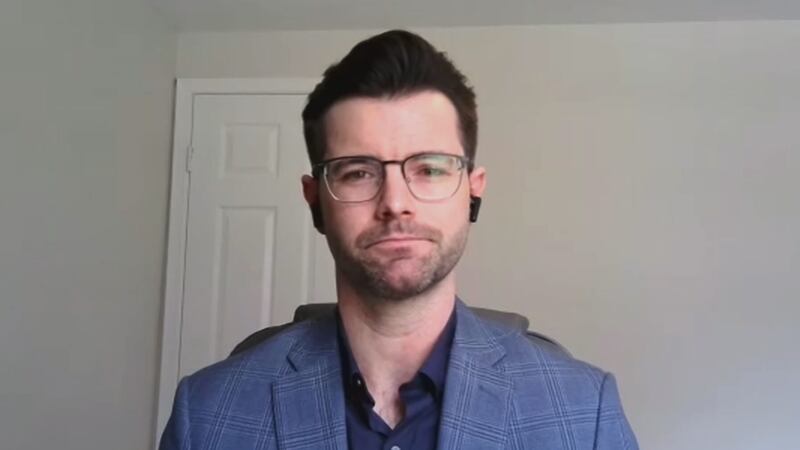
Read the full transcript below:
ANDREW: Okay, so President Trump over the weekend provided a deadline for Iran, saying unless a deal is reached by tomorrow, the U.S. could target electricity infrastructure. He has made that threat before. Let’s get more on what effect this could have on Canadian investors. We’re joined by Chris White, head of research at 5i Research. Thanks very much for joining us.
CHRIS: Thanks for having me.
ANDREW: What is the main theme you’re following in the market right now, or what’s your strategy in this environment?
CHRIS: Markets did move higher this morning on the heels of a potential 45-day ceasefire agreement. What we’ve seen over the last few weeks has really been a lot of headlines, a lot of noise and some conflicting statements. For investors, that’s created headline fatigue and some confusion.
What I’m really looking at is a signal that cuts through that noise, and for me, that’s the price of oil. If oil drops significantly on the day — say 10 to 15 per cent — on the back of news, and that move is sustained, that’s the market signalling some sort of eventual ceasefire or reopening of the Strait of Hormuz.
ANDREW: And would part of your thesis be that if oil drops — say five per cent — that would be a signal to buy equities?
CHRIS: I think so, if that move is sustained. If we see oil grind lower alongside other factors — like bond yields moving lower — that suggests inflation expectations are easing. The VIX is also a really important indicator for me.
ANDREW: What about gold? You’re not overly bullish right now?
CHRIS: That’s right. Gold has had a massive run as part of a risk-off trade. There’s been a lot of hedging through gold, and we saw a parabolic advance over the last year. I think that’s starting to weaken and decelerate.
We’re seeing some rotation out of gold, with miners consolidating gains. That could be an area where investors start taking profits and reallocating to other opportunities.
ANDREW: For years, investors favoured companies that didn’t require heavy capital spending. But you’re looking at so-called HALO stocks now — heavy assets, low obsolescence.
CHRIS: Yes. The HALO theme has been gaining traction. These are companies unlikely to be disrupted by AI. We’ve seen software names come under pressure as AI threatens legacy business models, so investors are rotating into more capital-intensive areas.
I favour a barbell approach between AI HALO and non-AI HALO names. AI HALO names are the physical infrastructure that powers data centres and AI systems. Non-AI HALO names include pipelines, utilities and energy infrastructure — areas that act as a hedge.
That approach allows investors to benefit from AI-driven spending while also gaining exposure to defensive sectors.
ANDREW: So, for example, Cameco has massive physical assets and could benefit from rising electricity demand tied to AI.
CHRIS: Exactly. Uranium and nuclear energy are key given the growing demand for power.
ANDREW: And companies like Stantec could benefit from increased electricity infrastructure development.
CHRIS: Yes, and other names we like include Hammond Power Solutions and Celestica.
ANDREW: Let’s get into some other ideas. Kraken Robotics — they’re involved in undersea robotics and have a defence angle.
CHRIS: Yes. Kraken Robotics develops underwater robotics and sonar systems for naval defence. Their sonar maps the ocean floor — essentially like Google Maps for underwater environments.
They can detect mines and pipeline damage, which is critical for offshore energy. Their services segment is growing faster than their products, supporting margin expansion.
They also received a $35-million order in January for subsea battery products. It’s not a cheap stock, but it benefits from long-term growth in global defence spending.
ANDREW: Your next idea is Celestica. It’s been seen as a key AI infrastructure play but has pulled back.
CHRIS: Celestica is, in my view, one of the best Canadian AI infrastructure plays. It designs and manufactures hardware systems used in hyperscaler data centres.
It takes semiconductors, networking equipment and power systems and integrates them into full systems for AI data centres.
Forward earnings growth is expected around 40 per cent. The stock has pulled back, making valuation more attractive at about 32 times forward earnings.
There are risks, including customer concentration, but the data centre buildout theme still has a long runway.
ANDREW: We’re tight for time. Briefly on your final idea — EQB.
CHRIS: EQB is Canada’s digital-first challenger bank. With fewer physical branches, it has a lean cost structure and can offer competitive rates.
A key catalyst is the PC Financial acquisition, expected to close this year, which could significantly expand its customer base and add about two million credit cards.
ANDREW: Chris, thanks very much.
CHRIS: Thank you.
ANDREW: Chris White, head of research at 5i Research.
---
This BNN Bloomberg summary and transcript of the April 6, 2026 interview with Chris White are published with the assistance of AI. Original research, interview questions and added context was created by BNN Bloomberg journalists. An editor also reviewed this material before it was published to ensure its accuracy and adherence with BNN Bloomberg editorial policies and standards.

