Escalating tensions in the Middle East are driving market volatility, but underlying economic conditions remain broadly constructive for investors.
BNN Bloomberg spoke with David Onyett-Jeffries, vice-president, economics and multi-asset solutions at Guardian Capital LP, who said recent market moves are being driven by uncertainty rather than a breakdown in growth, with resilience still evident across key economic indicators.
Key Takeaways
- Market volatility tied to geopolitical tensions is obscuring otherwise positive trends in global growth, inflation and monetary policy.
- The economic impact of the conflict hinges on how long it lasts and how severely it disrupts energy and commodity flows.
- U.S. economic strength remains intact, with broad-based growth and limited evidence of widespread job losses.
- Investors are encouraged to avoid reacting to short-term headlines, as policy shifts can reverse quickly and reduce uncertainty.
- Recent market declines have improved valuations across regions and asset classes, creating potential opportunities for long-term investors.
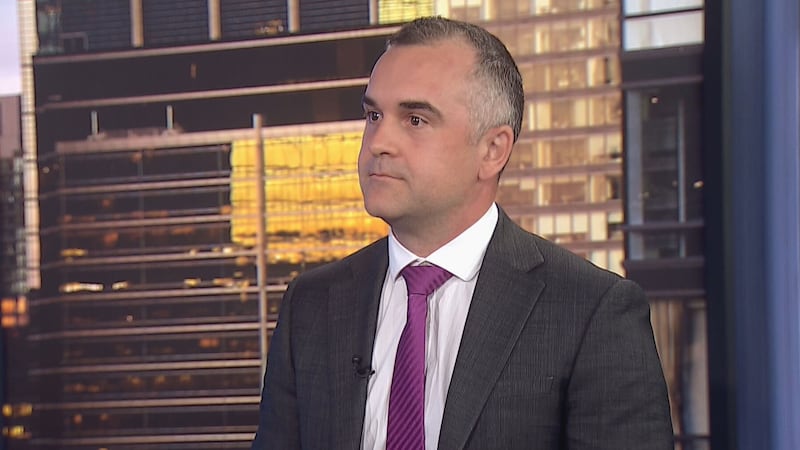
Read the full transcript below:
ANDREW: U.S. President Donald Trump is doubling down on threats to attack Iran’s infrastructure if the country does not reopen the Strait of Hormuz. Markets are under pressure.
We’re joined by David Onyett-Jeffries, vice-president, economics and multi-asset solutions at Guardian Capital. Thanks for joining us.
DAVID: Thank you very much for having me.
ANDREW: When you sit down with clients, what are they asking you? And what do you tell them?
DAVID: Taking a long-run focus doesn’t really scratch the itch for clients. They want to know what’s going to happen today or an hour from now.
On a day like today, I can’t say with high conviction what will happen in the next 12 hours. But we’ve been here before, where deadlines are set and we get close to the brink, only to see policy backtrack. Whether it happens immediately or a few days later, that’s what drives sharp volatility.
ANDREW: Prior to this, things were looking fairly good. Inflation seemed under control and growth was holding up.
DAVID: At the start of the year, it was a very constructive backdrop for this stage of the economic cycle. Inflation was still above target but well behaved enough that central banks weren’t overly concerned.
Growth was broadening, not just regionally but across different drivers. Over the past five years, it has largely been the U.S. consumer, but we’ve started to see more contribution from public and private investment and government spending, while the consumer remains in decent shape.
Then we were hit with a wave of geopolitical events, including developments in Venezuela and now the Middle East, which have created noise around what are otherwise positive underlying signals.
ANDREW: It does look like there could be a price shock, with petrochemicals, fertilizers and other commodities rising. The question is for how long.
DAVID: That’s the key issue. The impact on growth and inflation depends on the magnitude and duration of the shock.
If there’s a resolution quickly and the Strait of Hormuz reopens, we would likely see commodity prices fall and inflation expectations moderate. That would make the shock more transitory.
The longer it lasts, the bigger the impact. But given how these situations have evolved over the past year, it’s possible that by next week we could be focused on something entirely different.
ANDREW: What about the potential for a rotation away from U.S. assets? The U.S. dollar has been fairly strong.
DAVID: The strength in the U.S. dollar is largely a flight to safety tied to uncertainty.
Looking at the medium term, before these events, a weaker U.S. dollar was seen as the path of least resistance. Growth and interest rate differentials between the U.S. and other regions were narrowing, which supports capital flowing elsewhere.
That doesn’t mean the U.S. is a poor investment environment. It reflects improving opportunities in other regions, particularly where valuations are more attractive.
ANDREW: Asia is already experiencing disruption, including energy shortages.
DAVID: That’s part of the issue. Market performance over the past month hasn’t been uniform. It has been more selective.
Regions that rely more heavily on energy flows through the Strait of Hormuz, particularly in Asia and Europe, are more exposed. North America is relatively insulated because it produces more energy than it consumes.
Again, the outcome depends on how long the disruption lasts. If it eases, pressure on those economies should also diminish over time.
ANDREW: Could this boost interest in nuclear energy and alternatives?
DAVID: Yes, the push toward alternative energy is likely to gain momentum, but the driver is shifting.
It’s less about ESG considerations and more about energy security. Countries that lack domestic fossil fuel resources need reliable alternatives.
We’ve seen this shift since the pandemic, with supply chain disruptions, and now again with commodity shocks. Governments are increasingly focused on strengthening domestic infrastructure and energy independence.
ANDREW: History shows how critical energy access can be.
DAVID: Exactly. In the post-Second World War period, globalization allowed countries to specialize and rely on others for resources.
Now, as global relationships evolve, that model is being reassessed. There is a growing emphasis on domestic capacity and resilience, with governments backing that shift, though execution remains to be seen.
ANDREW: David, thanks very much. David Onyett-Jeffries, vice-president, economics and multi-asset solutions at Guardian Capital.
---
This BNN Bloomberg summary and transcript of the April 7, 2026 interview with David Onyett-Jeffries are published with the assistance of AI. Original research, interview questions and added context was created by BNN Bloomberg journalists. An editor also reviewed this material before it was published to ensure its accuracy and adherence with BNN Bloomberg editorial policies and standards.

