Markets are poised to open lower after a U.S.-ordered blockade of Iranian ports raises the risk of prolonged supply disruptions through the Strait of Hormuz. The move is fuelling a surge in commodity prices, with ripple effects across energy, metals and global supply chains.
BNN Bloomberg spoke with Michelle Connell, president and owner of Portia Capital Management, who says investors should closely track commodity trends and shifting sector valuations as geopolitical risks reshape the investment landscape.
Key Takeaways
- Oil, aluminum and copper prices are rising amid supply disruptions, with shipping backlogs and delays in natural gas adding to inflation pressures.
- Higher commodity costs are feeding through to consumers via fuel and transportation, increasing the cost of goods and services.
- Supply constraints are also affecting long-term investment themes, including data centre expansion that relies on key industrial metals.
- Financial stocks may offer selective opportunities as valuations fall despite strong profitability and elevated trading revenues.
- Technology remains a preferred sector, while defence stocks may be overvalued after sharp gains and present limited upside relative to risk.
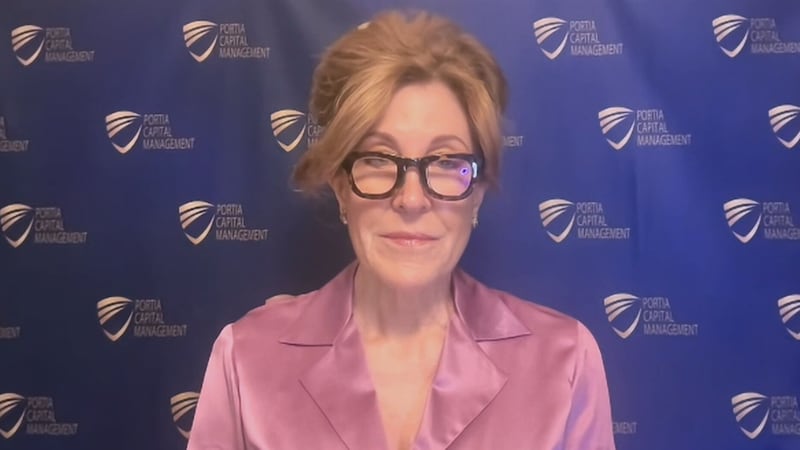
Read the full transcript below:
ANDREW: Looks like we are going to see equities down at the open after U.S. President Donald Trump ordered a blockade of Iranian ports, a move that threatens to deepen the global energy shock. Let’s get more from Michelle Connell, president and owner of Portia Capital Management. Michelle, thanks very much indeed for coming on the show. I know it’s almost a military question right now — what exactly the U.S. will do and on what timescale — but what are you paying most attention to this morning?
MICHELLE: I’m watching commodity prices and where oil futures continue to go. Obviously, that’s been an issue and will continue to be the main issue, right, Andrew, in terms of us being able to get ships through the Strait of Hormuz. We already have a six-week backlog, and we also have a several-month delay on natural gas. So those are things that really affect not just those prices, but what we’re paying as consumers at the pump, what we’re paying in terms of transportation for goods and services. There’s a lot that those commodities affect in our lives.
ANDREW: Let’s maybe have a look at aluminum. It has apparently hit a four-year high because of the disruption of supplies from the Gulf.
MICHELLE: That and several other commodities as well. Copper has also been high, and those commodities are important not only for housing, but also for building out data centres. So as we’re trying to catch up with the rest of the world in North America, in terms of our buildout of data centres, we need those commodities and metals to reach the point of buildout and where we want to be in terms of staying on track.
ANDREW: What should we look out for as we get reports from American banks? One hangover for the sector has been private lending, with some players such as Blue Owl running into liquidity problems. How are you playing the big U.S. banks right now?
MICHELLE: They look really interesting here, Andrew, because they’re down quite a bit relative to the overall market — probably about 21 per cent more than the S&P 500 — but at the same time, they have the second-highest profitability right after technology. The problem is everything has been taken down in the financial sector because of the private credit issue that you just spoke to. So I think there are going to be some stocks we can pick up as we start to see them report. Now, part of the reason why Goldman is down today is, yes, their fixed-income trading, but also what they put aside for credit writedowns. It was expected they would put aside an additional $115 million to $120 million — they took down an additional $300 million. So I think that kind of spooked the market.
ANDREW: In terms of tech stocks, you think Taiwan Semiconductor still looks like a solid bet?
MICHELLE: I do. Full disclosure, I own it in my portfolios. They report Thursday. I think they’re going to continue to have strong earnings. When they reported their March sales about a week or so ago, they were very strong and higher than expected. So I would think, at least in the near term, things look really solid for them. We have to remember they’re the biggest fabrication facility in the world for semiconductors, and we’re dependent upon them for artificial intelligence chip manufacturing.
ANDREW: And Broadcom — closer to home — you like the prospects of that one as well, another tech play?
MICHELLE: Yes, I do. I think I’ve spoken about this before on your show. I like the fact that they’re more of a customized AI chip company, meaning that if you’re a customer and you want something specific to how artificial intelligence will help your company, that’s where Broadcom comes into play, whereas Nvidia is more of a general semiconductor AI play.
ANDREW: Defence stocks, though — you think — have had their run, and you’re wary of those, the likes of Northrop Grumman and Lockheed Martin. Do you think a lot of optimism is already built in there?
MICHELLE: I do, because in the last 12 months, a lot of these stocks are up — some of them as much as 70 per cent — and year to date they’re the outlier because we’ve had all these geopolitical concerns. But when I look at the potential downside of these stocks, maybe we’re expecting too much. I recently had a client come in with a large position in a defence stock — a manufacturer here in North Texas — and we took some money off the table. When I looked at potential downside versus upside, the downside was at least equal to, if not more than, the upside.
ANDREW: That’s interesting. Why is that? Obviously, it seems there’s going to be solid military spending for now, but do you just feel things have become inflated in some of these defence names?
MICHELLE: Yes. I think markets in general don’t always focus on cash flow and profitability — that’s what I look at. Where we have pockets of downdrafts or updrafts is when emotions take us from one swing to another. Everybody is so focused — and rightly so — on not having enough defence. The United States is building up, and now the EU is having to catch up. Yes, that’s positive. But when you have stocks that have gotten slightly ahead of themselves, which some of these defence names have, it wouldn’t be best — if you’ve made 70 per cent in the last 12 months — to take some profits off the table or avoid buying here?
ANDREW: Michelle, we’ll have to take a break. Thank you very much indeed for joining us.
MICHELLE: Thank you, Andrew.
ANDREW: Michelle Connell, kicking off the week for us on The Open. Michelle is president and owner of Portia Capital Management.
---
This BNN Bloomberg summary and transcript of the April 13, 2026 interview with Michelle Connell are published with the assistance of AI. Original research, interview questions and added context was created by BNN Bloomberg journalists. An editor also reviewed this material before it was published to ensure its accuracy and adherence with BNN Bloomberg editorial policies and standards.

