North American markets are hovering near record highs despite elevated geopolitical tensions and oil price volatility tied to the Strait of Hormuz. Investors are navigating short-term uncertainty while shifting focus toward earnings and capital markets activity.
BNN Bloomberg spoke with Jay Bala, CEO and senior portfolio manager at AIP Asset Management, about how geopolitical risks are being absorbed by markets, the evolving outlook for U.S. bank earnings, and why structural forces — including major IPOs — could drive the next phase of investor demand.
Key Takeaways
- Markets are showing resilience despite geopolitical tensions, with volatility driven largely by oil price swings tied to the Strait of Hormuz.
- Oil remains the key transmission channel for risk, with price spikes tied to headlines rather than sustained supply disruptions.
- U.S. bank earnings are being supported by strong trading activity, reflecting elevated volatility and continued investor engagement.
- Capital markets activity is expected to strengthen, with a pipeline of major IPOs likely to boost trading volumes in the coming quarters.
- Structural demand from passive investing and index inclusion is emerging as a key market driver, particularly for large-scale IPOs.
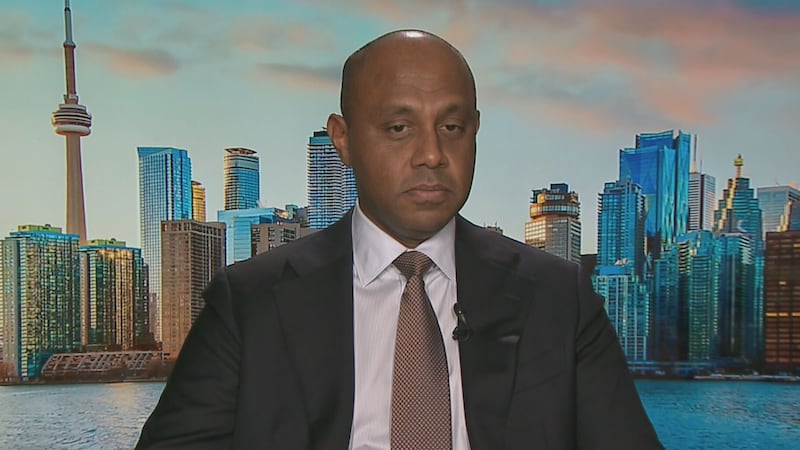
Read the full transcript below:
ANDREW: There’s still a faceoff at the Strait of Hormuz, and oil prices have shot up since late February. They’re off their highs, though, but around the world, remember, some users have been paying $140 US-plus per barrel. That’s not captured in the New York futures. However, stock markets are near a record high. So let’s get more from Jay Bala, CEO and senior portfolio manager at AIP Asset Management. Jay, thanks very much for joining us. Maybe we can pop up a one-year chart for the TSX Composite and the S&P 500 — markets recovering back to near record highs.
JAY: Yeah, yeah. No, thanks for having me on. And yeah, I mean, look, we see this over and over again. As you know, we’ve seen different wars evolve. So, you know, during the Iraq War, it’s kind of the same concerns — not obviously the Strait of Hormuz, but the same sort of geopolitical concerns. And what you realize is, during wartime, stock markets tend to rally. And so that’s all we’re seeing here. And so I think with the Strait of Hormuz and the Iran situation, where people have come to the realization is that there’s no short-term fix. This is just going to be a managed problem, which means it’s going to be on and off. There’ll be points in time where the situation gets worse. There’s going to be points in time where there’s stability. Ultimately, I think everybody realizes one way or the other that that strait needs to get opened. And ultimately, I think everybody’s also come to the realization that in order to make sure that it remains open in a stable format, Iran needs to come and sit at the table now, right? Before, they didn’t have to. And now the reality is they need to be at the table. So somebody’s going to give them a seat there. And so I think that solution is going to work its way through. From a North American perspective, particularly from a Canadian perspective, look, I think if you’re lucky enough to live here, you should thank your lucky stars, because the reality is the world’s problems are not our problems, right? And in many ways, that’s also a North American situation, right? Whether you live in Canada or the U.S., you should probably thank your lucky stars, because as a continent, we are energy independent. Canada, for sure, is by far much more energy independent than anybody else, right? We actually export a large amount of oil, and so we’re not going to be directly impacted. If anything, we’d be a direct beneficiary long term.
ANDREW: You said stocks go up during wars. I mean, don’t they initially correct? But then I know there’s evidence that a year later, markets tend to be higher, correct?
JAY: But I mean, like you’ve seen that in many, many collaborative situations, in many, many wars. At the end of the day, everybody hates to say it, but wars, no matter how you think about it, end up employing lots of people. You make lots of stuff, right? You manufacture lots of things. Half of those things get blown up somewhere, and so you have to keep rebuilding. And so that tends to be a net positive for the equity markets. But a lot of that is built on the concept of, well, you have to take on lots of debt as a country to fund that growth, right?
ANDREW: The big U.S. banks — are you interested in owning those these days? Names like Goldman Sachs, for example?
JAY: Yeah. I mean, we don’t directly invest in them, but we do keep an eye on them. And what’s been interesting with both Bank of America and Morgan Stanley and a lot of the banks that have come out of the U.S. is what you see is the key driver to a lot of that earnings growth is basically equity sales and trading. And so what that tells you is, at the end of the day, even if the economy is kind of stabilizing, the stock market has always been the saving grace for this. And I think on a go-forward basis, I think that stock rally is going to continue. I think that’s going to benefit the banks, both from a sales and trading perspective and an investment banking perspective. And I think that is going to be a key driver of growth going forward. And if you look at the next few quarters — Q2, Q3, Q4 — you’re going to see some big-name brand IPOs coming out, like SpaceX, OpenAI, Anthropic. Those all come out as IPOs before the end of the year, and so that’s going to drive that trading volume even higher, right?
ANDREW: What are your thoughts on this monster IPO we’re expecting from SpaceX? I know it depends on pricing, et cetera, but is that a name you’d be interested in, do you think?
JAY: Oh, we’re absolutely interested in it. So one of our funds already owns SpaceX. And the reason we like SpaceX and companies like SpaceX is, I think if you start thinking about the valuation, you’re effectively asking the wrong question in something like SpaceX. And so what we see this as is a structural trade. So if you look at SpaceX and you look at how the market is built today, what you notice is there’s a lot of upside built into it, irrespective of price. And so what I mean by that is, if you look at the equity markets, it’s very much passive money. It’s very much ETF money that follows indexes. So, for example, the Nasdaq-100 has $5 trillion in ETF money that passively buys those 100 stocks. The S&P 500 is $24 trillion globally that buys 500 stocks. And so if you look at SpaceX at $1.75 trillion or $2 trillion, whatever that number is going to be as a market cap, the Nasdaq-100 has already come out to say, look, we’ll fast-track the stock to 15 days of trading volume before we add them to the index, right? And so as soon as that happens, let’s assume that SpaceX is only one per cent — so one company out of 100 — so one per cent of $5 trillion is $50 billion worth of passive buying power switches on day 15, right? And so if you think about it, the stock goes public for 15 days, you’ve got high-frequency funds, you’ve got retail, you’ve got a bunch of people that are going to buy the stock. Come 15 days later, every ETF that tracks the Nasdaq-100 is a forced buyer of that stock, right? And so you pretty much know which direction that goes in for the many, many weeks that come along with it. And then ultimately, if they get added to the S&P 500, and again, even if they take a one per cent position there, that’s $240 billion worth of buying power. And so this is probably the best index arbitrage we’ve seen in many, many years, right?
ANDREW: Give us that arbitrage again. So how would you do it? Just very — we’re tight for time — how would that work? You’d get in when?
JAY: Well, it depends. There are two choices. So you could either invest in a fund like ours, like XIPO, which buys pre-IPO stocks like SpaceX, or you can wait for the first trading day of SpaceX to buy the stock.
ANDREW: Thank you very much, Jay. Really appreciate it.
JAY: No problem. Thank you.
ANDREW: Jay Bala, CEO and senior portfolio manager at AIP Asset Management.
---
This BNN Bloomberg summary and transcript of the April 15, 2026 interview with Jay Bala are published with the assistance of AI. Original research, interview questions and added context was created by BNN Bloomberg journalists. An editor also reviewed this material before it was published to ensure its accuracy and adherence with BNN Bloomberg editorial policies and standards.

