The idea of government-run grocery stores is gaining traction as policymakers look for ways to address high food prices, but critics argue the approach misunderstands how pricing works.
BNN Bloomberg spoke with Alex Whelan, director of Atlantic Canada prosperity at the Fraser Institute, who says public grocery stores would redistribute costs to taxpayers rather than reduce them, while broader economic forces continue to drive prices.
Key Takeaways
- Government-run grocery stores would shift food costs to taxpayers rather than eliminate them.
- Pricing is driven by input costs such as wages, energy and transportation, not temporary policy measures.
- Selling groceries below cost would require ongoing subsidies funded through public finances.
- Increasing competition by reducing taxes and regulatory barriers is presented as a more effective approach.
- Government policies such as supply management, taxes and regulation contribute to higher grocery prices.
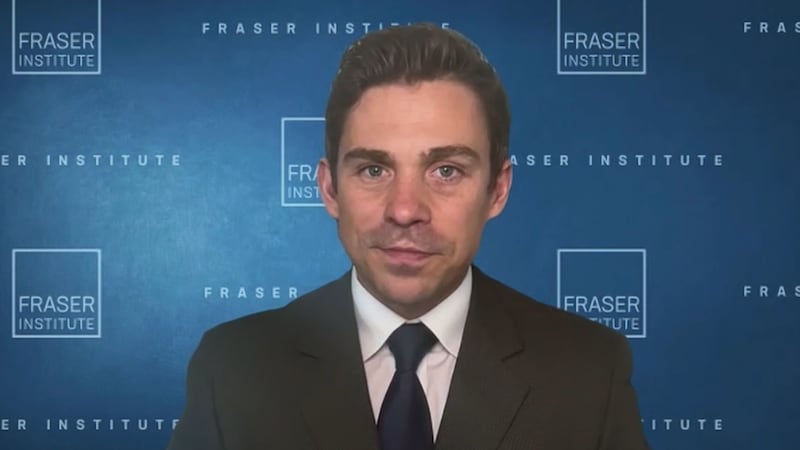
Read the full transcript below:
ANDREW: Okay, let’s stick with the story of costs. Government-run grocery stores have been having something of a moment, with New York’s new mayor popularizing the idea, and Canada’s new NDP leader, Avi Lewis, using them as a key component in his campaign. Toronto city council passed a motion to open four government-run grocery stores, but our guest says government shouldn’t be involved in the business, and any discounts at these stores will really only shift, rather than eliminate, the cost of food. We’re joined by Alex Whelan, director of Atlantic Canada prosperity at the Fraser Institute. Alex, thanks for joining us.
ALEX: Good morning, Andrew. Pleased to be with you.
ANDREW: Give us your main criticism of the idea of government-run grocery stores.
ALEX: The main criticism of government-run grocery stores is that, quite simply, there’s no free lunch. If we or the government choose to lower grocery prices through state-owned grocery stores, taxpayers will ultimately end up footing the bill.
ANDREW: Because you say that they won’t be — well, provide some examples. You say they’re selling bacon at almost six bucks. Bacon, normally in Ontario lately, has been going at nearly six bucks. Say they start selling it at $3 — that’s a $3 loss, or close to a loss, and it’ll have to be picked up by taxpayers.
ALEX: That’s exactly right. And in fact, that hypothetical example probably underestimates the cost, because we also have to address the fact that government-run grocery stores likely will not be as efficient as grocery stores that operate in the market. You’re exactly right to highlight that government could set the price of bacon from $6 to $3. In fact, government could set the price of bacon to zero. But the key point for the taxpayer and the consumer to understand is that that does not make it costless. If Toronto city council, or any other city council in Canada, decides to open grocery stores, those costs will show up on the backs of taxpayers somewhere.
ANDREW: I guess part of your argument indicates that grocery stores are not profiting unduly, that there is adequate competition.
ALEX: Well, I wouldn’t go as far as to say there is adequate competition. In fact, I think that highlights a key point, which is that government’s role in this space, I think, is to promote competition, reduce taxes, reduce regulatory barriers. I haven’t looked specifically at the degree of competition in the grocery industry in Canada, but what I can tell you is that state-owned grocery stores would be a very costly solution. That’s the main point that we’re trying to make in our piece.
ANDREW: It seems a bit of a gap that you haven’t looked into whether the grocery stores are actually competing, because if they are earning undue profits because of oligopoly factors, that would indicate that the government stores could offer lower prices.
ALEX: Well, certainly, I can tell you anecdotally that anybody in Canada can open a grocery store. There are relatively low barriers to actually do so.
ANDREW: Well, I don’t know about that. It’s pretty capital-intensive.
ALEX: Well, sure, but I mean, if you look at — you raised the example of New York City off the bat — there’s a government-run grocery store being opened in East Harlem, and many of the people that are against it are actually very small business owners, owners that are running small corner stores and bodegas. And so, I mean, there are lots of different ways for people to participate in this industry.
ANDREW: I wonder. I mean, the government has said — or the Liberal government has said in the past — we’d like to bring in foreign grocery chains. They haven’t. The likes of Aldi and Lidl are in America, but they haven’t come into Canada. So it seems like this is not that attractive a market.
ALEX: Well, I mean, there is the broader Canadian business landscape, which I think has been challenging in recent years. Taxes have gone up, the regulatory burden has gone up. In general, I think government removing barriers to competition is a great policy solution in this space, compared to, again, nationalizing grocery stores.
ANDREW: Right. You’d like to see that, and they have leaned, to some extent, in that direction, as you know, combating these leases whereby if I open a grocery store, I can get the landlord to ban any other grocery stores in the same development. So government has leaned towards that, but you’d like to see more encouragement of competition.
ALEX: Absolutely. I mean, consider, Andrew, that we’re talking about grocery prices at the core of this issue here. One of our publications has shown that taxes in Canada have actually increased at a greater degree since 2020 than grocery prices. And so that just highlights one example of how governments could actually undertake productive reforms in this area.
ANDREW: I wonder, even if it costs taxpayers money — and everything costs — if they open a few stores, would it tend to stimulate competition, though? Because people might go into the government store and say, “Well, it’s only this price.” Would that put pressure on Loblaws and Metro to do a better job of matching it?
ALEX: Well, it would certainly put pressure on the other competitors in the industry. But at the end of the day, government has no bottom line, so they can pass that subsidy, which is effectively what it is, onto the consumer.
ANDREW: Right. Obviously, they’re spending other people’s money. So you’d bring down burdens such as planning fees, I guess — these infamous development fees — so that people could build rival food stores more cheaply.
ALEX: Yes. I think we should make it as easy as possible for competitors to come into this space. That should be true across all industries. If we want to see competitive pricing, you need relatively low barriers to entry. And there are a number of other ways. We should note as well that governments drive up the cost of groceries. In Canada, we have a system called supply management. You mentioned land-use regulation, taxes and fees, and so on.
ANDREW: The government — I mean, it has been tried in some places. Mexico has thousands of government-owned grocery stores. It’s a very different economy from Canada, but some places have made it work. I know that the record is mixed.
ALEX: Sure, and I think it’s important to look at our own record in Canada when it comes to nationalizing industries. I mean, the federal government in Canada, as you probably know, used to own an airline, used to own a national railway, used to own a national string of gas stations. In general, I think the lesson from those experiences is that government shouldn’t be in business and government should focus on their core functions.
ANDREW: We better leave it there. Thank you very much indeed.
ANDREW: Thanks for having me.
ANDREW: Alex Whelan, director of Atlantic Canada prosperity at the Fraser Institute.
---
This BNN Bloomberg summary and transcript of the April 20, 2026 interview with Alex Whalen are published with the assistance of AI. Original research, interview questions and added context was created by BNN Bloomberg journalists. An editor also reviewed this material before it was published to ensure its accuracy and adherence with BNN Bloomberg editorial policies and standards.

