Canada’s spring economic update points to a lower-than-expected deficit and stable public finances, even as growth remains weak and uncertainty persists.
BNN Bloomberg spoke with Kevin Page, president and CEO of the Institute of Fiscal Studies and Democracy and former parliamentary budget officer, about fiscal discipline, economic risks and gaps in the government’s plans.
Key Takeaways
- The federal deficit came in about $11 billion lower than expected, sitting near two per cent of GDP and remaining stable in coming years.
- Higher oil prices provided fiscal room, which was largely used to support a weak economic outlook rather than new capital investment.
- The government is balancing short-term affordability measures with longer-term goals like trade diversification and capital investment.
- Economic growth is expected to remain weak at around one per cent, with output below potential levels.
- A lack of clarity on defence spending and NATO commitments represents a major transparency gap in the fiscal plan.
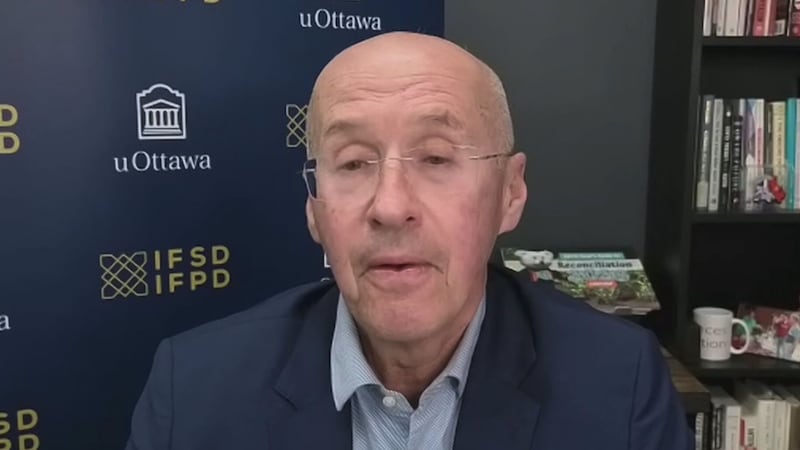
Read the full transcript below:
ANDREW: Ottawa released an update on the public finances yesterday afternoon. Let’s break it down and get his key takeaways. We’re joined by Kevin Page, president and CEO of the IFSD, and former head of the Parliamentary Budget Office. Kevin, great to see you, and thanks very much for joining us.
KEVIN: Great to be with you, Andy.
ANDREW: Against the backdrop of government wrestling with lots of economic uncertainties, higher energy prices, the ongoing trade conflict, what did you think of this budget update? Did anything jump out for you, Kevin?
KEVIN: Well, I think there are a number of headline stories. One probably, Andy, is the deficit coming in much lower than they anticipated just in the November budget. So, you know, $11 billion lower, down from $78 billion to about $66 billion. That means we’re likely to have a federal budgetary deficit in about the two per cent range, and it stays relatively flat over the next few years.
I think another headline for this update, Andy, would probably be that the government got a bit of a fiscal uplift, or found some fiscal room thanks to the higher oil prices that you were just talking about. They effectively spent it. They didn’t spend it on capital formation. They spent it to really prop up a relatively weak expected economy in 2026.
So again, modest deficits overall relative to GDP, still much better than most OECD countries. Debt-to-GDP ratio staying relatively flat, but a little bit lower than it was back in November, and more of a traditional update, about half the size of the budget, but still a lot of moving parts, a lot of measures.
ANDREW: And they have — I mean, a lot of this additional revenue apparently already spent on programs such as topping up the GST credit for lower-income people.
KEVIN: Yeah. So I think definitely what we learned from the government is there are two tracks to the Canada Strong program. One track is very much more medium- to long-term focused. This is really about capital formation, trade diversification, moving towards those NATO targets.
I think the other track is still the short term, trying to stabilize the economy. Again, we’re expecting real GDP to grow about one per cent. We’ll get another number from the governor of the Bank of Canada with the monetary policy report. That’s very weak growth. We’re operating about one-and-a-half to two per cent below probably our potential in this environment. And we’re running a deficit of about two percentage points of GDP. So the second track is really about stabilizing the economy, dealing with these affordability challenges.
ANDREW: What do you think of budget discipline from the current government? Of course, they say they’re on this big investment track, infrastructure projects of national importance, et cetera. But are they showing signs of discipline on the deficit?
KEVIN: Well, I think on the positive with respect to discipline, they’re holding to the track of getting to something called an operating budget balance in 2028-29. They’re after running deficits of about one-and-a-half percentage points of GDP, that’s capital-related.
I think the government could be criticized for not giving us more confidence that there are guardrails to deal with these uncertain shocks that we’re likely to experience over the next year. So we could easily be thrown off that track of an operating budget balance in three years. So there are some pluses and minuses with respect to discipline. There are certainly opportunities to add additional discipline to fiscal planning.
ANDREW: Andrew Coyne, the Globe columnist, is pretty scathing about what he calls this phrase “a day-to-day operating balance.” He reckons that’s just mumbo jumbo, and the term has never been properly defined by the government.
KEVIN: Well, I think Mr. Coyne is obviously a bright journalist. I think it’s good to have people poking away at these definitions of what is operating, what is capital. You could probably look at the definition the government is using and say the government is being generous with the capital definition.
From the government’s perspective, they see that Canada’s business capital formation has just been horrible. They feel they have to step in, particularly to deal with these bigger infrastructure projects, get more foreign direct investment, but really support it with government investment.
Personally, Andy, I’m actually happy with the split of operating and capital. I think for too long we’ve not had transparency of what the government is spending in terms of its own capital or capital transfers. I think this is an additional amount of transparency that is good, and it’s a nominal target, getting an operating balance in 2028-29 that’s more reminiscent of the late 1990s.
ANDREW: How bleak is the debt figure? And just to go back to Andrew Coyne for a second, he’s citing C.D. Howe research, and he says the combined federal-provincial debt is on its way to 82 per cent by fiscal 2029. Are we not taking the debt seriously enough, do you think?
KEVIN: Well, I think Andrew is definitely right that since prior to the 2008 financial crisis, we’ve seen a significant increase in debt, particularly federal debt. We’re up probably about 12 percentage points of GDP.
We had a big bump up in debt because of the financial crisis, an enormous bump during the COVID-19 pandemic. The government really stepped in in those two shocks to help Canadians, households and businesses.
So now we have federal debt sitting at about 42 per cent. Again, I think Andrew is probably using a net or gross figure for combined federal and provincial debt. It’s elevated. If we look at gross liabilities as a percentage of the economy, we’re probably a little bit more than the OECD average. When you take into account our public pension systems, it brings our debt way down. We’re actually among the leaders with respect to low debt.
But yes, how did we get here? Two big crises. And where are we now? We’re potentially facing another deep trade or security shock in 2025-26.
ANDREW: One area that I think you are faulting is disclosure — you say more information is needed — defence spending and the massive projected increase there.
KEVIN: Yeah, I think again, one of the big pillars of the Canada Strong plan is to build our military. For too long, we’ve seen defence spending relative to GDP in the one per cent range. We’re getting to two per cent in 2025-26. The target for core military spending is to get to three-and-a-half per cent by 2035. There’s an additional one-and-a-half per cent for military infrastructure.
It’s the biggest fiscal moving part in the fiscal planning framework, and yet we don’t see it clearly in the budgetary plan. We don’t really know to what extent we’re moving toward those NATO targets. It’s such an important component. I think it’s an enormous transparency gap that has to be closed by the federal government sooner rather than later.
ANDREW: Kevin, thank you very much indeed. Kevin Page, president of the Institute of Fiscal Studies and Democracy, and former head of the Parliamentary Budget Office.
---
This BNN Bloomberg summary and transcript of the April 29, 2026 interview with Kevin Page are published with the assistance of AI. Original research, interview questions and added context was created by BNN Bloomberg journalists. An editor also reviewed this material before it was published to ensure its accuracy and adherence with BNN Bloomberg editorial policies and standards.

