Markets are balancing strong artificial intelligence-driven earnings against growing concerns over oil prices, inflation and rising bond yields. Nvidia shares gained after reports CEO Jensen Huang joined U.S. President Donald Trump on a trip to China, where chip export restrictions and broader trade tensions are expected to be discussed with Chinese President Xi Jinping.
BNN Bloomberg spoke with Lyle Stein, president at Forvest Global Wealth Management, about the market themes he calls “Straits and Rates,” including geopolitical risks tied to the Strait of Hormuz and the Taiwan Strait, elevated long-term bond yields and whether concentrated investment in AI-related stocks is creating new market risks.
Key Takeaways
- Nvidia shares rose as investors focused on potential discussions around U.S. chip export restrictions during meetings between American and Chinese officials.
- Geopolitical tensions involving the Strait of Hormuz and the Taiwan Strait remain key risks for global trade, shipping and energy markets.
- Rising long-term bond yields are reflecting growing inflation concerns as investors question whether central banks can return inflation to 2 per cent targets.
- Artificial intelligence-related companies continue to drive market gains, although concentrated investor flows into semiconductor and memory-related stocks are increasing risk levels.
- Oil markets remain volatile as spot crude prices trade well above longer-dated futures prices, highlighting uncertainty around supply disruptions and global economic impacts.
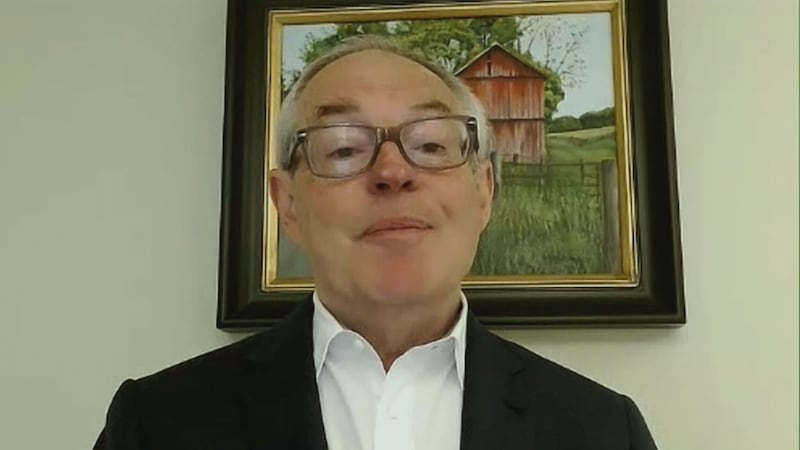
Read the full transcript below:
LINDSAY: Nvidia CEO Jensen Huang is, at the last minute, joining U.S. President Donald Trump on his trip to China to meet Chinese President Xi Jinping. It’s expected chip sale restrictions in China will be one of the topics of discussion, and that is giving shares of Nvidia a boost. Let’s get perspective now from Lyle Stein, president of Forvest Global Wealth Management. It’s great to have you join us. Good morning.
LYLE: Good morning.
LINDSAY: So I guess, first of all, what are your thoughts on what may come of this China trip, and specifically this kind of last-minute addition of Nvidia’s CEO joining that trip?
LYLE: Well, I think you hit the important thing. The issue is the restrictions of North American export of chips to China. That is a very important thing because Mr. Trump needs the support of the Chinese with respect to, I think, what is more important than even the chips, and that’s what we call straits and rates. But for Jensen Huang to be on that trip with Cook and with Musk, I mean, those are the big heavyweights in American industry. He’s really showing, I think, respect to the Chinese, and the Chinese will give him respect as well.
LINDSAY: Do you think we’ll actually see any movement or any progress coming out of these meetings, or is this more so kind of like a warming of relations at this point?
LYLE: I think this is just, “Hi. How are you? Let’s get to be more friendly.” You know, the temperature was raised, and I think it’s time to drop that temperature.
LINDSAY: And Donald Trump said that he thought the closure of the Strait of Hormuz, the ongoing conflict in the Middle East, was not going to be top of the agenda. Do you think that will be talked about at all? Do you think we’ll see any movement there? I mean, China has maybe a bit of an agenda there as well.
LYLE: Well, it’s not just the Strait of Hormuz. It’s the Strait of China, or the China Strait between China and Taiwan, that is equally important, and I’m sure that will be discussed because the notion of global trade and free movement of ships moving goods and whatnot is now under question with respect to what’s happened in the Strait of Hormuz. So we’ve got bigger issues than just, you know, getting ships through the Iranian strait. It’s also the China Strait.
LINDSAY: For sure. Okay, let’s switch gears now and talk about earnings season. We’re almost at the end of earnings season. Most results have been better than expected, especially when it comes to many of those stocks that are tied to AI. Are AI-related earnings masking weakness in other sections of the market, do you think?
LYLE: No, I think the market, by and large, is doing very well from an earnings perspective. We’ve seen just blowout numbers on the tech front, some being more extraordinary than the normal earnings. But earnings, I think, have surprised to the upside right across the spectrum. If you miss, though, the market does punish you. But by and large, companies have come through better than analysts originally expected.
LINDSAY: Do you see any cracks appearing in corporate earnings at all? I take your point that, for the majority, for the most part, it was pretty strong.
LYLE: Yeah, I think it’s tough to pick where the cracks are going to be at this stage. I think the cracks are going to be more macro than anything else. You know, the big surprise to the market was just the continued spending of the AI mega companies and what that is doing to GDP. And if we ever saw a slowdown there, that’s where the cracks will be. So, you know, as we go into now the second quarter, and we look for second-quarter numbers coming up in July, it’s exactly how much cash flow are we getting from these hyperscalers with respect to the investments they are making, and will the market continue just to pour money into that area? You know, we’ve seen money pour into the DRAM stocks. That’s been the hot flavour of the last six weeks. Money is flowing, and that’s, you know, what you see in a bull market.
LINDSAY: Is that the sector that you’d say is most vulnerable right now then, just because there’s so much risk tied to that heavy spending?
LYLE: I think there is more risk from the market perspective than maybe the heavy spending. You look at the movement in Micron, for example, and we sold some Micron shares yesterday. That stock is up on a flagpole that reaches to the moon. The reason we did it isn’t just Micron, but we love the earnings. We absolutely really like what earnings are going to be for Micron. But the fact that $5 billion poured into a DRAM ETF in a period of less than two months is concentrating way too much money. And it does remind me a bit of the meme stock phenomenon. And so you just have to be careful when you see a hockey stick, and in this case, it’s a big hockey stick. You just have to take some chips off the table. We did — that’s a bad line — but we did pretty well in Micron, and we peeled back a significantly overweight position thanks to the market.
LINDSAY: I want to talk a little bit about oil because I know that you’ve been following the price of oil closely. There’s a bit of a gap right now between spot oil prices and futures, and I’m wondering if you could explain that and what scenarios you think could maybe close that gap.
LYLE: Yeah, I think that’s the biggest question. Again, it’s straits and rates. It’s all about the Strait of Hormuz. The spot price for oil is significantly elevated relative to futures prices one year or two years out, and that’s because it is just hard to get physical supply. But if you’re an oil executive or if you’re making long-term investment decisions, the price of oil isn’t US$100 or US$105. It’s more like US$70 or US$75. That’s where long-term decision-making is being done. That’s why you’re not seeing a lot of drilling in response to this. So it all comes down to how it is going to wind out in the Strait of Hormuz and what’s going to happen with respect to the dislocation in global economies that have occurred and will continue. Because even if peace breaks out tomorrow, it’s going to take at least a month to a month and a half to get all that oil to the markets that need it. In the meantime, prices are tough. I mean, it’s probably the biggest question we face as investors today.
LINDSAY: Well, and now we’re seeing just how much oil production was lost throughout the months of March and April, which is astounding. How seriously should markets maybe price in a NACHO scenario then, which, for those who maybe don’t know yet, is a new term: “Not A Chance Hormuz Opens”?
LYLE: I think it’s something that we’re very concerned about. We have a global team, and yesterday one of the members of our team used to work in the Mideast, and he made a very interesting point: if you look at it through a Western lens, where everybody wants to kind of get along and it’s all nice and easy, that’s one way. But this is as much a religious war as it is an economic war. And, you know, the Iranians think they’re winning, the Israel-American alliance think they’re winning, and both parties have big egos. They’re not going to step down. So it’s a tough place to be.
LINDSAY: We’re also watching long-term bond yields. They’re rising globally. Just before we let you go, what’s your take on that?
LYLE: Inflation concerns. Inflation concerns now are coming front and centre. You know, we had two poor prints on the CPI, primarily energy-related. Is it going to suddenly fall down? You know, one of the interesting things that I want to spend some more time on is looking at the services inflation component, and that doesn’t seem to be going down. And that’s what really will drive long-term inflation expectations. But long-term inflation expectations are creeping up. You know, the target of 2 per cent is looking more and more like a target that isn’t going to get hit in ’26, or maybe not even in 2027.
LINDSAY: Okay, we’ll leave it there. Lyle Stein, president of Forvest Global Wealth Management. Appreciate you joining us this morning. Thanks for your time.
LYLE: Take care. Thanks.
---
This BNN Bloomberg summary and transcript of the May 13, 2026 interview with Lyle Stein are published with the assistance of AI. Original research, interview questions and added context was created by BNN Bloomberg journalists. An editor also reviewed this material before it was published to ensure its accuracy and adherence with BNN Bloomberg editorial policies and standards.

