Canada’s economy is entering a period of slower employment and GDP growth as lower immigration reduces labour force expansion, according to Don Drummond. He argues the shift could make the economy appear weaker even when it is operating near capacity, raising the risk of policy mistakes if demographic changes are misread as economic deterioration.
BNN Bloomberg spoke with Don Drummond, fellow-in-residence at the C.D. Howe Institute and Stauffer-Dunning fellow at Queen’s University, about how reduced immigration targets are reshaping Canada’s labour market, why policymakers may be overstating future growth expectations and the inflation risks tied to unnecessary economic stimulus.
Key Takeaways
- Canada’s slower employment growth increasingly reflects weaker population growth tied to reduced immigration rather than deteriorating economic conditions.
- Drummond said employment declines of several thousand jobs per month could become normal in a lower-immigration environment even if the labour market remains stable.
- Real GDP growth could average roughly 0.5 per cent in the near term and settle around 1.2 per cent over the long run, below federal and Bank of Canada projections.
- Drummond warned policymakers risk fuelling inflation if demographic-driven economic softness is mistaken for weak demand requiring stimulus.
- The report argues stronger productivity growth and higher labour force participation will be needed to offset slower workforce growth over time.
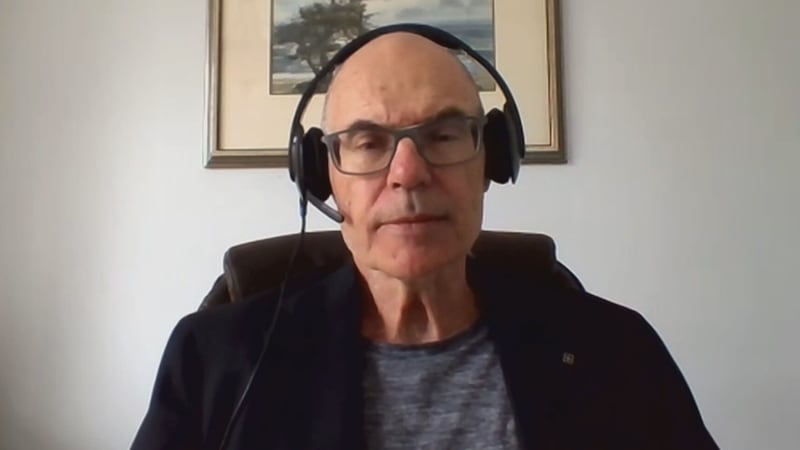
Read the full transcript below:
LINDSAY: Over the past year and a half, Canada has been scaling back its immigration targets, and our next guest says the recent slowdown in jobs and GDP has more to do with those demographic shifts than with any real economic weakness. So joining us now is Don Drummond, fellow-in-residence at the C.D. Howe Institute and Stauffer-Dunning fellow at Queen’s University. It’s great to have you join us. Thanks so much.
DON: Thank you very much.
LINDSAY: So can you explain how immigration levels have been impacting employment in Canada, first of all?
DON: Well, we had three years of unbelievably strong population growth, almost all of it through immigration. Over a million people were coming in per year. Our population was growing at three per cent per annum. That’s tripled the normal pace for a long time, based on 350,000 to 400,000 immigrants. Typically, our population was growing about one per cent, and then it exploded to three per cent. We actually haven’t seen anything like that in Canada before. We had one year, 1956, where we had a similar increase, and that was the exodus from Eastern Europe, particularly Hungary. But that only lasted for one year. So in three years, and then all of a sudden, we go from over a million people coming in, plus a reduction in the temporary foreign workers to this new target of 350,000 to 380,000, and we’ve seen now a couple of quarterly releases from Canada saying our population actually has been declining lately. So that affects everything, and affects our employment numbers, that affects our GDP numbers. And the reason we wrote this report is we keep reading the same commentary: it’s weak deficiency of demand. We said, no, it’s largely coming from the change in demographics.
LINDSAY: Yeah. So largely coming from that change. Let’s talk about how much of the weakness is coming from that change versus economic weakness.
DON: Well, we did this mathematical exercise and said, if the labour market was operating normally, i.e. the unemployment rate stayed where it is, 6.9 per cent, which is the average that’s been for the last 25 years, what would the demographics and productivity trends generate? And it actually generates a decline in employment this year and next, roughly 4,500 per month this year, 1,400 next year. So if, by some coincidence, you saw employment drop in a particular month by 4,500, that’s what the demographics would give you. Now, of course, if demand is weak, it could be a worse outcome than that. And of course, if demand is stronger, it could be a stronger outcome, but that’s kind of your benchmark. And so when you see like the last month where employment fell by 18,000, that’s somewhat larger than would be generated just from the demographics, but it’s in the ballpark of that. It doesn’t necessarily indicate that demand is deficient. We shouldn’t be rushing out, oh, the Bank of Canada has got to stimulate because demand is deficient. No, our capacity of the Canadian economy is growing very slowly at the moment.
LINDSAY: And as you say, you wrote this report because that’s what you kept hearing, right, is that the softening labour market is a result of economic weakness, rather than a byproduct of slowing immigration. What are the risks of that narrative, do you think?
DON: Well, there’s certainly a big risk on the policy front, because you would interpret a modest change, either a small decline or a very small increase somewhere in that vicinity, as being a deficiency of demand. And of course, the knee-jerk reaction is, well, the Bank of Canada has to cut its rate to stimulate. Department of Finance should be stimulating fiscally. Of course, if you created an increase in demand at that point, you’d be bumping against that reduced capacity. And of course, that would be inflationary. So this is very reminiscent of the periods from 1973 to 1995 — hopefully it doesn’t last for 22 years — where there was what turned out to be a permanent downshift in the rate of productivity, and the policy authorities either failed to recognize it or refused to accept it, and they kept interpreting it as a deficiency of demand. We got monetary stimulus that led to an outbreak of inflation. Ultimately, the Anti-Inflation Board, the six-and-five program, mortgage rates went to 22 per cent. Every year the fiscal authorities stimulated, and we ended up, thanks to that, in a fiscal crisis in 1995. I mean, we’re a long way from that situation, but it has that same kind of feel. And I notice even in describing the March, the April outcome for the employment, some get it. There was some good analysis pointing to the demographics. But others say, oh, this is just a weak month. We expect it to get stronger, and it will exactly. Why do you expect it gets stronger? You do realize our population is dropping, and due to aging of the population, the labour force is dropping even more, so why would employment get stronger?
LINDSAY: Okay, so we’ve talked about the impacts on the labour market, and I know you touched on this, but maybe you can go into more detail about how Canada’s reduction in immigration is impacting GDP growth.
DON: Yeah, so that we somewhat different approach, of course, to do the GDP, we have to bring in productivity, and it’s a very simple assumption. Output per hour worked has averaged a 0.8 increase, so less than 1.8 per cent since 2000. That’s a pretty long-term — that’s a 25-year average. That’s pretty robust. In fact, in the last five years has been weaker. So we could be more pessimistic. I’ll return to that. But if we have the 0.8 and the labour market operates normally, then you would only get half a per cent, 0.5 per cent growth in real GDP this year and next year. It would then go over to one per cent for a few years, but it would settle at only 1.2 per cent over the long term. And in the spring economic update, when Finance did that long-term projection to 2060, they use 1.5, and 1.2 versus 1.5 may not seem a big difference, but look at the level gap. When you compound that all the way from 2026 out to 2060, it gives you a huge difference in the level. Now again, demand could be stronger, productivity could pick up, and that’s what a lot of them forecasters, whether they realize it or not. And I think in a lot of cases, they don’t realize what they’re assuming productivity be stronger. But again, you ask yourself, why would it be? Why would it do better than the average of the last 25 years, and a lot better than over the last five years?
LINDSAY: Okay. And really interesting conversation. We’re going to have to leave it there, though. We’re out of time. Don Drummond, fellow-in-residence at the C.D. Howe Institute and Stauffer-Dunning fellow at Queen’s University. Thanks so much for your time. I appreciate it.
DON: Okay, you’re welcome. Bye.
---
This BNN Bloomberg summary and transcript of the May 14, 2026 interview with Don Drummond are published with the assistance of AI. Original research, interview questions and added context was created by BNN Bloomberg journalists. An editor also reviewed this material before it was published to ensure its accuracy and adherence with BNN Bloomberg editorial policies and standards.

