Strong U.S. retail sales are reinforcing concerns that inflation pressures could remain elevated as consumers continue spending despite rising costs linked to the war in Iran. Markets are also weighing the possibility that higher inflation expectations could push Treasury yields even higher.
BNN Bloomberg spoke with Earl Davis, head of fixed income and money markets at BMO Global Asset Management, about the implications of resilient consumer demand, inflation expectations, central bank policy and why investors are cautious on longer-term U.S. government bonds.
Key Takeaways
- U.S. retail sales remained broadly resilient in April, with nine of 13 retail categories posting gains and consumer demand continuing to support economic growth.
- Rising inflation expectations tied to energy prices and the war in Iran are increasing pressure on bond markets and contributing to higher yields.
- Markets are still expecting central banks to hold interest rates steady through 2026, though the possibility of rate hikes in 2027 is increasing.
- Investors are favouring shorter-duration corporate bonds over longer-term debt as inflation risks create uncertainty for fixed-income markets.
- High-yield bonds remain attractive because of resilient economic growth and ongoing fiscal support, although investors are becoming more cautious on valuations.
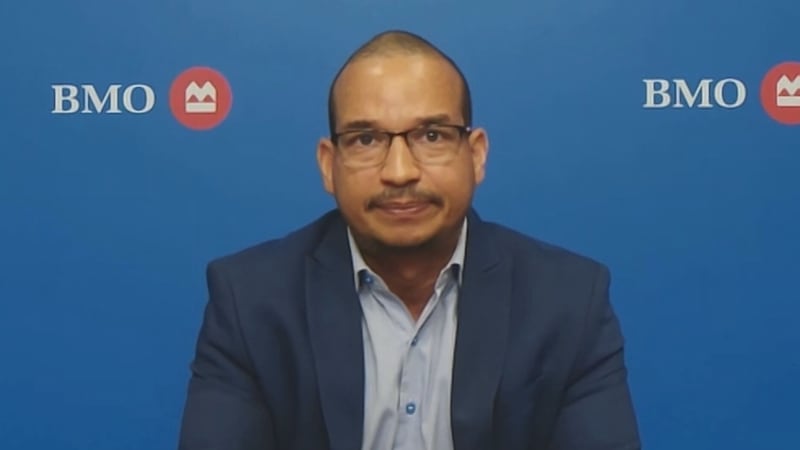
Read the full transcript below:
LINDSAY: U.S. retail sales rose 0.5 per cent in April, narrowly missing expectations. The latest snapshot of the U.S. economy was released amid growing frustration over the spike in prices as a result of the war in Iran. Let’s get some perspective. Joining us now is Earl Davis, head of fixed income and money markets at BMO Global Asset Management. Good morning. It’s great to have you join us.
EARL: Good morning. It’s always a pleasure. Thank you.
LINDSAY: What do you make of these latest retail sales numbers? Is the increase mostly due to higher prices?
EARL: No, it’s not. Actually, the increase is broad-based. Nine out of the 13 sectors they look at in retail sales showed positive improvement or upward momentum in sales. So that’s very solid.
They also have something within retail sales called the control group, which is basically the contribution to GDP in the U.S., and that came in slightly above expectations. Overall, it’s a very solid number and comforting from an economic perspective.
LINDSAY: Right. When you compare that with the CPI numbers we saw earlier this week, where does that leave the U.S. economy?
EARL: That’s a great question. I’ll answer it through the eyes of a fixed-income trader. There are three things that impact fixed income: growth, inflation and monetary policy.
This number reflects growth because the U.S. is a consumer-based economy that drives a lot of GDP. It shows the consumer is surprisingly resilient despite the initial effects of inflation coming through from the war. So growth gets a check mark. That means you want to be long corporate bonds. You’re comfortable owning investment-grade and high-yield bonds.
The second thing is inflation. Inflation is bad for bonds because it means investors want higher yields. What we’re starting to see with the CPI release and other numbers is a flow-through effect into inflation. A lot of people are calling this transitory because they believe the war will come to a resolution shortly, but if it does not, that could accelerate.
What does that mean for fixed income? It means you still like holding corporate bonds, but you want shorter duration. Instead of owning a 10-year corporate bond, you want to own a two- to five-year corporate bond.
The final thing is monetary policy. So far, this means status quo in the U.S. Why? Because there is still an easing bias in the U.S. Until they change that to neutral, it’s basically a green light for risk-on assets.
LINDSAY: I do want to talk more about fixed income in a moment, but first I want to talk about Kevin Warsh, who has now been confirmed by the U.S. Senate as the next Fed chair. His tenure begins as markets are increasingly concerned about long-term inflation risk. Do you think he could hike rates despite pressure from the U.S. president to cut them?
EARL: Yes, it is possible he could hike rates. He is a credible Fed governor. He’s not just a political voice.
Having said that, it’s still a very high hurdle for him to hike rates. As I said, they would first have to move from an easing bias to neutral, and we don’t believe they will do that at the next meeting in June. It’s possible they could do that in July.
The market is currently pricing in a slight possibility of a hike in the U.S. by the end of 2026, roughly 10 per cent, and we believe that’s appropriate.
LINDSAY: What about the Canadian economy? We’re expecting another snapshot of Canada’s economy next Tuesday. Could we see a rate hike in Canada as well?
EARL: Not in 2026. The discussion would be more focused on 2027.
The reason is what we saw in last week’s employment report, with the unemployment rate rising to 6.9 per cent. That’s important from a central bank perspective for two reasons.
First, you need a job to spend money. If fewer people are employed, there are fewer dollars supporting inflationary demand, and that gives the Bank of Canada some leeway.
Second, you need a job to pay your mortgage. The Bank of Canada wants to ensure employment remains stable, even though it’s not part of the official mandate. It’s still a very important secondary consideration.
So we don’t believe there are any hikes on the table in Canada in 2026, but in 2027 it’s definitely possible.
LINDSAY: Interesting. Now back to fixed income. What’s your view on 10-year Treasuries right now?
EARL: We don’t like 10-year Treasuries at the moment. We’re underweight 10-year Treasuries because of inflation.
There is something in the U.S. called inflation expectations, which reflects what investors expect inflation to be. Right now it’s around 2.5 per cent, which is the highest it’s been in about a year. If it moves higher, which we believe is very possible if the war in Iran is prolonged, that could drive yields even higher.
At around 4.6 per cent on the 10-year Treasury, we start to like them and begin buying. But at current levels, around 4.45 per cent this morning, we remain underweight.
LINDSAY: Could Treasury yields reach five per cent this year?
EARL: It is possible, but that would likely represent the high. We would be significantly overweight 10-year Treasury bonds at five per cent.
The reason is we believe the Fed or the U.S. Treasury would likely step in and buy bonds through quantitative easing to keep yields lower. So we think there is strong protection in buying U.S. 10-year Treasuries at five per cent.
LINDSAY: And what are your thoughts on high-yield bonds right now?
EARL: We still like high-yield bonds. We’re overweight high yield, although we’re not adding to positions.
We believe the economy will continue to be resilient for several reasons. One is the tax refunds flowing through to consumers, which supports spending, and we’re seeing that in the data.
There’s also still a lot of public and fiscal spending taking place, which remains supportive. Even if we see a pullback in the private sector, we believe some of that weakness will be offset by public-sector spending.
So we continue to like high yield. Valuations are very rich, but if the market rallies further, we would start to lighten positions and reduce some of our holdings.
LINDSAY: We’ll leave it there. Earl Davis, head of fixed income and money markets at BMO Global Asset Management. Always good to talk to you. Thanks so much.
---
This BNN Bloomberg summary and transcript of the May 14, 2026 interview with Earl Davis are published with the assistance of AI. Original research, interview questions and added context was created by BNN Bloomberg journalists. An editor also reviewed this material before it was published to ensure its accuracy and adherence with BNN Bloomberg editorial policies and standards.

