Bitcoin has fallen below the US$70,000 level amid a broader pullback in digital assets, as investors grapple with risk-off sentiment, ETF outflows and geopolitical uncertainty. Despite the recent weakness, industry participants continue to point to growing institutional adoption and regulatory progress as long-term drivers.
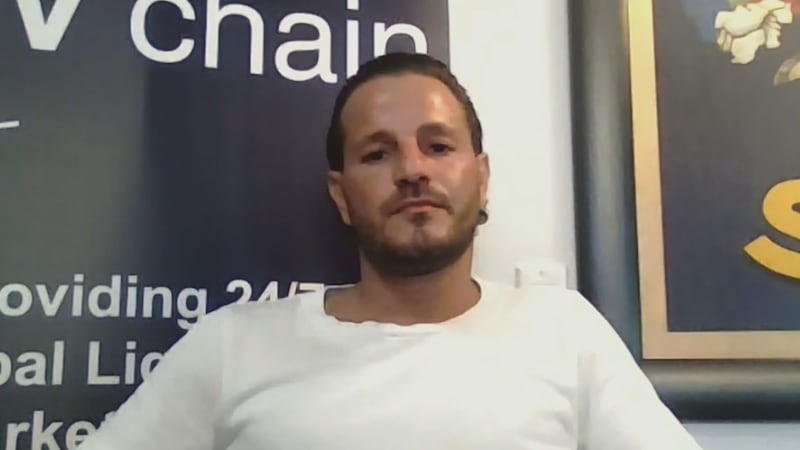
BNN Bloomberg spoke with Michael Rabkin, global head of business development at DV Chain, about the recent selloff in cryptocurrencies, shifting institutional participation, the potential impact of U.S. crypto legislation and the outlook for digital assets through the remainder of 2026.
Key Takeaways
- Bitcoin’s recent decline reflects a combination of risk-off sentiment, ETF outflows, geopolitical uncertainty and leveraged-position liquidations across crypto markets.
- Institutional participation continues to broaden through ETFs, asset managers, family offices and corporate treasuries, changing the makeup of the crypto investor base.
- The proposed U.S. CLARITY Act is viewed by industry participants as a significant step toward clearer regulatory oversight and greater institutional confidence.
- Stablecoins remain one of the fastest-growing areas of digital assets, supported by increasing use in payments, settlements and financial infrastructure.
- Digital asset markets are expanding beyond Bitcoin, with growing interest in tokenized financial products and blockchain-based access to traditional asset classes.
Read the full transcript below:
LINDSAY: Bitcoin is coming under renewed downward pressure, slipping below 70,000 for the first time in two months. Let’s take a closer look at what’s driving the move and whether leveraged investors are positioning for a rebound. Joining me now is Michael Rabkin, global head of business development at DV Chain. Great to have you join us. Thanks so much.
MICHAEL: Thank you for having me on, Lindsay. So...
LINDSAY: Go ahead. What’s driving that slide that we’re seeing?
MICHAEL: Yeah, so everybody wants to know what’s driving the slide down. So, obviously, you know, Bitcoin’s down year over year around 34 per cent. Ethereum is down year over year close to 22 per cent. Another couple of reasons for the recent selloff here. So, firstly, MicroStrategy did its first sale. So, they’re the largest institutional holder of Bitcoin. They disclosed in an SEC filing that they sold 32 Bitcoin to fund dividend payouts. So, this broke really a long-standing never-sell policy and kind of spooked the market.
Second reason is capital rotation to tech. So, while Bitcoin has struggled, traditionally U.S. stock markets reached rapid highs, and so investors have rotated capital into AI and chip stocks, really siphoning attention and investment away from digital assets.
And then ETF flows and geopolitical tensions. So, sustained institutional withdrawals from some of the biggest digital asset ETFs, combined with kind of a risk-off market environment, which is driven by renewed geopolitical tensions in the Middle East, really increased selling pressure.
And then one of the last reasons I have here is long liquidations and fear, right? So, the broader crypto market sentiment quickly soured, with the crypto fear and greed index really dropping into fear, leading into a wave of forced liquidations.
And then, you know, saying all that, Bitcoin continues to trade well below its 2025 highs, but the broader story still remains institutional adoption. And what we’re seeing is really a much more mature market than previous cycles.
LINDSAY: You mentioned Bitcoin ETF flows as well, and I wanted to dig into that a little deeper. Like, what story do you think that’s telling us right now in terms of what you’re seeing?
MICHAEL: I think that there’s fear in the market, and as I mentioned, we are in a risk-off market, especially in speculative assets, which Bitcoin is still viewed as, right, generally.
So, to say that the buyer base significantly has changed over the last couple of years versus three years ago, you know, we’ve seen a lot of ETFs come in the market, asset managers, family offices, pubcos, corporate treasuries, and really unlike prior cycles, which were really, in my opinion, heavily retail-driven, institutional participation does continue to increase.
But again, it’s short-term fear, but the long play is still intact. And the key question is really not if Bitcoin survives. The key question is how large of an allocation Bitcoin ultimately becomes within institutional portfolios as time progresses.
So really, the debate has shifted from whether institutions should own Bitcoin to how much Bitcoin they should own. And really the biggest difference today versus previous cycles is that institutional adoption and regulatory clarity are moving in the same direction, which is creating a much stronger foundation for the asset class.
And really, to answer your question directly, Lindsay, Bitcoin is still a risk asset. It trades within the broader macro environment. High rates, uncertainty around growth and broader risk-off sentiment can impact Bitcoin in the short term, even while the long-term adoption story remains intact.
LINDSAY: Is Bitcoin the only cryptocurrency, though, that’s facing these headwinds right now?
MICHAEL: No. Bitcoin is typically the leader, so if Bitcoin’s down, you’ll see the rest of the market down. Ethereum, which is the second-largest cryptocurrency by market cap, has faced downwinds as well, and so has the rest of the market.
But, you know, Bitcoin continues to lead the market. The bigger story here is that confidence is returning across the broader digital asset ecosystem outside of the last seven days as institutional adoption grows and really as we get more regulatory clarity, specifically the CLARITY Act.
LINDSAY: I wanted to ask you about the CLARITY Act that will move Bitcoin to the Commodity Futures Trading Commission. Tell us more about the CLARITY Act and what that means, what that will do for Bitcoin.
MICHAEL: Yeah, for sure. So, this may be the most important development of the year.
So, for years, the industry wasn’t really asking for less regulation; it was asking for clear regulation. And so markets reward certainty. The more clarity institutions receive around custody, trading, settlement and token classifications, the easier it really becomes for traditional firms to participate.
Generally, markets don’t fear regulation; markets fear uncertainty. And so one of the biggest regulatory stories, as I mentioned, is the CLARITY Act.
The CLARITY Act is essentially about defining the rules of the road for digital assets. For years, we wanted that as an industry. Really, the bill aims to establish clear oversight between the SEC and CFTC and reduce regulatory uncertainty.
That’s more important because capital tends to move toward markets where the rules are clearly defined, and for years this has been one of the biggest questions facing our industry.
LINDSAY: What’s your outlook for digital assets for the remainder of 2026?
MICHAEL: So, there’s a couple of key takeaways that I have. One being we’re hoping that the CLARITY Act advances. We’re still waiting for the Senate committee to vote on it. It looks like it will pass, but you never know.
I think stablecoin adoption continues to grow. I think that’s probably the biggest story of the year. Traditional financial institutions continue expanding stablecoin initiatives as regulatory frameworks improve.
Unlike a lot of institutions, recently expanded access to stablecoin offerings to millions of customers, and stablecoins are really used in many different ways: cross-border payments, faster settlement, etc.
And I think what we’re seeing right now is digital assets being integrated into the traditional financial system. So, we’re seeing crypto rails, such as perpetual swaps, which have been a standard instrument on offshore crypto exchanges for years.
Venues like Hyperliquid have opened up the market to 24/7 decentralized access to commodities, energies, equities and even some pre-IPO perps like SpaceX, for example.
And so, you know, we’ve seen that token do quite well despite Bitcoin’s volatility. And, you know, even at DV Chain, despite being primarily a crypto desk, we are seeing these on-chain commodities, energies and equities, like I mentioned, start taking a serious share of the volume.
LINDSAY: Okay, okay. We’re going to have to leave it there. Michael Rabkin, global head of business development at DV Chain. Thanks so much for your time. Appreciate you joining us.
MICHAEL: Thank you for having me on.
---
This BNN Bloomberg summary and transcript of the June 2, 2026 interview with Michael Rabkin are published with the assistance of AI. Original research, interview questions and added context was created by BNN Bloomberg journalists. An editor also reviewed this material before it was published to ensure its accuracy and adherence with BNN Bloomberg editorial policies and standards.

