The Canadian dollar could face further downside as investors focus on economic divergence between Canada and the United States, with interest-rate expectations increasingly favouring the U.S. dollar.
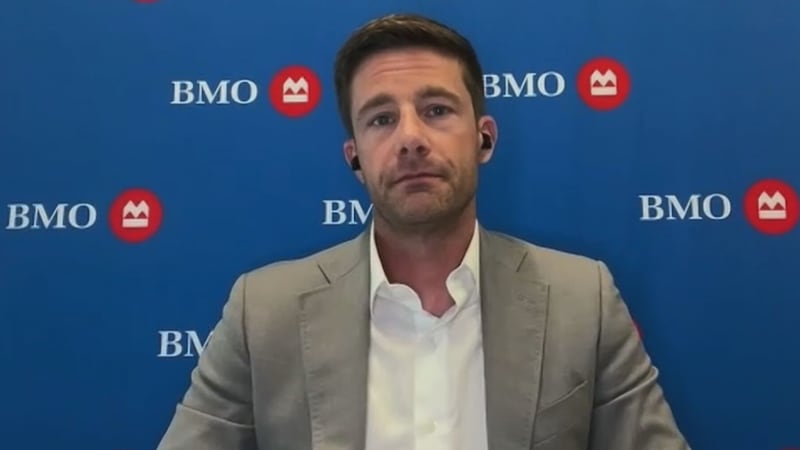
BNN Bloomberg spoke with Mark McCormick, chief FX strategist at BMO Capital Markets, who said stronger U.S. growth, persistent inflation and the possibility of further Federal Reserve tightening are supporting the greenback, while Canada’s economy remains constrained by weaker growth and limited policy flexibility.
Key Takeaways
- Diverging economic conditions between Canada and the United States are increasingly driving currency movements and supporting U.S. dollar strength.
- McCormick expects the Canadian dollar could fall below 71 cents as foreign exchange markets reconnect with interest-rate differentials.
- Higher oil prices do not automatically benefit the Canadian dollar against the U.S. dollar because both countries are major energy producers.
- Prospects for Federal Reserve rate hikes and stronger U.S. equity performance continue to support demand for the greenback.
- Improvements in Canada’s long-term outlook may depend on infrastructure development and expanding energy exports, but those benefits are unlikely to materialize in the near term.
Read the full transcript below:
ROGER: All right, welcome back. My next guest says the loonie is being pulled by a strong U.S. dollar, especially in the near term, because of the macro backdrop. Let’s find out what the prediction is for the loonie in the third quarter of the year. Joining me now is Mark McCormick, chief FX strategist at BMO Capital Markets. Thank you very much, Mark, for joining us.
MARK: Thanks for having me.
ROGER: All right, let’s get it out of the way now. Where do you think the dollar is going, and how’s the U.S. dollar, the greenback, driving it?
MARK: Yeah, so there’s a lot of things in motion. Markets — there’s a lot of uncertainty, complexity, but at the end of the day, there’s divergence between the respective economies of the U.S. and Canada. I think it comes down to there’s a growth story, there’s an inflation story, there’s obviously the focus around energy and terms of trade that comes through in the Iran conflict. But at the end of the day, the U.S. is an economy that’s got strong growth and high inflation. We should see the markets probably be surprised again by a hawkish Fed. I wouldn’t be surprised if the Fed actually delivered a hike at some point in the fall.
The flip side, you basically have a Canadian economy where, again, it probably cannot handle higher rates. Although there’s the need potentially to remain on hold, they probably can’t cut rates, which is probably the direction they’d like to go, because inflation is a little bit too high relative to where they’d like it to be.
So, at the end of the day, what you have is the foreign exchange market reconnecting back to rate differentials, and there’s a clear divergence story that should take the Canadian dollar below 71 cents at some point.
ROGER: And is that pretty much what’s been driving it? Because with oil, normally the dollar kind of rides along with oil going up, doesn’t it? The Canadian dollar.
MARK: I think that’s one of the myths that’s quite important. At the end of the day, what the Canadian dollar is really correlated to is risk sentiment. Sometimes, when the equity markets are going up and oil is going up, that’s a risk-on trade, and that’s when the Canadian dollar does well.
I think what people need to disentangle from that is when equity markets are moving in a certain direction, there’s volatility and oil is driven by supply-side factors. That’s not necessarily a good thing for the Canadian dollar, or at least relative to the U.S. dollar, because the U.S. is also an oil producer.
It’s good for the Canadian dollar on crosses. It’s good for the Canadian dollar relative to Europe and Asia, which are natural gas and energy importers, but it doesn’t move the needle for U.S.-Canada the way people thought it did. That is one of the strongest things I like to push back on — that oil goes up and it’s automatically bullish for the Canadian dollar.
ROGER: So, what would be a change that might have an impact? Is it a resolution in the Middle East, or is it our economy? Do we have to strictly strengthen the economy? What might have an impact over the next six months?
MARK: So, I think in the next six months, what you need to see is there definitely needs to be a pivot. You need to see a pro-growth environment that sees capital either coming back into Canada or markets in Canada starting to outperform.
I think the big challenge when you think about the currency market is you always want rate differentials, you want to pick up carry, you want to look for places where there’s growth and strong equity performance. In this environment, again, you’re dealing with a terms-of-trade shock, so you want to buy countries or currencies that essentially have energy dependence in terms of becoming an exporter, not an importer.
When you line those things up, they’re all just in favour of the U.S. dollar.
So, I think the things that have to change are that the Canadian economy really needs to start firing on different cylinders than it has for the last couple of years. Again, maybe that’s a rotation away from a housing-based economy back to an energy-intensive economy. Again, it could be part of the infrastructure buildout that Carney is pushing, trying to get pipelines moving east to west.
I think those are the things you’re laying the groundwork for, where maybe the economy is bottoming out and the currency is a reflection of that. But I still think for the next six months, the story is really going to be about the strength of the U.S. dollar, potential Fed hikes, the outperformance of U.S. equities and the carry you pick up in the U.S. dollar.
So, I still think it’s going to be generally a U.S.-driven market, but I think those conditions can change into 2027. A lot of it’s going to hinge on whether or not the government can pull off this infrastructure buildout and basically turn the economy back into an energy producer.
ROGER: And are we seeing any signs of that? I mean, the last two quarters, GDP was weak. We’re right around, whether it’s what you want to call a recession or not. Within all those numbers, were there any indicators that maybe there’s some wheels starting to turn somewhere in the back there?
MARK: I think the best way you can think about it is sentiment’s changing. I think conversations we have with clients globally, there’s a lot of questions around what Canada is going to do to revitalize the economy again.
There’s a lot of discussion when you think about what the problem is in Asia. Countries in Asia — Japan, Korea — have an issue where they need natural gas. That is also a thing Germany needs.
One of the potential outcomes from the conflict in Iran is a rebuild around natural gas, and Canada, if it can again realign itself as more of an energy producer and produce and sell natural gas from different parts of the country, whether it be the East Coast or the West Coast, can fill that void.
So, I think the sentiment around this conversation is starting to change in a more positive direction. But again, the data right now is just not on the Canadian dollar’s side. It’s not on the Canadian economy’s side, and that’s probably going to be where we are for at least the next couple of months.
As sentiment starts to change, psychology changes, and then markets start to price that in. But again, I think that’s more of a 2027 story and not one for this year.
ROGER: Okay, we’ve got to wrap it up there. Mark, thanks very much for joining us.
MARK: Thanks for having me.
ROGER: Mark McCormick, chief FX strategist at BMO Capital Markets.
---
This BNN Bloomberg summary and transcript of the June 9, 2026 interview with Mark McCormick are published with the assistance of AI. Original research, interview questions and added context was created by BNN Bloomberg journalists. An editor also reviewed this material before it was published to ensure its accuracy and adherence with BNN Bloomberg editorial policies and standards.