The recent selloff in semiconductor stocks has raised questions about whether the artificial intelligence trade is losing momentum or simply taking a breather after a powerful run.
BNN Bloomberg spoke with Dan Rohinton, portfolio manager at iA Global Asset Management, who said investor expectations and positioning have played a larger role in the pullback than any change in AI demand. He also shared his views on the highly anticipated SpaceX IPO and the challenges of supporting its valuation.
Key Takeaways
- The semiconductor selloff was driven largely by elevated expectations and crowded positioning rather than a deterioration in AI spending trends.
- Nvidia and Broadcom remain preferred holdings because of their dominant positions, pricing power and central role in AI infrastructure spending.
- Higher energy prices matter to technology stocks primarily through their potential impact on inflation, interest rates and equity valuations.
- Fast buying after the pullback suggests investors continue to view semiconductor weakness as a correction within a broader AI-driven bull market.
- SpaceX’s long-term investment case depends on the success of Starlink and Starship, but the current valuation leaves little room for execution missteps.
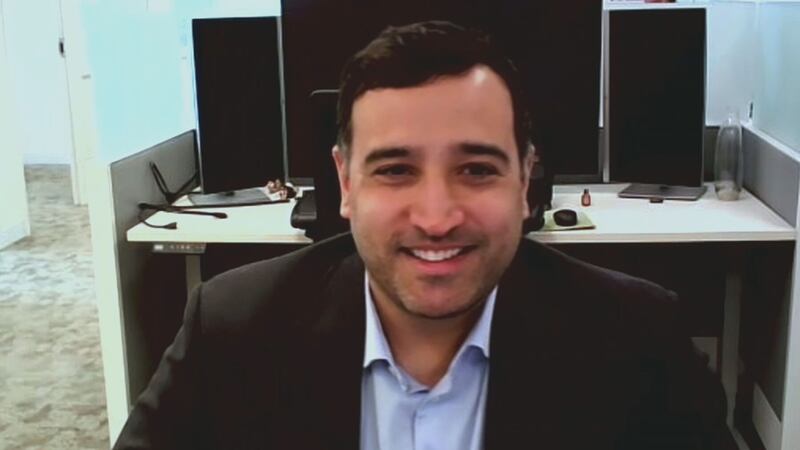
Read the full transcript below:
ROGER: Well, the S&P and Nasdaq are in the green today as investors buy the dip following the selloff of chipmakers over the last few days. Our next guest says he’s a buyer on this weakness as well, but choosy about it. Joining us now is Dan Rohinton, portfolio manager at iA Global Asset Management. Dan, always good to see you, sir. Thanks very much for joining us.
DAN: Good to see you, Roger.
ROGER: All right, and the day has kind of gotten a little more interesting, hasn’t it, with the reports out of Washington now that the president’s saying he’s ready to launch more attacks. How are you taking all this right now? Where are you? What are you doing right now?
DAN: Yeah, I mean, taking a step back, when it comes to energy prices versus semiconductors, it’s really, you know, tomatoes and oranges. There’s really no comparison that matters. And the reason I say that is, at the end of the day, what drives the semiconductor stocks and the record run that they have seen — and it should be taken in stride how strong the performance has been recently — has been the belief that capex is going to continue to rise, and forward estimates are moving even further and further out.
So what used to be maybe a peak cycle a year from now or two years from now, people are talking about three years from now. So that’s really what’s been driving the strength, and now there’s more supply coming out of the market — think SpaceX this morning — and then also more equity raised by the big companies. It starts raising those questions of, well, how much more can you fund? And if that’s the case, then eventually supply catches up, and the supercycle profits that we are expecting to earn for some of these companies maybe don’t last that long.
So we’re in that jittery phase, but we should take stock of the fact that this was, call it, one of the best months in the prior two and a half decades for these stocks. So volatility is the price of admission for these types of companies, no question.
ROGER: It has been quite the last — I mean, since the start of the war — and then the recovery has been, it’s been a rocket launch for so many of them. So you’re being fairly focused on what you’re looking at, though, aren’t you?
DAN: Yeah, and the best way to think about it — and I do want to emphasize one more point, Roger, if I may — is the way that energy prices will have an impact on tech stocks and semiconductor stocks, outside of whatever is going on inside the AI conversation in its own hermetically sealed container, is inflation pushing to higher interest rates, pushing to lower discount rates for equities. That’s how I see that transmission from anything oil-related or conflict-related.
But specifically to what we see as the opportunity in the here and now, I think it’s important to think about when you see the real animal spirits come out. Some of the biggest companies that are best positioned over time tend to be left in the lurch.
So you can buy Nvidia at a cheaper multiple than RBC by a decent proportionality, about 10 to 15 per cent. I wouldn’t sleep on Nvidia, I wouldn’t sleep on Broadcom, and the reason for that is they’re the through-line for all of this major spending to come through.
So although memory has seen a huge expansion in margins — 80 per cent margins is pretty good — you can’t really go much higher than that, and you kind of just have to hope these stocks go longer in terms of their supernova profits.
But when you talk about Broadcom, when you talk about Nvidia, a lot of that same conversation exists, but the belief that the persistency isn’t there for these companies, I think, is a lot tougher to come around to than the idea of a supercycle in memory eventually going into a bust, like it has in many other instances.
ROGER: Why do you think it’s a lot tougher? What’s what are people worried about with Broadcom?
DAN: They’re worried that they didn’t upsize the TAM. So what’s interesting about the recent volatility in semiconductor stocks actually started with Broadcom because they basically said we’re not going to change our $100-billion revenue estimate for this year, and we’ll update it in the future, when some of the expectations were $130 billion, $140 billion.
That was basically what I would call an expectations miss in the quarter, and that then cascaded across the rest of the semiconductor space because everyone’s animal spirits were really at a fever pitch.
But take a step back. They are going to keep accelerating. They are being conservative. Same with Nvidia. So if you can buy these companies at teens P/E multiples or less with clean balance sheets, that is probably the best place to be in the broad ecosystem because you always run the risk of further downside, further pressures.
So you want to be dominant in your value chain as you’re owning these things through, and that’s why we go to where we do, which is Nvidia and Broadcom, especially in semiconductors.
ROGER: All right, and the one I think everybody’s talking about, SpaceX. What are you doing with that? Would you buy if you had the chance?
DAN: Look, I think, as with a lot of Elon companies, you kind of have to suspend belief. When we were sitting in on some of the teach-ins and the roadshows for this, it’s interesting to see very serious folks who sharpen their pencil on everything talk about reusable rockets, terrestrial and extraterrestrial space travel, mass drivers on the moon, and having to put numbers on that.
So I would just say this is a universal good. If SpaceX is successful, for you to believe that the IPO is something you own for a protracted period of time — measured longer than days, longer than weeks, in months, quarters and years — you have to believe that Starship is reusable. I can’t believe I’m saying that, which would be a feat for humanity, for one.
Two, you have to believe that Starlink, which is the current profit driver, can actually push that and take over a huge portion of the telecommunications profit pool around the world.
To get to the valuation making a lot of sense from here, all those things are directionally heading in the right place, but whether it happens in 2028, 2030 or 2035 are the key things you need to think about.
So am I cheering on SpaceX for the vision for humanity they’re putting forward? I am. Do I think it’s attractive as a medium-term hold from current valuations? I’ll be a little skeptical. But this is a retail meme stock, so anything is possible when this thing goes public with Elon Musk.
ROGER: Right. I mean, people love to hate him, but you just have to look at his numbers and go, he does something right.
DAN: Yeah, you’re catching rocket boosters with chopsticks and launching low-Earth-orbit satellites that are going to provide telecommunications for the whole world. You’ve got to cheer that on.
But that doesn’t mean you always have to buy the stock blindly. That’s the part we always struggle with. We love the mission, but the valuation, we always struggle to make sense of.
ROGER: All right, just for fun, $1.75 trillion is at $1.8 trillion now, which is kind of the number they’re settling on right now. Do you think that’s where it ends up tomorrow? Where do you think it ends up? Just for fun.
DAN: Tomorrow? Yeah. So I’ll bet 30 cents on this. I’ll tell you it ends up north of $2 trillion.
I’ll tell you specifically why I get there. The way that the IPO has been structured has been very, very narrow, plus a decent retail allocation. So Elon’s supporters in the retail world are going to be very much involved, and you don’t buy this thing to be bearish the next day.
So I bet there are more buyers than sellers. And then the institutional allocations, which are the broad thrust of the IPO — and it’s a huge IPO, it should not be forgotten that this is the largest IPO we’ve seen outside of maybe Aramco — the institutional allocation, Roger, is very tight as well.
So I think it’s set up to pop. But that goes back to that’s a tomorrow conversation, and that’s why I’m only betting 30 cents on it.
ROGER: All right, we’ll leave it at that. Dan, always a pleasure to talk to you, sir.
DAN: Pleasure. Good to see you.
ROGER: Dan Rohinton, portfolio manager at iA Global Asset Management.
---
This BNN Bloomberg summary and transcript of the June 11, 2026 interview with Dan Rohinton are published with the assistance of AI. Original research, interview questions and added context was created by BNN Bloomberg journalists. An editor also reviewed this material before it was published to ensure its accuracy and adherence with BNN Bloomberg editorial policies and standards.

